
 Worksheets
Reconstruction Era SSUSH10
Total questions: 15
Worksheet time: 9mins
What purpose did the dividing of the South into military districts after the Civil War have on Southern society?
Protect the rights of newly freed slaves, and oversee the readmission of Southern states into the Union.
What was the main focus of Congressional Reconstruction?
Punishing Southern states for seceding
Under the Ten-Percent Plan, what was the main requirement for Southern states to be re-admitted into the Union?
Which organization had the most impact on the lives of formerly enslaved people after the Civil War?
The Declaration of Independence states, "We hold these truths to be self-evident that all men are created equal that they are endowed by their Creator with certain unalienable rights, that among these are Life, Liberty, and the Pursuit of Happiness." Which amendment to the US Constitution BEST represents this ideal?
Why was the Fourteenth Amendment ratified by Congress in July of 1868?
To grant citizenship and provide equal protection under the law to formerly enslaved people
What did the Thirteenth Amendment accomplish?
What is the historical significance of the passage from the Fifteenth Amendment? "The right of citizens of the United States to vote shall not be denied or abridged by the United States or by any State on account of race, color, or previous condition of servitude."
The Fifteenth Amendment prohibited Black Americans from voting based on race, color, or previous servitude.
The Fifteenth Amendment granted Black men the right to vote (suffrage)
What evidence do we have that shows that Reconstruction did not provide lasting protection to the civil rights of formerly enslaved people?
What event marked the end of the Reconstruction Era (1865-1876)?
President Hayes ordering the removal of the last federal troops from the South
The invention of the telegram
The repeal of the Northwest Ordinance of 1787
The annexation of Hawaii
What HBCU was established in Atlanta, Georgia in 1867?
Put the following components of the Thirteenth, Fourteenth, and Fifteenth Amendments in order: voting rights (suffrage) for Black men, abolition of slavery, and citizenship and equal protection.
Reading the following points:
In 1870 Hiram R. Revels, a formerly enslaved man from Mississippi, becomes the first Black American elected to the US Senate.
In 1986 Mike Espy becomes the first Black Mississippian elected to federal office since Reconstruction.
What can we infer about how Black Americans were treated after Reconstruction?
Mississippi and other Southern governments treated Black Americans equally after Reconstruction.
Mississippi and other Southern governments treated Black Americans fairly during Reconstruction.
Mississippi and other Southern governments treated Black Americans well only after Reconstruction.
Mississippi and other Southern governments used legal and illegal methods of preventing Black Americans from exercising their rights.
How was the disputed presidential election of 1876 between Rutherford B. Hayes (Republican Party) and Samuel J. Tilden (Democrat Party) resolved?
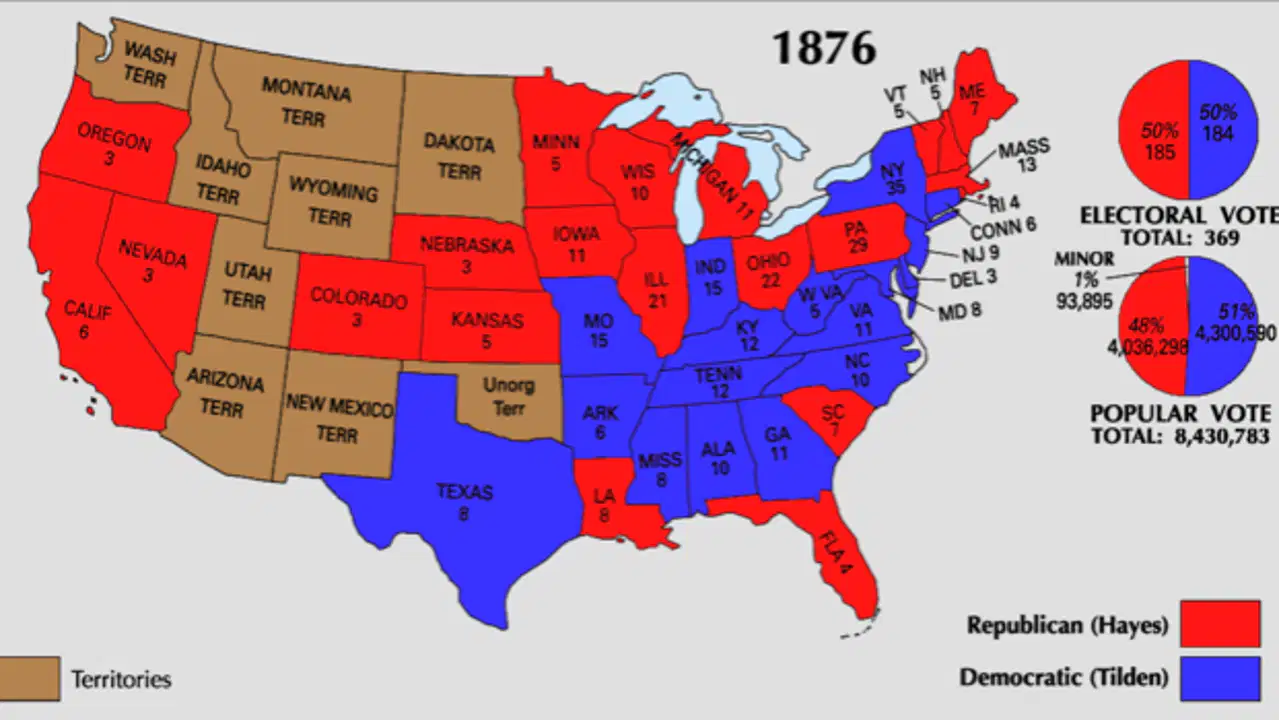
Why were many Southerners angered by the decision to award the 1876 election to Rutherford B. Hayes following several disputes regarding the electoral votes?
Southerners were angry because Samuel J. Tilden won the popular vote.
Southerners were angry because they were not allowed to create a new political party for the election.
Southerners were angry because they wanted to remove the usage of the Electoral College.
Southerners were not angry because they fully supported the Republican Party and Hayes.

