
Font size
 Worksheets
APES Unit 3 Review Questions
Total questions: 101
Worksheet time: 1hrs 1mins
The rule of 70 can be used to determine a population’s doubling time. Doubling time is a measure of the
population growth rate
environmental impact of each individual in a population
length of time an individual born in a population is expected to live
average age of the first reproductive event per 1,000 women in a country

The graph shows the three types of survivorship curves over time.
Which of the following is a characteristic of an organism that displays a Type III survivorship curve?
The organism has a fairly constant mortality rate over time.
The organism reaches reproductive maturity after many years.
The organism produces large numbers of offspring every time it reproduces.
The organism provides constant parental care to its offspring for several years.
The graph shows the three types of survivorship curves over time.
Which of the following is a characteristic of an organism that displays a Type III survivorship curve?
The organism has a fairly constant mortality rate over time.
The organism reaches reproductive maturity early in life.
The organism produces only a few number of offspring every time it reproduces.
The organism provides constant parental care to its offspring for several years.
The graph shows the three types of survivorship curves over time.
Which of the following is a characteristic of an organism that displays a Type II survivorship curve?
The organism has a fairly constant mortality rate over time.
The organism reaches reproductive maturity after many years.
The organism produces large numbers of offspring every time it reproduces.
The organism provides constant parental care to its offspring for several years.
When a population size tends to fluctuate around the environment's carrying capacity, it is
Irruptive
Stable
Irregular
Decaying
Of the following, which is an example of a density-independent population control?
Limited food
Limited space
Earthquakes
Parasitism
When a population's growth adjusts to the environment's carrying capacity (K), it is known as
A species's biotic potential
A population crash
Exponential growth
Logistic growth
When a population exceeds the environments carrying capacity (K),
It can suffer a sudden population crash.
It enters the exponential growth phase.
It overcomes environmental resistance.
Its age structure becomes heavily weighted toward older ones.
When the individual of a population are most likely to be found in groups, this is known as
Uniform dispersion
Exponential growth
Random dispersion
Clumping
As opposed to a K-selected species, an r-selected species usually has
numerous relatively small offspring
offspring that tend to survive to reproductive age
a population that stays close to the environment's K
high parental care of offspring
Of the following characteristics, which three are typical of K-selected species?
late colonization, early reproductive age, generalist niche
early reproductive age, generalist niche,small size adult
early reproductive age, small size adult, few offsprings
late colonization, few offspring, specialist niche
Which country uses economic rewards and penalties to try to reduce their population growth?
China
Mexico
Great Britain
Japan
Which of the following is not a factor affect of birth rates and fertility rates?
Importance of children as part of the labor force
Infant mortality rate
Availability of legal abortions
Replacement-level fertility
Which of the following does not help reduce death rates?
Increased food supplies
Low access to family planning
Improvements in sanitation and personal hygiene
Improvements in medical and public health technology
Which stage has the lowest total fertility rate (TFR)?
Pre-industrial
Industrial
Post-industrial
Transitional
Match the following age category to the associated age group
Pre-reproductive
0-14
Reproductive
15-44
Post-reproductive
45+
A high infant mortality rate usually indicates all of the following except
Insufficient food
Good quality of life
Poor nutrition
A high incidence of infectious disease
The rate of the world's annual population change is affected by all of the following except:
Crude birth rate
Infant mortality
Death rate
Migration
A population has a growth rate of 2% per year. How long will it take for this population to double?
70 years
40 years
35 years
15 years
2 years
An age-structure pyramid is used to
study the immigration rates in a population.
calculate the doubling time of a population.
study the carrying capacity of a habitat.
determine what the density-dependent factors are for a population.
study the number and ages of people in a country.
What section indicates the Industrial Revolution beginning?
What section indicates the Agricultural Revolution?
What section indicates the stage of the current United States?
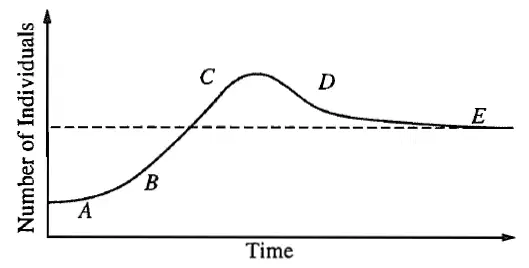
The diagram illustrates how the number of individuals in a population changed with time as a result of external stresses and resource limitations.
Which lettered portion of the curve most likely corresponds to the carrying capacity of the ecoystem?
A
B
C
D
E
The diagram illustrates how the number of individuals in a population changed with time as a result of external stresses and resource limitations.
How could you describe what is occuring at point C?
logistic growth
exponential growth
overshoot
dieback
Which of the following factors is not considered a density-dependent factor in population growth?
Competition for resources
Predation
Parasitism
Natural disasters
What is the term used to describe the maximum number of individuals that an environment can support indefinitely?
Biotic potential
Carrying capacity
Population density
Ecological footprint
Which of the following is a characteristic of a population experiencing exponential growth?
Constant population size
Decreasing birth rates
Increasing death rates
J-shaped growth curve

What type of population growth is being shown in this population pyramid?
Rapid growth
Stable growth
Declining growth
What can cause a population to grow?
The birthrate becomes higher than the death rate.
The birthrate stays the same, and the death rate increases.
The birthrate becomes lower than the death rate.
The birthrate and the death rate remain the same.
What can cause a population to decline (get smaller)?
The birthrate becomes higher than the death rate.
The birthrate stays the same, and the death rate increases.
The birthrate increases while the death rate stays the same.
The birthrate and the death rate remain the same.
What will happen if a population's emigration is greater than its immigration?
The population will stay the same size.
The population will grow larger.
The population will decrease in size.
This will not affect the population's size. It only affects density.

What type of population growth graph is shown here?
exponential growth
unstable growth
logistic growth
stable growth

What type of population growth graph is shown here?
exponential growth
unstable growth
logistic growth
stable growth

Which of these is the term for the maximum number of individuals that can be supported by an environment? (Hint: it's represented with a red line in the example graph.)
carrying capacity
population ceiling
logistic growth
exponential growth

Geographic distribution describes the dispersion of individuals within a population. What type of distribution pattern is shown by the birds in this picture?
clumped distribution
uniform (even) distribution
random distribution
Which of these choices shows the least densely populated area?


What growth model has an S-shaped curve?
Logistic
Exponential
What growth model has an J-shaped curve?
Logistic
Exponential

What age groups does the bottom of a population pyramid represent?
The elderly
The working adults
The children
Males

What growth rate does this population pyramid represent?
Rapid Growth
Slow Growth
Negative Growth
Zero Growth

Is this country Developed or Developing?
Developed
Developing
Which of the following are density dependent factors?
competition for resources
predation
disease
natural disasters
Which of the following are examples of a density independent factors?
forest fire
seasonal cycles
storms
disease
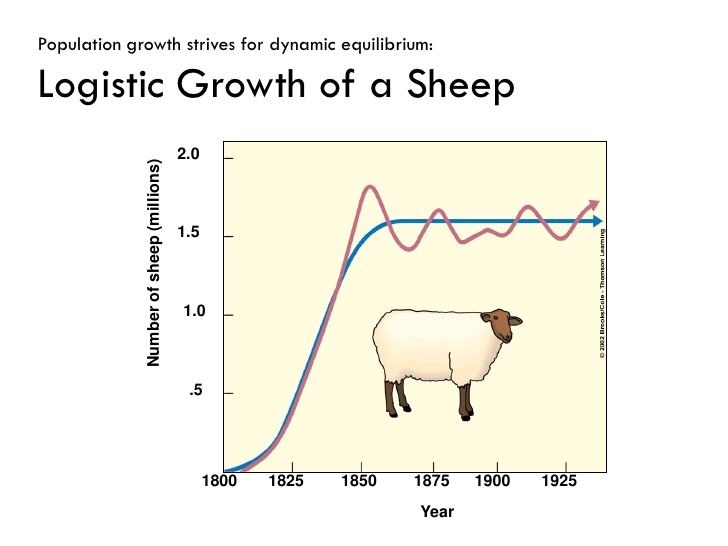


What point on the graph represents the carrying capacity?
A
B
C
D

What growth model has an J-shaped curve?
Logistic
Exponential
What growth model has an S-shaped curve?
Logistic
Exponential
When a population has unlimited resources, and it continues to grow to its FULL LIVING POTENTIAL, it is called
Peak
Top shelf
Resource controlled limit
Biotic potential
factors that affect a population depending on its size
- these include food, predation, parasitism, and disease
Density-Dependent factor
Density-Independent factors
affect all populations similarly regardless of population size. Examples include: natural disasters, rapid climate changes (drought or floods), and human activity and disturbances
Density-Dependent factors
Density-Independent factors
Describes how many individuals of different ages make up a population
Age Structure
Age Layout
The youths collation
Age Spread
Which population has the greatest potential for rapid growth?
Populations with a large number of middle aged individuals
Older populations
Populations with large numbers of young offspring
None of these
Population pyramids measure:
Age and Gender
Gender and Race
Age and Race
Land size
What age groups does the bottom of a population pyramid represent?
The elderly
The working adults
The children
Males
What growth rate does this population pyramid represent?
Rapid Growth
Slow Growth
Negative Growth
Zero Growth
Lower birth rate
More developed
Less developed
Is this country Developed or Developing?
Developed
Developing
Which of the following are density dependent factors?
competition for resources
predation
disease
natural disasters
Which of the following are examples of density independent factors?
forest fire
seasonal cycles
storms
disease
What factor describes when populations decrease because animals are moving out of a population?
Emigration
Limiting Factors
Immigration
Exponential Growth
What point on the graph represents the carrying capacity?
A
B
C
D

Tracks organisms that tend to live long lives (low death rate and high survivorship rate); toward the end of their life expectancies, however, there is a dramatic increase in the death rate.
Type I
Type II
Type III
Type IV
Describes organisms with a high death rate (or low survivorship rate) immediately following birth. Examples include bacteria, fishes, and invertebrates.
Type I
Type II
Type III
Type IV
These organisms typically live in unstable, unpredictable environments & are able to reproduce rapidly (exponentially). They do not take care of their young & are subject to predation.
k-strategist
r-strategist
m-strategist
s-strategist
These organisms occupy stable environments, are larger in size and have longer life expectancies. They produce, during their life spans, fewer offspring, but place a greater investment in each.
k-strategist
r-strategist
m-strategist
s-strategist
Click density dependent factor(s).
competition for resources
predator-prey relationships
parasitism and disease
weather
Click density independent factor(s).
competition for resources
predator-prey relationships
parasitism and disease
weather, natural disaster and man made disturbances

A pattern of survival over time in which there is high survival throughout most of the life span, but then individuals start to die in large numbers as they approach old age.
Type i survivorship
Type ii survivorship
Type iii survivorship

A pattern of survival over time in which there is a relatively constant decline in survivorship throughout most of the life span.
Type ii survivorship
Type i survivorship
Type iii survivorship

A pattern of survival over time in which there is low survivorship early in life with few individuals reaching adulthood.
Type III survivorship
Type II survivorship
Type I survivorship
A generalist species is a species that generally has a wide range of things in their diets as well as a relatively large area of habitat.
Generalists
Specialist
Organisms adapted to narrow habitats, limited food resources, or other specific environmental conditions.
Specialist
Generalist
Human population growth in 2020 was 0.98 %. If this growth were to remain constant in what year will the human population double?
2051
2091
2109
9120
Human population growth of Mozambique in 2021 was 2.8. If growth remains constant, in what year will the human population double?
(a)
In 2004 China's CBR was 11.8 the CDR was 6.3. what is the growth rate for China in 2004?
0.38%
0.49%
0.55%
0.68%
Which of the following is most typically associated with the transition form a rural to an urbanized society?
Reduced birth rates
Reduced need for sewage-treatment facilities
Increased rates of population growth
Increased air quality in urban areas
Increased stabilization of microclimate in urban areas.
High birth rate and high death rate means the total population is low
stage 1
stage 2
stage 3
stage 4
stage 5
Which describes the birth and death rate of Stage 3 of the Demographic Transition Model?
The death rate is decreasing and birth rate remains high
Both the death and birth rate are high
The death rate is low but the birth rate is high
Both the birth rate and death rate are decreasing
Which describes the birth and death rate of Stage 2 of the Demographic Transition Model?
The death rate is decreasing and birth rate remains high
Both the death and birth rate are high
The death rate is low but the birth rate is high
Both the birth rate and death rate are decreasing

In Stage 1, the birth rate is...
High
Falling
Low

In Stage 1, the death rate is...
High
Falling
Low

In Stage 2, the Total Population is...
Growing Slowly
Growing Quickly
Not Growing

In Stage 3, the Birth Rate is...
High
Dropping quickly
Low

In Stage 4, the Death rate is...
High
Rising
Low

In Stage 4, the Total Population is...
Growing Quickly
Leveling Out
Decreasing Quickly
In Stage 4, the Population Pyramid looks like...


What stage is this country in?
Stage 1
Stage 2
Stage 3

A characteristic of stage one of the Demographic Transition Model shows
High birth and death rates
Low death and high birth rates
Low birth and death rates
High death and low birth rates

Which correctly describes the term demographic transition?
The transition from low birth rates and death rates to high birth rates and death rates as a country develops.
The transition from high birth rates and death rates to low birth rates and death rates as a country develops.
The transition from high birth rates to low death rates as a country develops.
The transition from low birth rates to high death rates as a country develops.

