
 Worksheets
Earth Science Post Test Review
Total questions: 30
Worksheet time: 15mins
Name
Class
Date
1.
(E-ESS1-1) What is the source of energy for the Sun?
a)
hydrogen fusion
b)
internal combustion
c)
nuclear fission of metals
d)
burning of solar gases
2.
(E-ESS1-2) As part of the modern theory of the origins of the elements, it is hypothesized that before the formation of the stars, most of the matter in the universe consisted of what atoms?
a)
nitrogen and carbon
b)
hydrogen and helium
c)
silicon and lithium
d)
uranium and radium
3.
(E-ESS1-3) Stars begin their life cycle in _______.
a)
a black hole.
b)
a nova.
c)
a nebula.
d)
a supernova.
4.
(E-ESS1-2) Astronomers viewing light from distant galaxies observe a shift of spectral lines toward the red end of the visible spectrum. This shift provides evidence that _______.
a)
orbital velocities of stars are increasing.
b)
Earth's atmosphere is warming.
c)
the sun is cooling.
d)
the universe is expanding.
5.
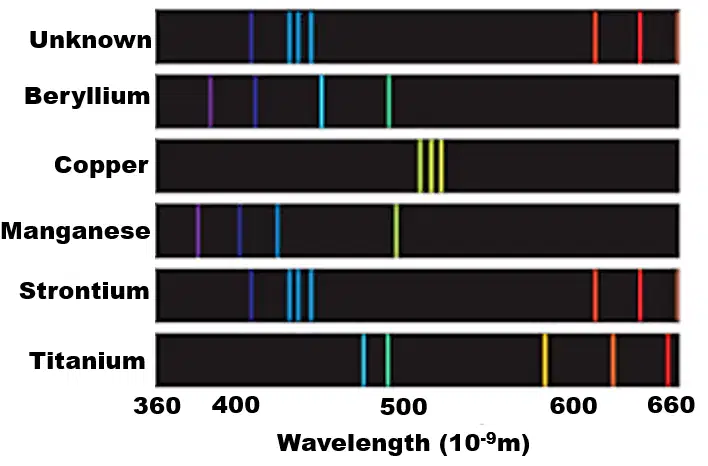
(E-ESS1-3) Which element does this unknown star contain?
a)
beryllium
b)
copper
c)
manganese
d)
strontium
6.
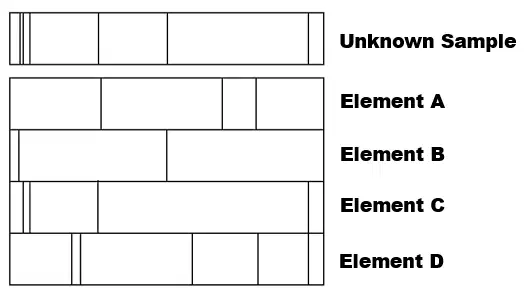
(E-ESS1-3) Which TWO elements are present in the unknown sample? (Choose TWO)
a)
Element A
b)
Element B
c)
Element C
d)
Element D
7.
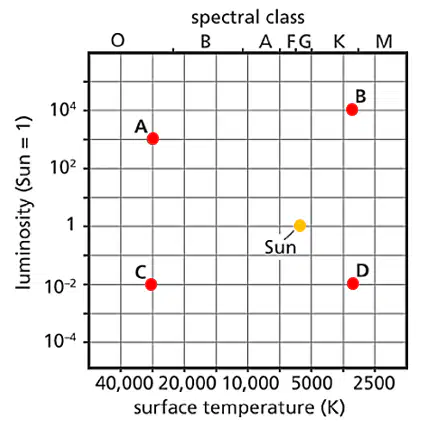
(E-ESS1-3) Which of the four stars shown has the largest diameter?
a)
star A
b)
star B
c)
star C
d)
star D
8.
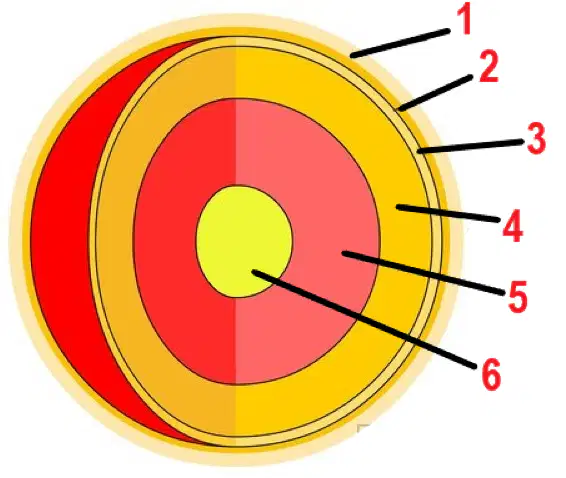
(E-ESS1-1) Nuclear fusion takes place in which layer of the sun?
a)
Layer 3
b)
Layer 4
c)
Layer 5
d)
Layer 6
9.
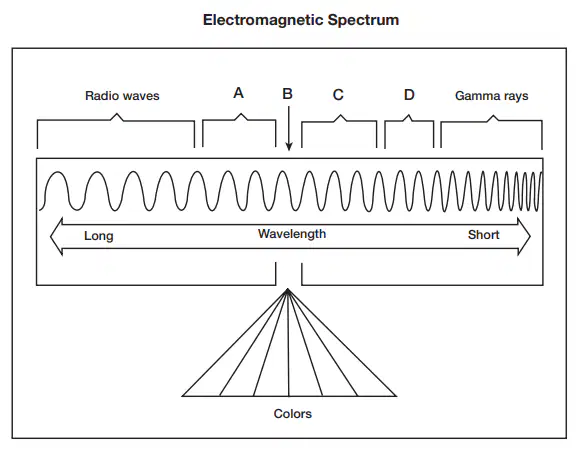
(E-ESS1-1) According to the diagram, which type of electromagnetic radiation has the longest wavelength?
a)
radio
b)
gamma
c)
infrared
d)
ultraviolet
10.
(E-ESS1-3) To classify a star by color and temperature _________.
a)
the hottest are red; the coolest are blue-white
b)
yellow stars like our Sun are hottest
c)
the hottest are blue; the coolest are red
d)
the hottest are white; the coolest are red
11.

(E-ESS1-3) Which of the following statements best fills in the blank for the life cycle of high mass stars?
a)
nuclear fusion stops, stars turn into black holes
b)
nuclear fusion stops, stars enter the main sequence
c)
lighter elements continue to fuse into heavier elements until the star runs out of lighter elements
d)
heavier elements continue to fuse into lighter elements until the star runs out of heavier elements
12.
(E-ESS1-2) What does Cosmic Background Radiation have to do with the big bang theory?
a)
it is part of the theory that has never been explained
b)
it is leftover radiation from the big bang that was spread all over during universe expansion
c)
it was radiation in space that got moved out of the way as the universe expanded
d)
it is when blue-shifted waves change and suddenly become red-shifted waves
13.
(E-ESS1-2) According to the Doppler Effect, what will happen to an object’s wavelength as the object moves toward you?
a)
The wavelength will be shortened.
b)
The wavelength will be lengthened.
c)
The wavelength will not change.
d)
The wavelength will vary.
14.
(E-ESS1-3) Stars that are listed in the main sequence section on an HR diagram are currently fusing ________ in their cores.
a)
carbon
b)
nickel
c)
hydrogen
d)
oxygen
15.
(E-ESS1-1) Which graph best represents the relative wavelengths of the different forms of electromagnetic energy?
a)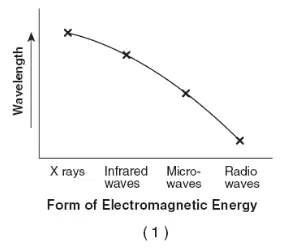
Graph 1
b)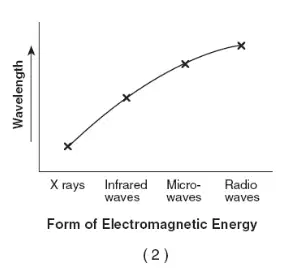
Graph 2
c)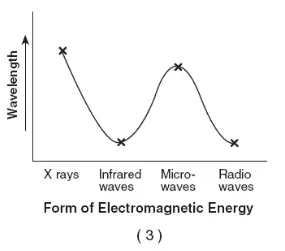
Graph 3
d)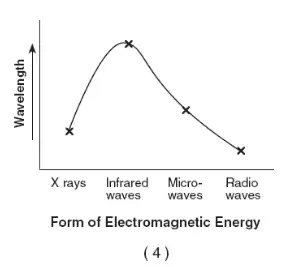
Graph 4
16.
(E-ESS1-1) Why does a sunspot appear dark?
a)
Because it is made of gas and dust that absorbs visible light.
b)
A dark sunspot is cooler than the surrounding areas on the sun’s surface.
c)
The spots are openings, or holes, through which the sun’s interior can be seen.
d)
This is another optical illusion caused by viewing the sun through the Earth’s atmosphere.
17.
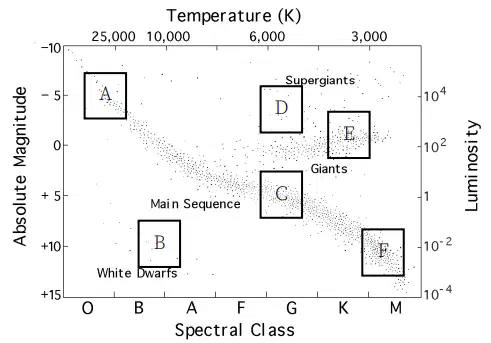
(E-ESS1-1) Where would our own sun be placed on the diagram below?
a)
Area C
b)
Area A
c)
Area B
d)
Area D
e)
Area E
18.
(E-ESS1-2) Which of the following is NOT a major piece of evidence supporting the Big Bang Theory?
a)
the stretching out of starlight
b)
the fact that most galaxies are elliptical
c)
the leftover energy from the big bang
d)
all of these are major evidences of the big bang
19.
(E-ESS1-3) A high-power telescope scans a patch of space and detects several elements, including carbon. The presence of carbon in this region suggests that…
a)
life exists in this region
b)
the telescope is most likely malfunctioning
c)
this region of space has been untouched since the big bang
d)
you are likely to find either stars or leftover stardust in this region
20.
(E-ESS1-2) Which of the following most accurately pairs up the events on the left with the elements that they create?
a)
big bang = heaviest elements; nuclear fusion = medium elements; supernovas = lightest elements
b)
big bang = lightest elements; nuclear fusion = heaviest elements; supernovas = medium elements
c)
big bang = lightest elements; nuclear fusion = medium elements; supernovas = heaviest elements
d)
big bang = medium elements; nuclear fusion = lightest elements; supernovas = heaviest elements
21.
(E-ESS1-2) What was contained in the singularity that gave rise to the Big Bang?
a)
Gamma rays
b)
All the mass, energy, and time in our universe
c)
Electrons in a highly excited state
d)
One atom of every known element in our universe
22.

(E-ESS1-2) Refer to the timeline below. Which of the following statements best describes when the big bang occurred?
a)
between points ‘A’ and ‘B’
b)
between points ‘B’ and ‘C’
c)
between points ‘C’ and ‘D’
d)
sometime after point ‘E’
23.
(E-ESS1-2) Which of the following best describes the big bang?
a)
all matter in the universe expanded outward from a tiny area
b)
all matter in the universe was created in its current location after an explosion
c)
several galaxies collided together and exploded, creating matter
d)
the Earth has gotten cooler since its original formation
24.
(E-ESS1-1) Energy released from _________ can cause damage to the International Space Station, disrupt radio and electrical transmissions on Earth, and cause Auroras in the skies near the North and South Poles.
a)
Sunspots
b)
Solar Flares
c)
Prominences
d)
Corona
25.
(E-ESS1-1) In which area of the sun does gas rise as it heats up, then fall back down as it cools?
a)
the core
b)
the convective zone
c)
the radiative zone
d)
the corona
26.
(E-ESS1-1) When we look at the sun, what layer are we viewing?
a)
photosphere
b)
chromosphere
c)
corona
d)
convection zone
27.
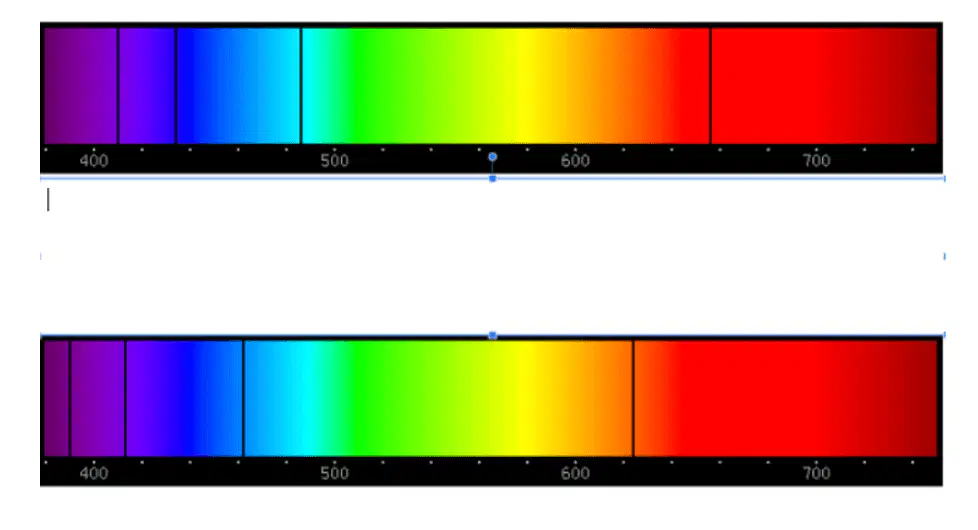
(E-ESS1-2) Based on the image, which statement is TRUE?
a)
The galaxies are moving at the same rate
b)
The galaxies are not moving
c)
The top galaxy is moving towards the bottom galaxy
d)
The top galaxy is moving away from the bottom galaxy
28.
(E-ESS1-1) Stars evolve because of changes in
a)
the chemical composition in the core.
b)
the temperature of the exterior conditions.
c)
the gravitational pull from nearby planets.
d)
the amount of carbon dioxide being released in the atmosphere.
29.
(E-ESS1-2) There is the same ratio of what two elements throughout the universe used to support the Big Bang Theory?
a)
Hydrogen: Oxygen
b)
Helium: Carbon
c)
Hydrogen: Helium
d)
Carbon: Hydrogen
30.
(E-ESS1-3) Which of these subjects should be studied to best learn about the creation of elements heavier than iron?
a)
the earliest moments in the history of our universe, right after the big bang occurred
b)
the core of our sun and the nuclear fusion that occurs there
c)
the development of a protostar and its eventual transformation into a main sequence star
d)
stars undergoing supernova explosions and the energy involved in such explosions
100 %

