Wayground logo

Free Printable Worksheets

Font size

S
M
L
XL
Worksheets

Erosion Review 1

Total questions: 21

Worksheet time: 20mins

Name
Class
Date
1.

What does Erosion do?

a)

Break down the material

b)

Move the material

c)

Deposit the material

2.

What is the difference between Weathering and Erosion?

a)

Weathering moves the rocks, Erosion breaks the rocks

b)

Weathering breaks the rocks, Erosion moves the rocks

3.

What is deposition?

a)

The movement of sediment

b)

The breaking of sediment

c)

The dropping of sediment

4.

Water freezing inside a rock and breaking it into smaller sediment is an example of...

a)

weathering

b)

erosion

c)

deposition

5.

Beach waves dropping sand to create a beach is an example of...

a)

weathering

b)

erosion

c)

deposition

6.

Small pieces of rock that have been weathered from a larger rock are known as...

a)

sand

b)

sediment

c)

soil

7.
What is sediment?
a)
the process of rocks being broken down and carried away
b)
bits of rock, sand, and silt caused by the weathering of rocks
c)
the top layer of the soil
d)
decaying plant or animal material 
8.
Which of these is an example of erosion
a)
Light Shinning onto a mountain
b)
Rain breaking down rock 
c)
Wind blowing away sediment
d)
All of the above
9.
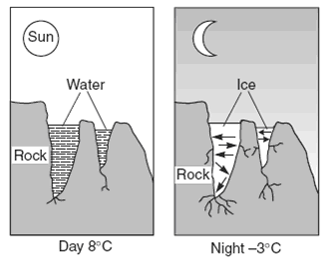
The diagrams  shows a natural process that weathers rock.
 Which statement best explains why this process results in weathering?
a)
frozen water acts as a solute
b)
water expands when it freezes
c)
the mass of water increases when it freezes
d)
frozen water dissolves most types of rock
10.
How do plants weather rocks?
a)
during photosynthesis
b)
when roots grow into cracks of rocks and expand the rock
c)
when the plant moves water from the roots to the leaves
d)
Plants don't weather rocks
11.
fossil fuels react with water producing acid rain that wears minerals away in the rock
a)
chemical weathering
b)
mechanical weathering
c)
erosion
d)
deposition
12.
If you drop a piece of chalk into a cup of vinegar, the chalk will fizz and dissolve after a few minutes. This process is an example of:
a)
chemical weathering
b)
differential weathering
c)
mechanical weathering
d)
infiltration
13.

With a steeper slope, we would expect to see...

a)

less erosion

b)

more erosion

c)

the same amount of erosion

d)

no erosion at all

14.
Which of the following statements is not true?
a)
Water causes more erosion on slopes without plants
b)
Water flows from higher to lower ground
c)
Faster water erodes more sediment
d)
As water slows, smaller particles are deposited first
15.
When a stream or river starts to slow down, it:
a)
Picks up more sediment
b)
Erodes more rapidly
c)
Deposits fine sediments, but continues carrying larger rocks
d)
Deposits larger rocks, but continues carrying finer sediment
16.
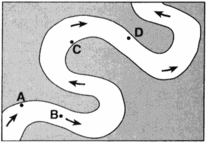
At which location is the greatest amount of sediment most likely being deposited?
a)
A
b)
B
c)
C
d)
D
17.

If the velocity of a stream decreases from 50 centimeters per second to 5 centimeters per second, which sediments will deposit?

a)

A) small cobbles and large pebbles

b)

B) small pebbles and large sand

c)

C) small sand and large silt

d)

D) small silt and large clay

18.

What is runoff?

a)

The process of sediment moving or being weathered away by wind or water.

b)

Water that moves over Earth's surface, because it doesn't infiltrate the ground.

c)

Water moving from the liquid state to the gaseous state.

d)

Observations described in words or letters.

19.
When would a river form a delta?
a)
when the river meanders across a plain
b)
when the river leaves the mountains
c)
when it is in the mountain
d)
when it enters the ocean
20.
How does a sinkhole form?
a)
Stalactites erode a ceiling of a cave
b)
Streams in mountains erode sediment
c)
Underground water forms a cave
d)
Stream erodes soil making it wider
21.
What force is responsible for erosion and deposition in landslides?
a)
gravity
b)
ice
c)
wind
d)
temperature