wayground logo

Free Printable Worksheets

NEW

Font size

S
M
L
XL
Worksheets

Module 3 Review

Total questions: 55

Worksheet time: 4hrs 41mins

Name
Class
Date
1.

Determine if the function graphed has a maximum or a minimum value and identify that value.

a)

maximum at -1

b)

minimum at -1

c)

maximum at 4

d)

minimum at 4

2.
Does this graph in the back have maximum or minimum value?
a)
maximum
b)
minimum
c)
neither
d)
both
3.

Determine if the function graphed has a maximum or a minimum value and identify that value.

a)

maximum at -1

b)

minimum at -1

c)

maximum at 4

d)

minimum at 4

4.

Does this graph have a minimum or maximum? What point?

a)

minimum at (-3, -5)

b)

minimum at (3, 5)

c)

maximum at (-3, -5)

d)

maximum at (3, 5)

5.

Does this graph have a minimum or maximum? What point?

a)

Minimum at (0, 0)

b)

Minimum at (0, 2)

c)

Maximum at (0, 0)

d)

Maximum at (0, 2)

6.

What is the x-intercept(s)?

a)

(0, 6)

b)

(6, 0)

c)

(2, 1)

d)

There is no x-intercept.

7.

What is the y-intercept?

a)

(0, 5)

b)

(5, 0)

c)

(0, -5)

d)

(-5,0)

8.

What is the y-intercept?

a)

(-11, 0)

b)

(0, -11)

c)

(11, 0)

d)

(0, 11)

9.
What is the x-intercept for the given graph?
a)
1
b)
-2
c)
2
d)
1/2
10.
What is the x-intercept shown on the graph?
a)
(2, 0)
b)
(-2, 0)
c)
(0, 3)
d)
(3, 0)
11.
What is the y-intercept shown on the graph?
a)
(0, -2)
b)
(3, 0)
c)
(0, 3)
d)
None of these.
12.
What is the y-intercept?
a)
(3,0)
b)
(0,-3)
c)
(0,3)
d)
(-3,0)
13.

Identify the x-intercept of the graph.

a)

(-4, 0)

b)

(0, -2)

c)

(0, -4)

d)

(-2, 0

14.
When is this function increasing?
a)
−2.5 < x < 2.5
b)
0 < x < 5
c)
0 < x < 55
d)
−5 < x < 0
15.
Over what interval is this function constant?
a)
−5 < x < ∞
b)
−3 < x < 4
c)
4 < x < ∞
d)
−5
16.
List the types of intervals that the graph demonstrates in order.
a)
decreasing, constant, increasing, constant
b)
increasing, decreasing, constant
c)
increasing, constant, increasing, constant
d)
increasing, constant, decreasing, constant
17.
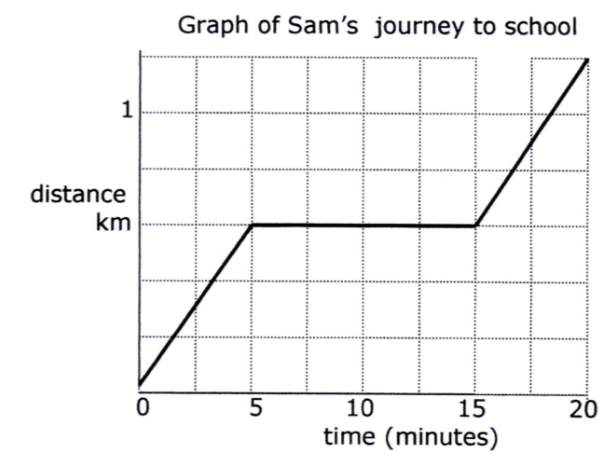
How long did Sam sit on the bench and wait for the bus?
a)
5 min
b)
10 min
c)
15 min
d)
20 min
18.
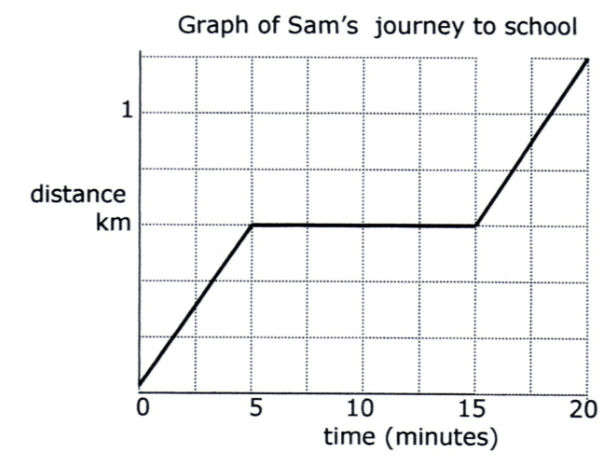
How long did it take Sam to get to school?
a)
5 minutes
b)
20 minutes
c)
1.25 km
d)
1.25 minutes
19.
Over which interval of time is this person returning home?
a)
8:00 < x < 9:00
b)
9:00 < x < 9:30
c)
9:30 < x < 11:00
d)
12:00 < x < 13:00
20.
Which statement is true about this graph?
a)
This function is always constant
b)
This function is always increasing
c)
This function is never increasing
d)
This function is both increasing and decreasing
21.

How many increasing and decreasing intervals are there in this graph?

a)

2 increasing, 2 decreasing

b)

1 increasing, 2 decreasing

c)

2 increasing, 1 decreasing

d)

1 increasing, 1 decreasing

22.

Using the vertical line test. Is this a function?

a)

Yes

b)

No

23.

Using the vertical line test. Is this a function?

a)

Yes

b)

No

24.

Using the vertical line test. Is this a function?

a)

Yes

b)

No

25.

Using the vertical line test. Is this a function?

a)

Yes

b)

No

26.

Using the vertical line test. Is this a function?

a)

Yes

b)

No

27.

Using the vertical line test. Is this a function?

a)

Yes

b)

No

28.

Is the relation a function? Why.

a)

Yes, because the x-value 11 has two y-values paired with it.

b)

Yes, because each x-value has only one y-value paired with it.

c)

No, because the x-value 11 has two y-values paired with it.

d)

No, because each x-value has only one y-value paired with it.

29.

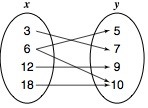
Does this mapping diagram represent a function?

a)

This is not a function because there is an output that has more than one input.

b)

This is a function because each input has exactly one output.

30.
Which ordered pair below would prevent this table from being a function?
a)
(10, 10)
b)
(2, 4)
c)
(6, 1)
d)
(-2, 0)
31.
Which graph does NOT pass the vertical line test?
a)
Graph 1
b)
Graph 2
c)
Graph 3
d)
Graph 4
32.
a)
Function
b)
Not a Function
33.
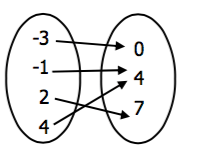
Is this mapping a function or not a function? 
a)
Function
b)
Not a Function
34.
For the function {(0,1), (1,-3), (2,-4), (-4,1)}, write the domain and range.
a)
D: {1, -3, -4,}
R: {0, 1, 2, -4}
b)
D: {-4, 0, 1, 2}
R:{-4, -3, 1}
c)
D: {0, 1, 2, 3, 4}
R:{1, -3, -4}
d)
D: {0, 1, 2, -4}
R: {1, -3, -4, 1}
35.
What is the range?
a)
{-3, -1, 2, 4}
b)
{0, 4, 7} 
c)
{0, 4, 4, 7}
d)
{7, 4, 0}
36.
What is the range?
a)
{-2,2,5}
b)
{1,3,5,6}
c)
all real numbers 
d)
-2<y<5
37.
What is the domain?
a)
all real numbers
b)
1<x<6
c)
{1,3,4,6}
d)
{-2,2,5}
38.
What is the range of the graph?
Remember: Range is y! 
a)
1 ≤ x ≤ 5
b)
1 < x < 5
c)
1 ≤ y ≤ 5
d)
1 < y < 5
39.
Express the following in Interval Notation
 -9 < x ≤ -4 
a)
[-9, -4]
b)
(-9,-4]
c)
[-9, -4]
d)
(-9,-4)
40.

DOMAIN is found by reading the ends of a graph from ___ to ___.

a)

Right to left

b)

Left to right

c)

Bottom to top

d)

Top to bottom

41.

RANGE is found by reading the ends of a graph from ___ to ___.

a)

Right to left

b)

Left to right

c)

Bottom to top

d)

Top to bottom

42.

The set of all x-values used to graph a function are called the ____.

a)

Domain

b)

Range

c)

Relation

d)

Function

43.

The set of all y-values used to graph a function are called the ____.

a)

Domain

b)

Range

c)

Relation

d)

Function

44.
f(x) = -2?
a)
4
b)
0
c)
3
d)
8
45.
What is f(1)?
a)
1
b)
5
c)
0
d)
4
46.
g(-2) = 
a)
-2
b)
4
c)
-4
d)
2
47.
g(x) = 0 
a)
x = 0
b)
x = -3.5, 0, 7
c)
x = -2, 5
d)
x = 5
48.

If f(x) = -3x - 8, find f(-1).

a)

f(-1) = 5

b)

f(-1) = -5

c)

f(-1) = -12

d)

f(-1) = -10

49.

If I know that f(2) = 4, what is another way I can write my answer?

a)

(4,2)

b)

(2, 4)

c)

That is the only way to write it.

50.

g(x) = 3x + 1

g(2) = _______

a)

6

b)

7

c)

8

d)

9

51.

If f(x) = x - 5, what is the value of x when f(x) = 15?

a)

20

b)

10

c)

5

d)

0

52.

Given f(x) = -4x - 10 and f(x) = 10. Find x

a)

x = -5

b)

x = 5

c)

x = -50

d)

x = 30

53.

Use the graph find x when f(x) = 1

a)

-3

b)

3

c)

3, -3

d)

0

54.

Use the graph to evaluate f(2)=

a)

2

b)

-2

c)

3

d)

0

55.
What is the x- intercept of the line?
a)
(0,-1)
b)
(-2,0)
c)
(-1,0)
d)
(0,-2)