
 Worksheets
iP1 - Waves
Total questions: 10
Worksheet time: 5mins
Name
Class
Date
1.

For the diagram shown which letter/s represent amplitude?
a)
A
b)
B
c)
C
d)
D
e)
E
2.
For the diagram shown which letter/s represent wavelength?
a)
B
b)
C
c)
D
d)
E
e)
F
3.
Which definition is correct for the frequency of a wave?
a)
The distance between two consecutive crests or troughs of the wave.
b)
The speed at which the wave travels through a medium.
c)
The amplitude of the wave.
d)
The number of complete cycles of the wave that occur in one second.
4.
Which definition is correct for the period of a wave?
a)
The distance between two consecutive crests or troughs of the wave.
b)
The speed at which the wave travels through a medium.
c)
The amplitude of the wave at a given point.
d)
The time it takes for one complete cycle of the wave to pass a given point.
5.
Which definition is correct for the amplitude of a wave?
a)
The speed of a wave.
b)
The maximum displacement or distance from the equilibrium position of a particle in a wave.
c)
The frequency of a wave.
d)
The wavelength of a wave.
6.

What type of wave is shown in the diagram?
a)
Longitudinal wave
b)
Electromagnetic wave
c)
Cannot be determined
d)
Transverse wave
7.
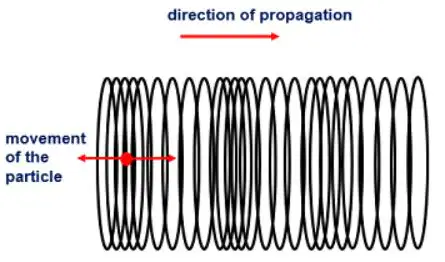
What type of wave is shown in the diagram?
a)
Longitudinal wave
b)
Electromagnetic wave
c)
Cannot be determined
d)
Transverse wave
8.
Which answer correctly shows the similarities between transverse and longitudinal waves?
a)
Both have a speed and a direction.
b)
Both have a crest and a trough.
c)
Both have a compression and a rarefaction.
d)
Both have a wavelength, frequency, and amplitude.
9.
Which answer correctly shows the difference between transverse and longitudinal waves?
a)
Transverse waves move perpendicular to the direction of the wave, while longitudinal waves move parallel to the direction of the wave.
b)
Transverse waves move parallel to the direction of the wave, while longitudinal waves move perpendicular to the direction of the wave.
c)
Transverse waves and longitudinal waves have the same direction of movement.
d)
Transverse waves and longitudinal waves have the same amplitude.
10.
In which type of wave is the motion perpendicular to the movement of the particles?
a)
longitudinal
b)
parallel
c)
circular
d)
transverse
100 %

