
 Worksheets
Habitat and Lifestyle (Science 9 - Alberta, G9 U1 T2)
Total questions: 10
Worksheet time: 18mins

An organism's niche involves two key aspects: (choose two of the following)
the colour of its fur
when it reproduces
its mass and size
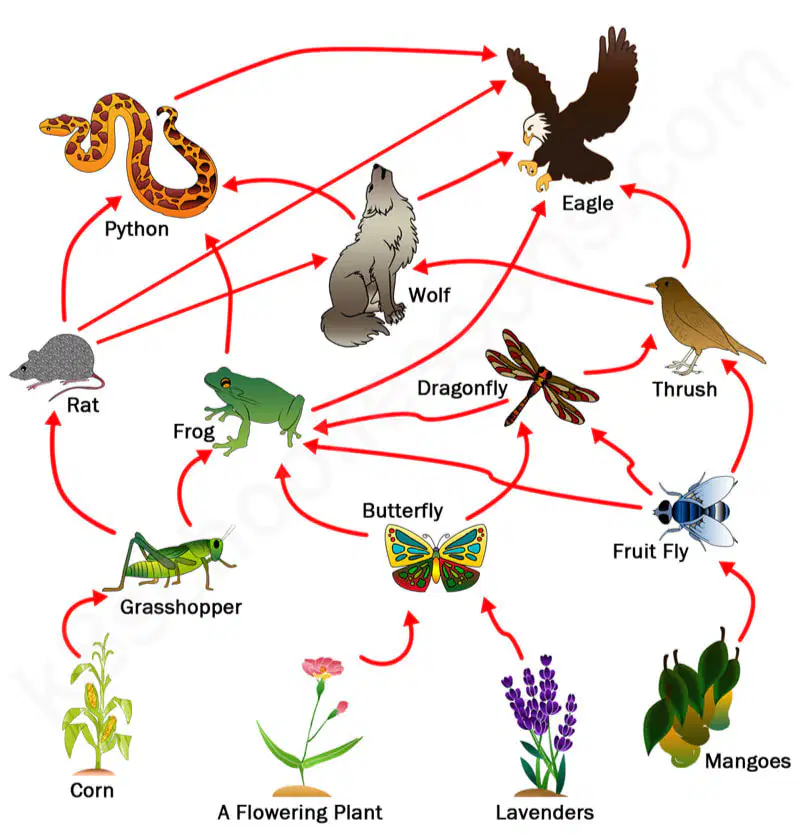
Look at this food web. Which predatory animals are competing for various prey?

Rat

Frog

Wolf

Eagle
Owls and hawks often hunt for rather similar prey, and yet the two can often have populations that co-exist with each other. What is the difference between the two that allows them to co-exist?
Difference in the time of day at which they hunt
Difference in the height at which they build their nests
Difference in their flight patterns
Differences in cell phone use: one uses Uber Eats, and the other doesn't
The word "niche," with its French traits of making an "sh" sound with the "ch," is taken from the French language. Based on what we use it for in science, what two words below are logical translations of the word "niche" from how it is used in French?
kennel
flower
doghouse
store
planet
Classify each of the following as generalists or specialists. Remember, an organism with a broad niche is a generalist, and a narrow niche, a specialist.

Raccoons

Rats

Humans

Cockroaches

Koalas

Pandas

Naked mole rats

Spotted salamanders
When discussing the fact that the grey wolf is a generalist, the text mentions that its scientific name is Canis lupus. On this picture, properly label the labels for the two parts of this scientific name.
kingdom
phylum
genus
species
family
order
This is the type of relationship that exists when two organisms of different species are in direct contact with each other:
(a)
Classify examples of the three types of symbiosis below. There are two examples of each.

Bees and flowers

Water buffalo and oxpeckers

Barnacles and whales

Orchids and trees

Tapeworm and human

Ticks and wolves
Sometimes when there is a niche that can be filled by an adaptation, evolution favours the selection of individuals with such traits. At the same time, when an organism is very resilient, it does not require further evolution, if it can tolerate almost any extreme environment. Which organism below can live both at the coldest temperatures of the poles and the hottest temperatures of the deserts, and has evolved very little in the last 500 million years?

A tartigrade

A spadefoot frog

A camel

A polar bear
An animal is considered feral if it is brought to a location as a domestic pet, and then manages to escape into the wild. If there are no niches for the organism to fill, it will die off. If there are many niches for it to fit, it will increase in number. What feral animal was introduced to Australia in the late 1800s (with roughly 100 of them), and by 1960, it was estimated to have established a population of 287 million?

Red foxes

Coyotes

Mice

Rabbits

