wayground logo

Free Printable Worksheets

NEW

Font size

S
M
L
XL
Worksheets

GENETICS

Total questions: 20

Worksheet time: 10mins

Name
Class
Date
1.

What type of Genotype is this: AA?

a)

Homozygous

b)

Heterozygous

2.
Which of the following is homozygous recessive?
a)
rr
b)
AA
c)
TT
d)
Ff
3.
Alternative forms of a gene are called
a)
Alleles
b)
Homozygous
c)
DNA
d)
Genetics
4.
The physical appearance of an organism based on traits
a)
Genotype
b)
Phenotype
c)
Meiosis
d)
Genetics
5.
How many letters does a genotype contain?
a)
1
b)
2
c)
3
d)
4
6.

Being able to roll the tongue is a dominant trait (T). Not being able to roll the tongue is a recessive trait (t). A persons genes are tt. Which trait would they have?

a)

Able to roll the tongue

b)

Not able to roll the tongue

c)

Can't tell

7.
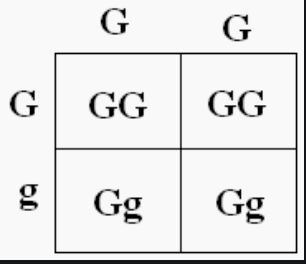
In a certain species of plant, the color purple (P) is dominant to the color white (p).
According to the Punnett Square, what is the probability of an offspring being purple?
a)
25%
b)
0%
c)
100%
d)
50%
8.

Why do scientist use Punnett Squares?

a)

A tool scientist use to to see alleles

b)

A tool scientist use to see which alleles are dominant

c)

A tool scientist use to determine possible genotypes for offspring
9.

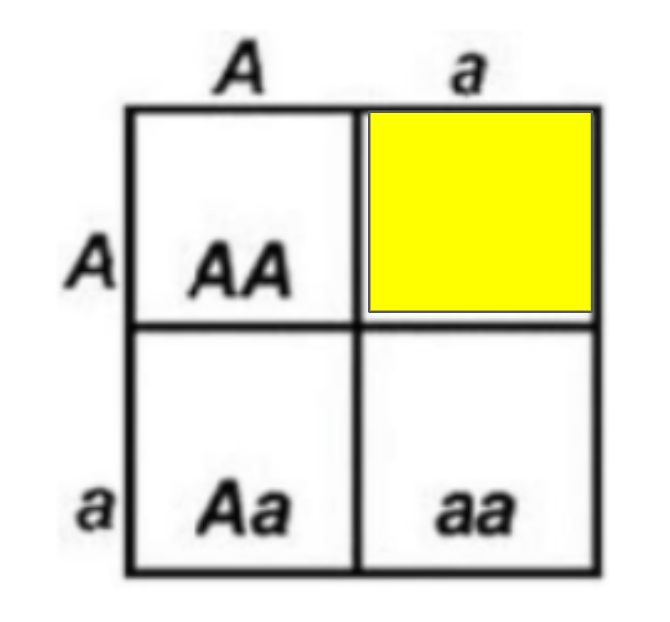
Fill in the Yellow Box

a)

AA

b)

Aa

c)

aa

10.

What is the chance the offspring born from this cross will have a homozygous dominant genotype?

a)

25%

b)

50%

c)

75%

d)

100%

11.
How much of your DNA do you inherit from your mom?
a)
10%
b)
25%
c)
50%
d)
it varies
12.
The law of segregation has two main parts:
Organism inherit 2 copies of each gene, one from each parent, AND
a)
the law of the land.
b)
the law of the jungle.
c)
the law of probability?
d)
Only one copy of a gene goes into an organism's gametes.
13.
Dihybrid crosses are crosses that
a)
examine the inheritance of two different traits.
b)
examine a specific trait.
c)
examine several hundred traits.
d)
examine nothing.
14.
Genes encode ______________________ that produce a diverse range of traits.
a)
the beautiful Dillon
b)
recessive
c)
dominant
d)
proteins
15.
When two alleles of a gene are the different, they are 
a)
heterozygous
b)
purebred.
c)
homozygous.
d)
traits.
16.
In genetics, the mating of two organisms is called
a)
dating.
b)
a lie.
c)
a wonderful life.
d)
a cross.
17.
A gene is
a)
different forms of genes.
b)
a type of pants.
c)
what an organism looks like.
d)
a piece of DNA that stores instructions for making proteins.
18.
Research that showed traits are inherited as discrete units came from 
a)
Hooke.
b)
Schleiden.
c)
Mandela.
d)
Mendel.
19.

Purebred is when

a)

an animal has papers to show its breeding

b)

a person has papers to show their breeding

c)

nothing happens.

d)

the offspring inherits homozygous genes.

20.

When the results of a cross show both traits are equally expressed, this is called _________.

a)

codominance

b)

incomplete dominance

c)

dominance

d)

recessiveness