
 Worksheets
10. The age of revolution (177-1871)
Total questions: 20
Worksheet time: 8mins
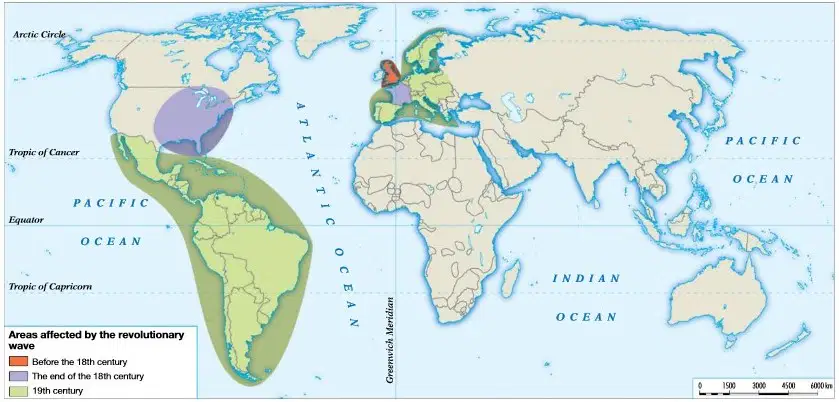
The objective of the bourgeois revolutions of the 18th century was...
to finish enlightened despotism
to execute all kings, nobles and clergy
to finish the Ancien Régime, absolutism and estate society
to reform the Ancien Régime to improve it

Which social group was the main engine of the revolutions against the Ancien Régime?
The Third Estate
The bourgeoisie
The nobility
The clergy

What was the main reason that impulsed the 13 colonies to declare independence (1776)?
The injustices of the English Ancien Régime system
Having to support English soldiers
The taxes that London forced them to pay and not having representation in Parliament
The wars against France and Spain

What was the event that started the American Revolution?
Boston Tea Party
Bastille attack
The Declaration of Independence
The signing of the Treaty of Versailles

Which day do the Americans celebrate the Independence?
4th of July
14th of July
12th of October
13th of January

What were the causes of the beginning of the French Revolution?
Social discontent due to the inequalities of the Ancien Régime
Economic crisis caused by poor harvests
The king's decision to declare war on England in 1789
The extension of Enlightenment, which criticized the Ancien Régime

Which social group left the Estates General and formed the National Assembly?
The nobles, who gathered in the gardens of the Palace of Versailles
The Third Estate, who gathered in a tennis court
King Louis XVI and his ministers, who met in the Royal Chamber
The clergy, who met in the chapel of the palace of Versailles

After hearing what happened in the Estates General, people of Paris _____?_____, which began the French Revolution
attacked the Bastille on 4th August 1789
attacked the Bastille on 14th July 1789
attacked the Bastille on 1st January 1789
attacked the Bastille on 6th March 1789

Which of these principles were part of the Constitution of 1791?
Censitary suffrage
Separation of powers
Universal suffrage
Parliamentary monarchy

During the Legislative Assembly, the two first political parties appeared, which were...
Girondins, moderates. They represented the wealthy bourgeoisie
Jacobins, radicals. They represented the petite bourgeoisie
Sans-culottes, radicals. They represented the absolute monarchy
Germinals, moderates. They represented the Third Estate

Which phase of the French Revolution was the Republic proclaimed and the king executed in?
The National Assembly
The Directory
The Consulate
The Convention

Robespierre, after leading a dictatorship that executed 50.000 people (the Terror), ended ...
lynched by Paris people
becoming consul
exiled in England
guillotined

After the Terror, a general named ____? ____ began to gain influence, and eventually took control of France
Napoleon Bonaparte
Emmanuel-Joseph Sieyès
Roger Ducos
Maximilien Robespierre

After having dominated all Europe, Napoleon was defeated in Russia and...
the battle of Leipzig
the battle of Waterloo
the battle of Trafalgar
the battle of Austerlitz

What was the Restoration?
A return to the political system of the Ancien Régime
A revolution started in France after Napoleon's defeat
An alliance made between Napoleon and Spain to conquer Portugal
A new artistic style of the 19th century

Which of the following measures were adopted in the Congress of Vienna (1814-1815)?
Absolute monarchies were reinstated
Europe's borders changed
European countries agreed to start a new French Revolution
European countries agreed to have Napoleon as their emperor

Which of the following countries was NOT a part of the Holy Alliance?
Russia
Austria
Prussia
Great Britain

What two ideologies were the most important ones during 19th century?
Liberalism and democracy
Liberalism and nationalism
Democracy and separation of powers
Liberalism and separation of powers

Which of the following were the main ideas of liberalism in the 19th century?
Individual liberties
Constitutional monarchy as the form of government
Popular sovereignty with universal male suffrage
All answers are correct

What is a nation?
A group of people and territory with similarities between them and differences with another territories.
A politicial organisation with a common territory, institutions and population with the same characteristics
A country and its borders

