
 Worksheets
MP1 Review
Total questions: 34
Worksheet time: 17mins
Name
Class
Date
1.
Why can’t we hear the constant nuclear explosions of the sun?
a)
The sun does not vibrate.
b)
There is no air in space to help the sound travel.
c)
The sound from the sun is ultrasonic.
d)
The sun only gives off radio waves
2.
Electricity is a flow of moving electrons. What can this be considered?
a)
kinetic energy
b)
magnetic energy
c)
radiant energy
d)
potential energy
3.
What is nuclear FISSION?
a)
the combining of two nuclei.
b)
the destruction a nucleus.
c)
the chemical bonding of two atoms.
d)
the splitting of an atomic nucleus.
4.
What is nuclear fusion?
a)
the forceful combining of two nuclei.
b)
the destruction a nucleus.
c)
the chemical bonding of two atoms.
d)
the splitting of an atomic nucleus.
5.
Which frequency of electromagnetic (EM) radiation has the most energy and shortest wavelength?
a)
radio
b)
microwave
c)
ultraviolet
d)
gamma
6.
How do microwaves increase the temperature of food?
a)
increasing the vibration and rotation of molecules inside the food
b)
increasing the potential energy of the food molecules
c)
breaking the molecular bonds in the food
d)
increasing the gamma waves going through the food
7.
As the temperature of any substance decreases, the kinetic energy of its molecules will:
a)
increase.
b)
increase then decrease.
c)
decrease.
d)
stay the same.
8.
Which is opaque to x-ray radiation?
a)
bone
b)
skin
c)
muscle
d)
fat
9.
Which is not a wavelength of visible light?
a)
red
b)
blue
c)
black
d)
violet
10.
All nuclear FUSION reactions will produce a ________ atom because TWO nuclei _____________
a)
lighter, split
b)
heavier, split
c)
lighter, combine
d)
heavier , combine
11.
By definition, energy is the ability to do
a)
motion
b)
work
c)
acceleration
d)
power
12.
When the nucleus of an atom is split, which form of energy is released?
a)
chemical
b)
mechanical
c)
nuclear
d)
thermal
13.
X-rays, microwaves, and radio waves are forms of which type of energy?
a)
mechanical
b)
heat
c)
electromagnetic
d)
nuclear
14.
Gasoline and food hold stored
a)
electromagnetic energy.
b)
chemical energy.
c)
mechanical energy.
d)
nuclear energy.
15.
The energy in a stretched rubber band or a roller coaster at the top of a hill is in which state?
a)
potential
b)
nuclear
c)
electromagnetic
d)
kinetic
16.
Which is a good example of kinetic energy and potential energy switching back and forth?
a)
a rock sitting on the top of a mountain
b)
a boy jumping on a trampoline
c)
a moving train
d)
electric charges moving in a straight path
17.
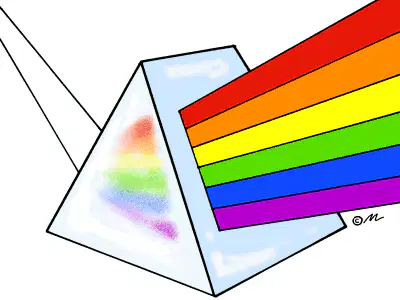
How is light affected by the prism below?
a)
The prism is transparent and refracts white light into purple light.
b)
The prism is transparent and reflects white light into the colors rainbow.
c)
The prism is transparent and refracts white light into the colors of the rainbow.
d)
The prism is translucent and reflects white light into most colors.
18.
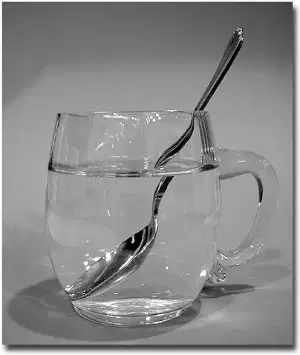
Why does the spoon in the glass appear broken?
a)
The light is bending or refracting as it enters and leaves the water because the speed of light changes in different mediums.
b)
The speed of light increases in water.
c)
The light energy is converting to heat energy
d)
The light is reflecting off the water.
19.
What is the Law of Conservation of Energy?
a)
When heat is lost through friction
b)
Energy can never be destroyed only transformed into other types
c)
When movement stops.
d)
When light is passes through an object.
20.
Which energy conversion/transformation occurs when a battery operated flashlight turns on?
a)
Electrical --> light --. chemical
b)
Light --> chemical --> heat
c)
Chemical --> electrical --> light
d)
Heat --> light --> electrical
21.
When plants make food through photosynthesis, which energy conversion/transformation occurs?
a)
Light energy --> chemical energy
b)
Heat energy --> chemical energy
c)
Chemical energy --> light energy
d)
Mechanical energy --> chemical energy
22.
Why do colors appear different to us?
a)
They each have a different wavelength.
b)
Some are faster than others.
c)
They pass through our pupils.
d)
They each come from the sun.
23.
When EM radiation is absorbed, it
a)
is converted into different wavelengths.
b)
is converted into matter.
c)
passes through the substance.
d)
is converted into heat.
24.
The smallest particle into which an element can be divided and still be the same substance is
a)
nucleus
b)
atom
c)
electron
d)
neutron
25.
Boron has an atomic number of 5. What does this mean?
a)
A boron atom has 5 atoms.
b)
A boron atom has 5 molecules
c)
A boron atom has 5 protons.
d)
A boron atom needs 5 neutrons.
26.
What is a pure substance that only comes in the form of atoms?
a)
element
b)
solution
c)
mixture
d)
compound
27.
Why can’t you see in a completely dark room?
a)
You can – your eyes “adjust.”
b)
The light changes color when you turn off the energy.
c)
The black waves of light enter your eye.
d)
No light enters your eyes.
28.
Matter can rise and sink due to changes in temperature and density. What is this cycle called?
a)
Static electricity
b)
Conduction
c)
Chemical bonding
d)
Convection
29.
Thermal energy from the sun does not conduct through space yet it still warms Earth. How?
a)
Solar flares send thermal energy to Earth.
b)
The sun is so bright, it’s gotta wear shades.
c)
Space convects thermal energy very easily.
d)
Thermal energy can be converted to infrared radiation (electromagnetic radiation) and travel through “empty” space.
30.
The Oyster Creek nuclear power plant generates electricity from fission in a multi-step process. What is the fuel?
a)
Hydrogen
b)
Natural gas
c)
Coal
d)
Uranium
31.
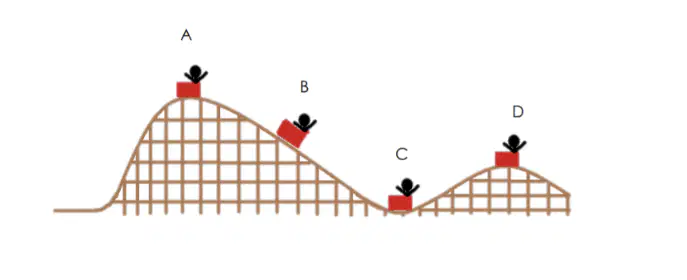
Use the diagram below to answer the following questions. The cart is moving to the right.
Describe the potential and kinetic energy at Point A
4 lines
32.
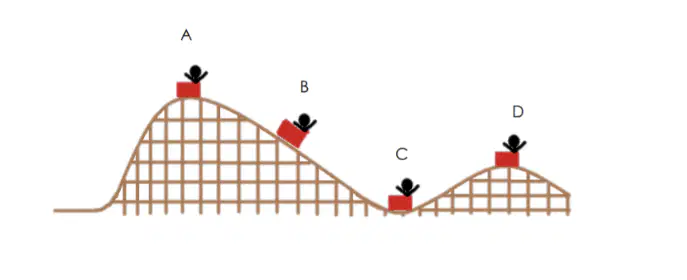
Use the diagram below to answer the following questions. The cart is moving to the right.
Describe the potential and kinetic energy at Point B
4 lines
33.
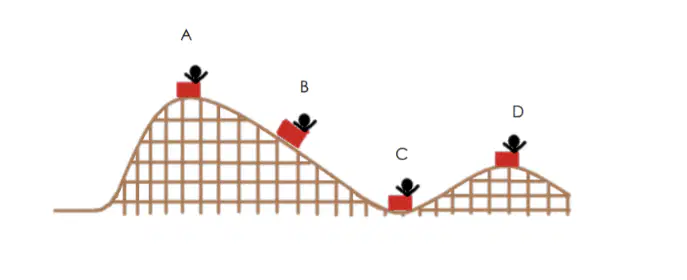
Use the diagram below to answer the following questions. The cart is moving to the right.
Describe the potential and kinetic energy at Point C
4 lines
34.
List the Independent Variable, Dependent Variable and the Control in the experiment below.
You water three sunflower plants with salt water. Each plant receives a different concentration of salt solutions. A fourth plant receives pure water. After a two week period, the height is measured.
4 lines
100 %

