
Font size
 Worksheets
Properties of Matter Review
Total questions: 25
Worksheet time: 25mins
Your lab group has been given a mixture of sand and water. The task at hand is to separate the sand from the water, producing a container of sand and a second container of water. Maria suggests using the procedure called crystallization but several other group members think that filtration would be the best way to separate the two. Provide support for the second separation method, filtration. All BUT ONE point is valid.
Sand is an insoluble solid that does not dissolve in water.
The two parts of the mixture, sand and water, have different boiling points.
Sand particles are large enough to be stopped by a piece of filter paper, separating the sand from the water.
Although crystallization would separate the sand from the water, it would not provide a method to collect the water.
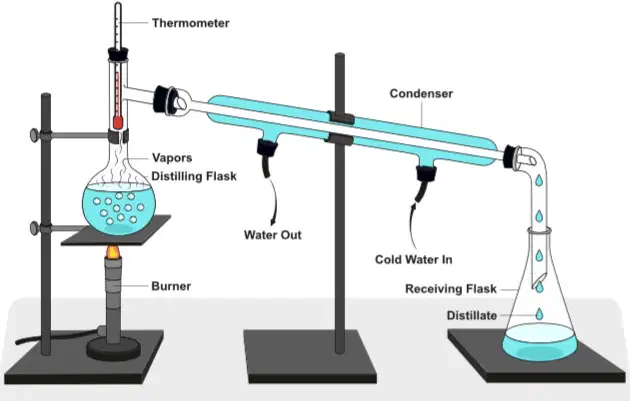
Salt plus water. Two compounds mixed together to form a solution. The water is the solvent; the salt the solute. Students have been tasked with separating the two compounds from solution. One group set up the distillation apparatus you see here. Explain the concept used to separate the salt and water.
The separation of the water from the salt is based on the boiling point and condensing point of water.
The separation is based on the temperature needed to change liquid water to a gas and then back again to a liquid: the boiling point.
The separation of the two is based on different boiling points of the salt (higher) and the water (lower). When the solution is heated the water evaporates from the solution, leaving salt behind.
The separation of the two is based on different boiling points of the salt (lower) and the water (higher). When the solution is heated the salt is transferred as water vapor collects in the condensing tube.
One situation indicates a physical change rather than a chemical change. Which situation indicates a physical change?
Solid copper melts to form liquid copper.
A firecracker explodes on the fourth of July.
Water reacts with the iron on your bicycle to form rust.
Magnesium metal is mixed with hydrochloric acid and hydrogen gas is formed.
Mary Sue is making caramel ice cream. In the first part of the process, she combines a cup of sugar and a cup of water in a saucepan. She cooks the mixture over medium heat until the sugar melts and browns to a light amber color. Then she adds the same amount of water to the mixture along with a cup and a half of cream and milk.
Which part of the preparation indicated a chemical change?
melting the sugar
mixing the sugar with water
adding cream and milk to the mixture
sugar changes from white to a light amber color
During a science lab, some students added small pieces of magnesium ribbon to 10 mL of hydrochloric acid. They noticed that bubbles formed, the test tube got hot, and the magnesium disappeared.
Which is a sign that a chemical reaction has taken place in this experiment?
change in odor
change in color
release of heat energy
disappearance of magnesium
Brad and Juan conducted several tests to determine the properties of silver metal. They noted that it was white, and conducted both electricity and heat. They computed the density to be 10.49 g/cm3. Silver did not react with water but in nitric acid, gas was released.
What evidence supports a chemical change in the silver?
Silver conducts electricity.
Silver reacts with nitric acid to produce a gas.
The color of silver at room temperature is white.
Silver conducted heat and as the temperature increased, became more malleable.

This flask originally held some copper wire and a clear solution of nitric acid. The two substances reacted and produced a brown gas and a blue solution. This reaction cannot be reversed. Evidence of a chemical reaction is shown by
ice forming.
steam rising.
the formation of a gas.
a change in state from a solid to a liquid.

The task in science lab: discover which solid substance, without tasting, is sugar. Donna and Dave have five substances to test, and unfortunately, two are white! "Let's heat them!" suggested Donna.
Did Donna have a reasonable solution to their problem?
Responses
Yes, it would help narrow the search to salt or sugar.
No, all four substances have pretty low melting points.
No, it's impossible to reach these temperatures in a student lab.
Yes, sugar's melting point is much lower than the other four solids.

From the data table, describe how you know a chemical reaction took place between sugar and oxygen.
The solubility decreased.
The density was not available on one of the reactants.
Because sugar will dissolve in water and change the solubility.
The chemical and physical properties of the products do not match the properties of the reactants.
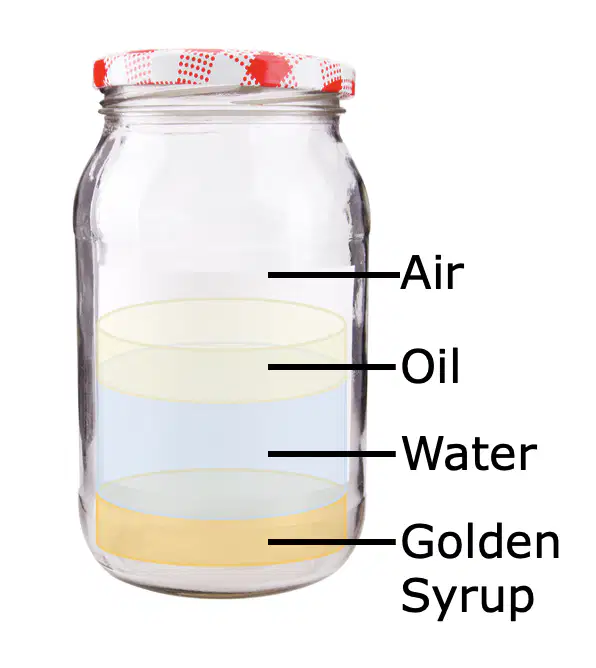
Your science teacher gives you three liquids to pour into a jar. After pouring, the liquids layer as seen here. What property of matter allows the different liquids to layer in the jar?
color
density
mass
texture
Josh is designing a lab to separate a mixture of sulfur powder and iron filings. He looks at all the ways to separate a mixture but decides that one way would work the best on this mixture. What method should Josh use?
density
filtration
evaporation
magnetic attraction

The table shows the density and volume of four liquid samples. The four liquids do not mix with each other. What is the order in which the layers will be formed, from top to bottom, if the four liquids are poured into a beaker and allowed to settle?
Sample A; Sample B; Sample C; Sample D
Sample C; Sample A; Sample D; Sample B
Sample D; Sample C; Sample B; Sample A
Sample B; Sample D; Sample A; Sample C
Two cups of the same size are filled to the brim with clear liquids. Only one container holds water. The other contains a liquid that has greater density than water. How could you safely identify the container holding the water?
See which cup feels heavier.
Taste the liquid in both cups.
Touch the liquid in both cups.
Add salt to the liquids to see if it dissolves.
Kamir and Alexis are studying the properties of water. They conducted a variety of experiments to determine its physical and chemical properties. Of the tests the students conducted, which one illustrates a chemical property of water?
Salt dissolves in water.
Oil and water do not mix.
Pencil shavings float on water and do not dissolve.
Neutral water reacts with carbon dioxide to form an acid solution.
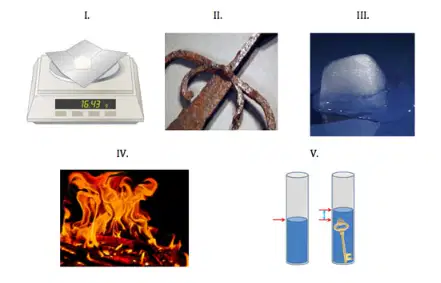
Which image displays a chemical property about a substance? Choose all that apply.
II and IV
I, IV, and V
I, III, and V
II, III, and IV
From the list below, identify which situation contains a chemical change.
A pot of water is being heated on a stove. Bubbles form and condensation appears on the lid of the pot.
A translucent, blue copper (II) sulfate solution is mixed with water and changes to a translucent lighter blue color.
Ammonium nitrate solid is added to water and the temperature drops significantly.
Red and blue paint are mixed together and the color purple appears.
Which of the following are physical changes?
(choose all that apply)
ice melting
a raw egg is fried
change in shape or phase
rusting of a nail
Which of the following are chemical changes?
(choose all that apply)
ice melting
rusting of a nail
nitrogen gas and hydrogen gas combine to form ammonia
a raw egg is fried
Which of the following falls under both physical and chemical changes?
(choose all that apply)
ice melting
matter is conserved
rusting of a nail
change in shape or phase
Select the scenarios that represent a chemical change.
(select all that apply)
Breaking a matchstick
Lighting a match
Pouring baking soda into vinegar causing it to fizz
painting the walls of a dollhouse
Which type of property is combustibility (flammability)?
physical
chemical
both
neither

During Mr. Nye's science class, students were expected to identify various substances using physical properties they could easily measure. Mr. Nye gave each of the five groups a green, metal cube and asked them to identify what the cube was made of.
Matt's cube, after 5 trials, had an average density of 7.40 g/cm3 . His group's cube was made of
aluminum
gold
nickel
zinc

Which of the following properties would change if more of the sample were added to their observations?
It has a dull luster
It weighs 6.5 g
It has a density of 3.25
it has a volume of 2.0 mL

Examine the table for properties of various substances (A-E) shown here. Calculate the densities for each of these substances. Determine which substances will float in water, which has a density of 1.0 g/ml. Select ALL that apply.
Substance A
Substance B
Substance C
Substance D
Substance E
Which of the following are physical changes?
(select all that apply)
Decomposition
Freezing
Melting
Dissolving
Burning

