
Font size
 Worksheets
Topic 1. Atomic structure
Total questions: 20
Worksheet time: 20mins
Define isotopes.
Different types of atoms with the same number of protons and neutrons.
Atoms with the same number of neutrons but different numbers of protons.
Atoms with the same number of protons and electrons but different numbers of neutrons.
Variants of a chemical element with the same number of protons but different numbers of neutrons.
What is the mass number of an atom?
Total number of neutrons in the nucleus
Total number of protons and neutrons in the nucleus
Total number of protons in the nucleus
Total number of electrons in the nucleus
Explain anions in terms of atomic structure.
Anions are neutral ions formed by gaining electrons.
Anions are negatively charged ions formed by gaining electrons.
Anions are positively charged ions formed by losing electrons.
Anions are atoms that have lost their outermost electrons.
What are cations and how are they formed?
Cations are positively charged ions formed by the loss of electrons from an atom.
Cations are negatively charged ions formed by the gain of electrons from an atom.
Cations are neutral ions formed by the sharing of electrons between atoms.
Cations are formed by the combination of protons and neutrons in an atom.
What is the difference between atomic number and mass number?
The atomic number is the number of neutrons in the nucleus, while the mass number is the total number of protons and electrons in the nucleus.
The atomic number is the number of electrons in the nucleus, while the mass number is the total number of protons and neutrons in the nucleus.
The atomic number is the number of protons and neutrons in the nucleus, while the mass number is the total number of protons in the nucleus.
The atomic number is the number of protons in the nucleus, while the mass number is the total number of protons and neutrons in the nucleus.
How do cations and anions differ?
Cations and anions have the same charge.
Cations are negatively charged ions, while anions are positively charged ions.
Cations are positively charged ions, while anions are negatively charged ions.
Cations and anions have no charge.

I am a metal and I have 30 electrons. My atomic mass is 65.38 amu's. What element am I? (use your periodic table)
Chromium
Terbium
Uranium
Zinc
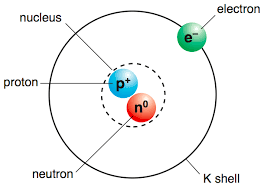


What is the atomic number of this atom?
2
4
6
8

What is the mass number of this atom?
1
3
4
7
Isotopes are atoms of the same elements that have different number of
(a)
Each isotope has a different
relative atomic mass
atomic number
Radioactive isotopes are
unstable atoms
stable atoms
Carbon has 3 isotopes :
6C12 6C13 6C14
How many neutrons does each have respectively?
12, 13, 14
6, 7, 8
6, 6, 6
What is a positive ion called?
anion
cation
isotope
covalent
If an atom loses electrons, the charge will be positive.
true
false
A Bromine ion gains 1 electron, which of the following is the correct symbol for a Bromine ion?
Br-1
Br+1
Br+7
Br-7
An atom with 2 protons, 3 neutrons, and 4 electrons has a charge of ____.
+2
-2
+3
0

