
Font size
 Worksheets
Unit 2 Post Assessment Review
Total questions: 20
Worksheet time: 19mins

The cell shown is most likely NOT a plant cell because...
No nucleus is present
No cell wall is present
Endoplasmic reticulum is present
Mitochondria is present
If a toxic chemical destroys the ribosomes, which cellular activity would be affected first?
Movement
DNA synthesis
Energy storage
Protein production
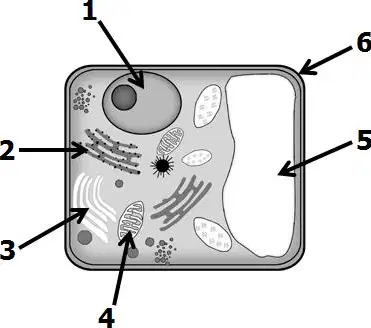
Which structure is responsible for releasing energy for the cell?
5
4
3
2
1
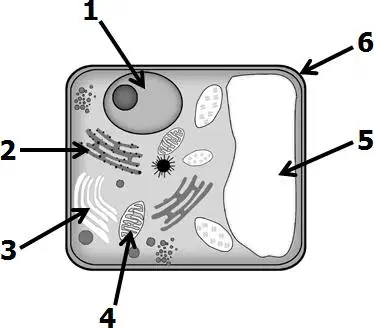
Which structure is the location of genetic material in the cell?
1
2
3
4
5
A teacher explains to her students that during mitosis, all the cells divide into two daughter cells and each daughter cell has the same number of chromosomes. The teacher asks her students to support this explanation. What statements should the students give?
During mitosis, cells divide continuously without growing.
During the growth phase between two mitotic divisions of a cell, chromosomes and the cytoplasmic organelles duplicate.
Each daughter cell receives exactly half the number of duplicated chromosomes.
Each daughter cell receives half the chromosomes and the cytoplasmic organelles from the parent cell and then duplicates.
Which statement below is an example of active transport?
The LDL (low-density lipoprotein) from a human body carries cholesterol, which binds to LDL receptors on the cell surface.
The gills of a marine fish remove salt from the fish's body by pumping it into the ocean water.
The root hair cells of a plant absorb the higher concentration of water from the soil into the plant's body.
The digestive enzymes of a bear are secreted from cells that line the inner surface of various exocrine glands.
Which statement below is an example of osmosis?
The root hair cells of a plant absorb the higher concentration of water from the soil into the plant's body.
The LDL (low-density lipoprotein) from a human body carries cholesterol, which binds to LDL receptors on the cell surface.
The gills of a marine fish remove salt from the fish's body by pumping it into the ocean water.
The digestive enzymes of a bear are secreted from cells that line the inner surface of various exocrine glands.
In multicellular organisms, different types of cells can perform different types of tasks. This is best described
as —
development
growth
specialization
generalization


When a cell forms a vesicle around unwanted particles and expels it OUT of the cell.
Pinocytosis
Endocytosis
Receptor-mediated
Exocytosis


The figure above shows the fluid-mosaic model of a cell’s plasma membrane. Which of the following best describes the structure indicated by the arrow in the figure?
A peripheral protein floating in lipids
A peripheral lipid floating in proteins
A transport protein floating in lipids
A transport lipid floating in proteins

