
 Worksheets
Unit 2 Review (Quizizz)
Total questions: 90
Worksheet time: 1hrs 9mins

What is the molecular structure of water?
1 Hydrogen
2 Oxygen
1 Hydrogen
1 Oxygen
2 Hydrogen
2 Oxygen
2 Hydrogen
1 Oxygen

Which side of the water molecule has a slightly positive charge?
Oxygen
Hydrogen
It's all positive
It's all negative

Which side of the water molecule has a slightly negative charge?
It's all negative
It's all positive
Hydrogen
Oxygen

What kind of Bond does a water molecule have?
Ionic
Polar Covalent
Non Polar Covalent
Metallic

What is the boiling point of water?
0 C
100 C
200 C
50 C

What is the freezing point of water?
0 C
100 C
200 C
50 C
What is the amount of heat required to raise the temperature of one gram of a substance by one degree Celsius?
Surface Tension
Density
Polarity
Specific Heat Capacity

True or False: Ice is Less Dense than Water
True
False

What is the property of the surface of a liquid that allows it to resist an external force, due to the cohesive nature of its molecules?
Cohesion
Surface Tension
Adhesion
Polarity

What is Cohesion?
Water molecules ability to stick to each other
Water molecules ability to stick to other surfaces
Water molecules ability to conduct electricity
Water molecules ability to melt
What is Adhesion?
Water molecules ability to stick to each other
Water molecules ability to stick to other surfaces
Water molecules ability to conduct electricity
Water molecules ability to melt

What is the movement of water within the spaces of a porous material due to the forces of adhesion, cohesion, and surface tension
Malleability
Conductivity
Freezing Point
Capillary Action

Which is a good example of capillary action?
Water splashing after throwing a rock into it
Water falling from the sky
Water being absorbed by a sponge
Water freezing in the cold

How is ice able to float in water?
water is less dense
gravity pushes the ice to the surface
ice cannot float
molecules are more tightly packed in water's liquid state than its solid state
Which molecule arrangement shows a frozen/solid state?


What water phenomenon can be observed in this picture?
Ice Melting
Water Freezing
Capillary Action
the Meniscus

What water phenomenon can be observed in this photo?
Water dissolving
Capillary Action
Chemical Reaction
Photosynthesis

Which TWO water properties can be observed in this picture?
Capillary Action
Cohesion
Adhesion
Freezing

What is the property of fluid having high resistance to flow
Adhesion
Conductivity
Density
Viscosity

How is this lizard able to run across water?
Capillary Action
The lizard is really light
The water is a little frozen
Surface Tension
Why does water ice have a lower density than liquid water?
Because it floats
Because it is a crystal
Because the molecules expand in volume as water freezes into a crystal
Because ice is colder than water
Enzymes belong to which class of macromolecules?
lipids
carbohydrates
proteins
nucleic acids
DNA belongs to which class of macromolecules?
proteins
nucleic acids
carbohydrates
lipids
Sugar belongs to which class of macromolecules?
proteins
lipids
nucleic acids
carbohydrates

Which macromolecule is shown?
lipid
protein
nucleic acid
carbohydrate


Match the following macromolecules to their monomers:
Carbohydrates
Monosaccharides
Lipids
Fatty acids
Proteins
Amino acids
Nucleic acids
Nucleotides
What macromolecule stores hereditary information?
Carbohydrates
Lipids
Proteins
Nucleic acids
One of the functions of carbohydrates is to provide (a) term energy. On the other hand, lipids provide (b) term energy.
Which of the following elements is found in proteins but not found in carbohydrates or lipids?
Oxygen
Nitrogen
Hydrogen
Carbon
Match the following Macromolecules to their pictures.

Carbohydrate

Lipid

Protein

Nucleic acid
Which of the following is an example of a carbohydrate?
Cellulose
Oil
Enzyme
RNA
Nucleic acids, including DNA and RNA, are the only macromolecule that contains (a)
Select ALL the correct answers: Which of the following are examples of lipids?
Phospholipids
Enzymes
Triglycerides
Amylose
A monomer is (a) building block of a macromolecule. A polymer is made of (b) repeating units.
Which of the following is a function of carbohydrates?
Providing structure in a plant's cell wall
Creating the hydrophobic barrier of the plasma membrane
Sending signals from glands like the thyroid to communicate with other cells
Store hereditary information that is passed down from parents to offspring
Which of the following is a function of a protein?
Provide short term energy
Speed up chemical reactions
Store hereditary information
Warmth / insulation
How does temperature influence the rate of enzymatic reactions?
Temperature does not influence the rate of enzymatic reactions.
Temperature slows down enzymatic reactions by denaturing the enzyme.
Temperature speeds up enzymatic reactions by reducing the reaction rate.
Temperature modifies the rate of enzymatic reactions by changing the enzyme's structure and accelerating the reaction rate.
What happens to enzymes at high temperatures?
Enzymes become inactive.
Enzymes denature
Enzymes break down.
Enzymes become more active.
What is thermal stability of enzymes?
The ability of an enzyme to maintain its structure and function at normal temperatures.
The ability of an enzyme to maintain its structure and function at low temperatures.
The ability of an enzyme to maintain its structure and function at high temperatures.
The ability of an enzyme to change its structure and function at high temperatures.
How does temperature affect enzyme-substrate interactions?
Temperature has no effect on enzyme-substrate interactions.
Temperature increases the concentration of enzymes in the solution.
Temperature affects enzyme-substrate interactions by altering the kinetic energy of the molecules.
Temperature decreases the rate of enzyme-substrate interactions.
At what temperature does enzyme activity start to decrease?
At what temperature does enzyme activity start to increase rapidly?
At what temperature does enzyme activity at optimal speed?
What is the process called when enzymes lose their structure and function at high temperatures?
denaturation
reduction
activation
inhibition
What are some factors that can affect the thermal stability of enzymes?
Light intensity, pressure, humidity
Salt concentration, enzyme concentration, reaction time
Enzyme size, reaction volume, stirring speed
pH, temperature, substrate concentration, inhibitors or activators
How does temperature affect the rate of enzyme-substrate reactions?
Temperature affects the rate of enzyme-substrate reactions by increasing it up to an optimal temperature and then decreasing it beyond that point.
Decreasing temperature always decreases the rate of enzyme-substrate reactions.
Increasing temperature always increases the rate of enzyme-substrate reactions.
Temperature has no effect on the rate of enzyme-substrate reactions.
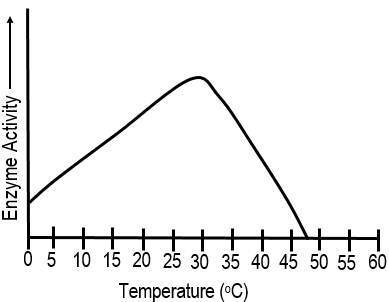

Based on the graph about temperature and rate of enzyme reaction, the enzyme catalyzes the reaction at an optimal temperature of (a)
What happens when enzymes are heated to a high temperature?
The enzymes die.
The shape of the enzyme are changed and it denatures
The enzymes' amino acid sequence changes.
The enzymes remain the same
Which enzyme will NOT have a functioning active site?
Which enzyme will have catalyze a reaction?
Based on the amount of oxygen produced, which is the optimal temperature for the enzyme?

Choose two enzymes. First, describe one way the two enzymes are different. Then, describe one way they are the same.
Stem: I choose ___ and ____. ___ while ____ . Both enzymes are ____.
WORD BANK: best pH, function, pepsin, salivary amylase, phosphatase, optimal pH, acidic environment, basic environment
At high temperatures, the rate of enzyme action decreases because the increased heat......
neutralizes the acids and bases in the system
alters the shape of the active site of the enzyme
increases the concentration of the enzyme
changes the pH of the system
Enzymes speed up the rate of chemical reactions by.....
giving you extra oxygen.
absorbing water released when polymers are formed.
lowering the activation energy.
combining with excess hydrogen to form a gas.
The "lock and key" description explain the mechanism of
enzyme specificity
how temperature works
exocytosis
vacuole formation
The reactants to which enzymes bind are also known as
lipids
reactions
controls
substrates

Which enzyme would you expect to find in bacteria growing in a hot environment?
Enzyme X
Enzyme Y

Both enzymes will have the same amount of activity at 40 degrees Celsius?
True
False

Which enzyme is active over the largest temperature range?
Enzyme X
Enzyme Y

Which enzyme has an optimum temperature of 40 degrees Celsius?
Enzyme X
Enzyme Y

Using the diagram, match the following.
A
Substrate
B
Enzyme
C
Active Site
D
Product
E
Enzyme Substrate Complex
Enzymes are important for the body because
they increase the activation energy needed for a chemical reaction.
keep the activation energy of a chemical reaction at a constant level.
lower the activation energy needed for the chemical reaction.
remove all of the activation energy needed for a chemical reaction.
An enzyme is which type of macromolecule
Carbohydrate
Lipid
Protein
Nucleic acid

The optimum pH for this enzyme is approximately
2
3.5
5.5
8
10
Which of the following does NOT have an impact on the rate at which an enzyme functions?
Temperature
pH
Amount of substrate
The type of enzyme
When an enzyme experience very low temperatures the rate of reaction increases?
True
False
A prolonged period of high fever is dangerous to humans because... (choose TWO that apply)
It makes the enzymes work faster
It denatures the enzyme and stops working
It can make the enzyme function better than it did before
It can change the shape of an enzyme so it can not bind to the right substrate

