
Font size
 Worksheets
RISE OF NATIONALISIM IN INDIA AND DEVELOPMENT
Total questions: 254
Worksheet time: 2hrs 8mins
The Bourbon dynasty, which had been deposed during the French Revolution, was restored to power after signing the Treaty of _______.
a) Vienna
b) Constantinople
c) Marseilles
d) Prussia
A large part of the Balkans was under the control of the _______ empire, which witnessed the most serious source of nationalist tensions in Europe after 1871.
a) Greek
b) Russian
c) Prussian
d) Ottoman
_________ regimes imposed censorship laws to control what was said in newspapers, books, plays and songs and reflected the ideas of liberty and freedom.
a) Liberal
b) Conservative
c) Democratic
d) Secular
Which of the following statements about the Civil Code of 1804, usually known as the Napoleonic Code, are true?
a) Secured the Right to Property
b) Established Equality before the Law
c) Removed all privileges based on birth
d) All of the above
Elle the measuring unit in Germany was used to measure
cloth
thread
height
land
Zollverein started in 1834 in Prussia refers to
Trade Union
Customs Union
Labour Union
Farmer's Union
What do the saints, angels and Christ represent in the Utopian Vision?
Fraternity among Nations
Equality among people
Equality among Nations
Resentment against Nations
Who were the 'Junkers?'
Soldiers
Large Landowners
Small Landowners
Aristocracy
Which Treaty recognized Greece as independent nation?
Treaty of Constantinople 1832
Treaty of Constantinople 1834
Treaty of Greece 1832
Treaty of Versailles
Which of the following powers collectively defeated Napoleon?
Britain, France, Italy, Russia
Britain, Austria, Spain, Russia
Austria, Britain, Russia, Prussia
Britain, Prussia, Russia, Italy
Romanticism refers to
cultural movement
economic movement
political movement
literacy movement
'Nationalism' emerged as a force in the 19th century means
a strong devotion for one's country but hatred for others
equal and strong devotion for all the countries
a strong devotion for one's culture with no appreciation for other nations
a strong devotion for one's history and culture
Which of the following countries did not attend the Congress of Vienna?
Britain
Switzerland
Prussia
Austria
Who among the following started 'Young Italy?'
Metternich
Johann Gottfried Herder
Giuseppe Mazzini
Otto von Bismarck
Who played an important role in the unification of Germany?
Kaiser William I
Otto Von Bismarck
Duke Metternich
Cavour
Who became the king of united Italy?
Victor Emmanuel II
Giuseppe Garibaldi
Wilhelm IV
William I
What helped in the formation of nation- state in Britain?
It was a result of a sudden upheaval
In 1688 the monarchy had seized power from the British parliament
In 1688 the British parliament had seized power from the monarchy
It was a result of a war with Scotland and Ireland
Which of the allegories wear a crown of oak leaves
Marianne
Britannia
Union Jack
Germania
A large of the Balkans was under the control of the
Habsburg Empire]
British Empire
Ottoman Empire
German Empire
Zollverein started in 1834 in Prussia refers to a:
Custom Union
Trade Union
Labour's Union
Farmer's Union
What do the saints, angels and Christ symbolize in the Utopian vision?
Fraternity among nations
Equality among people
Resentment among nations
Freedom of nations
Which of the following group of powers collectively defeated Napoleon?
England, France, Italy, Russia
Britain, Prussia, Russia, Italy
England, Austria, Spain, Russia
Austria, Prussia, Russia, Britain
‘Nationalism’, which emerged as a force in the late 19th century, means
strong devotion for one’s own country and its history and culture.
strong devotion for one’s own country without appreciation for other nations.
strong love for one’s own country and hatred for others.
equally strong devotion for all the countries of the world.
(a) was proclaimed the King of United Italy in 1861.
Who remarked “when France sneezes the rest of Europe catches cold”?
(a)
The first great revolution which gave the clear idea of nationalism with its core words: ‘Liberty, Equality and Fraternity’ was:
The Russian Revolution
The French Revolution
The American Revolution
India's First war of Independence
The liberal nationalism stands for:
freedom for the individual and equality before law.
preservation of autocracy and clerical privileges.
freedom for only male members of society and equality before law.
freedom only for senior citizens.
Who formed the secret society called ‘Young Italy’?
(a)
A large part of Balkan region was under the control of:
(a)
Who was the architect of German unification?
Napoleon
Otto Von Bismark
Mazzini
Garibaldi
Romanticism refers to:
Cultural movement
Religious movement
Literary movement
Political movement
Italian Princely house ruled which of the following states before unification of Italy?
Lombardy
Sardinia Piedmont
Kingdom of two sicilies
Venetia
The most serious source of nationalist tension in Europe, after 1871, was an area called
Ottoman
Prussia
Balkans
Macedonia
Q.2. Nationalism brought about in Europe the emergence of :
(a) The Nation State
(b) The Modern State
(c) Multinational Dynastic State
(d) Alliances formed among many European states
Q.3. Frederic Serrieu, a French artist, in his series of four prints (1848) visualised his dream of a world as :
(a) A world made up of ‘democratic and social republics’
(b) A world made up of one nation, one world
(c) A world with one absolute ruler
(d) A world following one religion, one language
Q.5. The Civil Code of 1804, also known as the Napoleonic Code, established :
(a) Equality before the law
(b) Secured the right to property
(c) Did away with all the privileges based on birth
(d) All the above
In the print prepared by Frederic Sorrieu, the Statue of liberty has __ in one hand and __ in another
Map, torch of enlightment
Torch of enlightenment, Charter of the Rights of Man
Symbols of Christianity, Bible
None of these
Who, among the following, hosted the Congress at Vienna in 1815.
King of Netherlands
Giuseppe Mazzini
Duke Metternich
Otto von Bismarck
Who among the following formed the secret society called ‘Young Italy’.
Otto von Bismarck
Giuseppe Mazzini
Metternich
Johann Gottfried Herder
Which one of the following types of government was functioning in France before the revolution of 1789?
Dictatorship
Military
Body of French Citizen
Monarchy
Which one of the following statements is not true about Giuseppe Mazzini?
He wanted a united Italian Republic.
He founded an underground society called ‘Young Italy’.
He wanted Italy to be a monarchy.
He was exiled for attempting a revolution in Liguria.
Who said “when France sneezes the rest of Europe catches cold” ?
Garibaldi
Mazzini
Metternich
Bismarck
Which treaty recognised Greece as an independent nation ?
Treaty of Versailles
Treaty of Vienna
Treaty of Constantinople
Treaty of Lausanne
Elle, the measuring unit in Germany was used to measure
cloth
thread
land
height
The Ottoman Empire was ruled by the emperor of
Turkey
Russia
Britain
Prussia
Which one of the following is true about the ‘Treaty of Constantinople’ in 1832.
It recognized Turkey as an independent nation.
It recognized Greece as an independent nation.
It recognized Germany as an independent nation.
It recognized France as an independent nation.
Which of the following powers collectively defeated Napoleon?
Britain, France, Italy, Russia
Britain, Austria, Spain, Russia
Austria, Britain, Russia, Prussia
Britain, Prussia, Russia, Italy
Romanticism refers to
cultural movement
economic movement
political movement
literacy movement
'Nationalism' emerged as a force in the19th century means
a strong devotion for one's country but hatred for others
equal and strong devotion for all the countries
a strong devotion for one's culture with no appreciation for other nations
a strong devotion for one's history and culture
Which of the following countries did not attend the Congress of Vienna?
Britain
Switzerland
Prussia
Austria
The first clear expression of Nationalism in Europe came with :
(a) The American Revolution
(b) The French Revolution
(c) The Russian Revolution
(d) The Industrial Revolution
Nationalism brought about in Europe the emergence of :
(a) The Nation State
(b) The Modern State
(c) Multinational Dynastic State
(d) Alliances formed among many European states
Frederic Sorrieu, a French artist, in his series of four prints (1848) visualised his dream of a world as :
(a) A world made up of ‘democratic and social republics’
(b) A world made up of one nation, one world
(c) A world with one absolute ruler
(d) A world following one religion, one language
The ideas of a United Community enjoying equal rights under a Constitution were expressed by the French as :
(a) La Patrie
(b) Le Citoyen
(c) Both (a) and (b)
(d) None of the above
The Civil Code of 1804, also known as the Napoleonic Code, established :
(a) Equality before the law
(b) Secured the right to property
(c) Did away with all the privileges based on birth
(d) All the above
1. What was the name of the print prepared by Sorrieu?
2.Which country became a full-fledged territorial state in Europe in 1789?
Germany
France
England
Spain
3. Which newly designed flag was chosen to replace the former Royal Standard in France?
Union Jack
Tricolour
Red Cross
White Saltire
4. Which event was a first clear expression of nationalism?
5. What does la patrie mean?
6. Which region was ruled over by the Habsburg Empire?
Scotland-Ireland
Spain-Portugal
Austria-Hungary
France-Netherlands
7. How many series of prints were prepared by Sorrieu?
2
4
3
5
8. What was the main occupation in the mid 18th century in Europe?
Peasantry
Trade and Commerce
Craftsmanship
All of the above
10. Which of the following reforms made the whole system in France more rational and efficient?
Social reforms
Economic reforms
Administrative reforms
Political reforms
11. To which country did the artist Frederic Sorrieu belong?
12. What was the main aim of the French revolutionaries?
To liberate the people of Europe from despotism
To liberate the people of France
To establish nation-states
All of the above

13. What do the images of shattered remains in the foreground signify?
14. During the 19th century, what force brought about sweeping changes in Europe?
15. Napoleonic code was known as:
Civil Code of 1805
Civil Code of 1804
Civil Code of 1803
Civil Code of 1801
16. Which of the following is not true about the Aristocrats of Europe?
They were tied by marriage
Owned a lot of land
They were in majority
All of the above
17. Which form of government was there in France before 1789?
Dictatorship
Monarchy
Body of French citizens
Military
18. What was the Estates General renamed as?
19. Which of the following classes were politically and socially dominant in Europe in the 18th century?
Middles class
Landed aristocracy
Peasants
Serfs
20. In revolutionary France, who were given the right to vote?
All men
All men and women
Men with property
All property owning men and women
21. Which region in the Habsburg Empire had a largely a German-speaking aristocracy?
Venetia
Sudetenland
Bohemia
Lombardy
22. Which of the following was not a measure of the Civil Code of 1804?
Did away with all privileges based on birth
Simplified administrative divisions
Established the feudal system
Freed peasants from serfdom
23. The term 'suffrage' means:
Right to express
Right to religious practice
Right to property
Right to vote
Who was Frederick Sorrieu?
A Revolutionary
Chancellor of Austria
King of Frame
French Artist
What does the German oak stand for?
Heroism
Patriotism
Liberalism
Socialism
Who remarked “When France Sneezes, the rest of Europe catches cold”?
Giuseppe Mazzini
Metternich
Louis Philippe
Johann Gottfried
Who among the following formed ‘Young Italy’?
Ottovon BismarK
Giuseppe Mazzini
Metternich
Johngotfried Herder
The term ‘absolutist’ is referred to:
Monarchical government
Abstract theory
A vision
None of these
Who were the ‘Junkers’?
Soldiers
Large landowners
Aristocracy
Weavers
Name the act which resulted in the formation of the ‘United Kingdom of Great
Britain’.
The Act of Union, 1707
Tax Reform Act, 1784
Commutation Act, 1784
None of these
Zollverein was a
Diplomatic institution
Custom union
Administrative union
Trade union
Which year was known as the year of dear bread?
1830
1848
1789
1815
Who founded the revolutionary militia ‘Red Shirt’?
Mazzini
Garibaldi
Tsar Alexander II
Metternich
Arrange the following in the correct sequence:
(i) Napoleon invades Italy
(ii) Fall of Napoleon
(iii) Greek Struggle for independence begins
(iv) Unifi cation of Italy
(ii) — (iii) — (iv) — (i)
(iv) — (ii) — (iii) — (i)
(i) — (ii) — (iii) — (iv)
(i) — (iii) — (ii) — (iv)
Arrange the following in the correct sequence:
(i) Peasants revolt against economic hardships in Europe.
(ii) Slav nationalism gathers force in the Habsburg and Ottoman Empires.
(iii) Unifi cation of Italy.
(iv) Unifi cation of Germany.
(i) — (ii) — (iii) — (iv)
(i) — (iii) — (iv) — (ii)
(i) — (iv) — (iii) — (ii)
(i) — (iii) — (ii) — (iv)
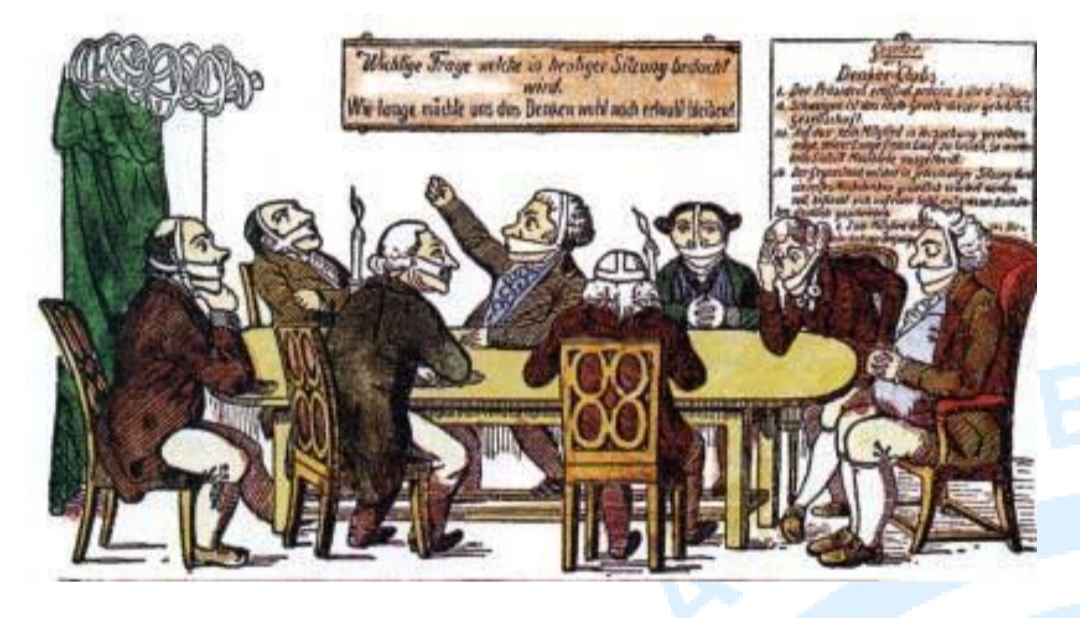
Study the picture and answer the question that follows:
Which of the following option best suited the cartoon?
Silence is the first commandment of this learned society.
To avoid the eventuality whereby a member of this club may succumb to the temptation
of speech, muzzles will be distributed to members upon entering.
Most of them imposed censorship laws to control what was said in newspapers, books,
plays and songs and reflected the ideas of liberty and freedom.
Both A and B
Assertion: Giuseppe Mazzini worked with the conservatives for the monarchy.
Reason: Italy had to continue to be a patchwork of small states and kingdoms.
Both assertion and reason are true and reason is the correct explanation of
assertion.
Both assertion and reason are true but reason is not the correct explanation of
assertion.
Assertion is true but reason is false.
Both assertion and reason are false.
Liberal-nationalist mainly belong to which class?
Elite class
Educated middle-class elite
Working class
Artisans
Who, among the following, hosted the Congress at Vienna in 1815.
King of Netherlands
Giuseppe Mazzini
Duke Metternich
Otto von Bismarck
Who among the following formed the secret society called ‘Young Italy’.
Otto von Bismarck
Giuseppe Mazzini
Metternich
Johann Gottfried Herder
Which one of the following types of government was functioning in France before the revolution of 1789?
Dictatorship
Military
Body of French Citizen
Monarchy
Which one of the following statements is not true about Giuseppe Mazzini?
He wanted a united Italian Republic.
He founded an underground society called ‘Young Italy’.
He wanted Italy to be a monarchy.
He was exiled for attempting a revolution in Liguria.
Who said “when France sneezes the rest of Europe catches cold” ?
Garibaldi
Mazzini
Metternich
Bismarck
Which treaty recognised Greece as an independent nation ?
Treaty of Versailles
Treaty of Vienna
Treaty of Constantinople
Treaty of Lausanne
Elle, the measuring unit in Germany was used to measure
cloth
thread
land
height
Zolleverin started in 1834 in Prussia refers to a
Trade Union
Customs Union
Labour Union
Farmer’s Union
The Ottoman Empire was ruled by the emperor of
Turkey
Russia
Britain
Prussia
Which one of the following is true about the ‘Treaty of Constantinople’ in 1832.
It recognized Turkey as an independent nation.
It recognized Greece as an independent nation.
It recognized Germany as an independent nation.
It recognized France as an independent nation.
What do the saints, angels and Christ represent in the Utopian Vision?
Equality among people
Equality among Nations
Fraternity among Nations
Resentment against Nations
Which of the following powers collectively defeated Napoleon?
Britain, France, Italy, Russia
Britain, Austria, Spain, Russia
Austria, Britain, Russia, Prussia
Britain, Prussia, Russia, Italy
Romanticism refers to
cultural movement
economic movement
political movement
literacy movement
'Nationalism' emerged as a force in the19th century means
a strong devotion for one's country but hatred for others
equal and strong devotion for all the countries
a strong devotion for one's culture with no appreciation for other nations
a strong devotion for one's history and culture
Which of the following countries did not attend the Congress of Vienna?
Britain
Switzerland
Prussia
Austria
The first clear expression of Nationalism in Europe came with :
(a) The American Revolution
(b) The French Revolution
(c) The Russian Revolution
(d) The Industrial Revolution
Nationalism brought about in Europe the emergence of :
(a) The Nation State
(b) The Modern State
(c) Multinational Dynastic State
(d) Alliances formed among many European states
Frederic Sorrieu, a French artist, in his series of four prints (1848) visualised his dream of a world as :
(a) A world made up of ‘democratic and social republics’
(b) A world made up of one nation, one world
(c) A world with one absolute ruler
(d) A world following one religion, one language
The ideas of a United Community enjoying equal rights under a Constitution were expressed by the French as :
(a) La Patrie
(b) Le Citoyen
(c) Both (a) and (b)
(d) None of the above
The Civil Code of 1804, also known as the Napoleonic Code, established :
(a) Equality before the law
(b) Secured the right to property
(c) Did away with all the privileges based on birth
(d) All the above
What did we see in the years after 1919?
We saw nationalist movements spreading to new areas
Non-cooperation movements
Civil disobedience movements
Unification of India
What is the weapon of the weak?
Physical force
Soul force
Passive resistance
Supreme dharma
When was the Foundation of the Hindustan Socialist Republican Army (HSRA) found?
1927
1928
1929
1930
The new tory government in Brittan constituted a statutory commission under?
General Dyer
Sir John Simon
George Bush
None of the above
How many demands were made in in Irwin impact?
9
11
15
10
Through the first world war the prices of the taxes were doubling within ___ years
1913-1918
1913-1915
1914-1916
1913-1916
How did women show their response in civil disobedience movement?
They took part in the protests, marches etc.
They prepared food in bulk and served for the people who participated in the protests
both a and b
none
Which one of the following Viceroys announced a vague offer of dominion status for India in October 1929?
Lord Mount batten
Lord Dalhousie
Lord Irwin
None of these
What was the Inland Emigration Act of 1859 about?
Relaxation towards the plantation workers in Assam
plantation workers were not permitted to leave the tea gardens without permission
free mobility for the plantation workers
workers defied the authorities and left the plantations
Who set up the ‘Oudh Kisan Sabha’?
Alluri Sitaram Raju
Jawahar Lal Nehru and Baba Ramchandra
Jawaharlal Nehru and Mahatma Gandhi
Mahatma Gandhi and Baba Ramchandra
Who announced a dominion status for India and wen?
Sir John Simon, 1929
General Dyer, 1928
Lord Irwin, 1929
Mountbatten 1939
Why did mahatma Gandhi go to Ahmedabad?
to support peasants against revenue collection
to inspire peasants to fight against the oppressive plantation system
to organise a satyagraha movement against cotton mill workers
None of the above
What happened when Abdul Ghaffar Khan, a devout disciple of Mahatma Gandhi, was arrested in April 1930?
there meetings held by the Congress leaders
he was executed
. Agitation started in different places
angry crowds demonstrated in the streets of Peshawar, facing armoured cars and police firing, many were killed
Which of the following agreements gave reserved seats to the ‘Depressed classes’ in provincial and central legislative councils?
Lucknow Pact
Gandhi Irwin Pack
Poona Pact
None of these
Who created the first image of Bharat Mata?
Mahatma Gandhi
Bankim Chandra Chattopadhyay
Rabindranath Tagore
Subhash Chandra Bose
: In which of the following Indian National Congress sessions was the demand of‘ Purna Swaraj’ formalised in December 1929?
Madras Session
Lahore Session
Calcutta Session
Nagpur Session
in which of the following places Mahatma Gandhi organised satyagraha for the first time in India?
Dandi
Ahmedabad
Champaran
Shabarmathi aashram
The Non-cooperation Movement began on which one of the following dates?
January 1921
November 1921
December 1921
May 1921
who among the following was associated with the formation of Swaraj Party within the Congress?
Subhas Chandra Bose
Motilal Nehru
Jawaharlal Nehru
Dadabhai Naoroji
Why had the Congress ignored the dalits for long?
Due to their liberal outlook
Due to fear from the Britishers
For fear of offending the sanatanis
For fear of Dr B.R. Ambedkar
Who was the leader of the Peasant Movements of Awadh?
Baba Ramchandra
Alluri sitaram Raju
Mahatma Gandhi
B.R. Ambedkar
Under which act the Plantations workers of Assam were not permitted to leave the tea garden?
The Rowlatt Act
Cripps Mission
The Inland Migration act
The Inland Emigration act
Name the leaders who founded Swaraj Party?
CR Das and Motilal Nehru
CR Das and Jawaharlal Nehru
CR Das and Subhash Chandra Bose
Motilal Nehru and Gandhiji
At which place did Gandhiji make salt out of sea water.
Dandi
Sabarmati
Ahmedabad
Kheda

Gandhiji, Jawaharlal Nehru and Jinnah
Gandhiji, Jawaharlal Nehru and Maulana Azad
Gandhiji, Jawaharlal Nehru and Muhammed Ali
Gandhiji, Jawaharlal Nehru and Shaukat Ali

Who designed this flag?
Jawaharlal Nehru
Mahatma Gandhi
Bal Gangadhar Tilek
Abanindranath Tagore
In which movement there was large scale participation of women?
Non-Cooperation Movement
Khilafat Movement
Boycott and Swadeshi Movement
Civil Disobedience Movement
Second Round Table Conference was held in December---------------(year)
(a)
In (a) (year) Gandhiji organised a Satyagraha to support the peasants of the Kheda district of Gujarat.
Why was Simon Commission boycotted?
It looked to the functioning of the
Constitutional system in India.
It was headed by Sir John Simon
It will suggest changes in the Constitutional system.
It did not have a single Indian member.
Who published "The folklore of Southern India", a collection of Tamil Folk tales?
Rabindranath Tagore
Abanindranath Tagore
Raja Ravi Varma
Natesha Shastri

Identify (A) the place where Gandhiji organised Satyagraha against oppressive plantation system.
Champaran
Kheda
Ahmedabad
Amritsar
Ambedkar and Gandhiji signed Poona Pact on September (a) (year)
The refusal to deal and associate with people, or participate in activities, or buy and use things; usually a form of protest is known as _________________.
Boycott
Picket
Forced recruitment
Begar
State whether the following statement is True or False.
Gandhiji relaunched the Non-Cooperation Movement
True
False
Why were the Dalits ignored by the Congress for a long time?
Fear of offending the Sanatanis
Fear from industrialists
Fear from Muslim League
Fear from Hindu Mahasabha
In which Congress session the idea of Non-Cooperation programme was adopted?
Calcutta
Nagpur
Madras
Lahore
State whether True Or False
Industrial working class did not participate in the Civil Disobedience Movement in large numbers.
True
False
Which one of the statements is false about Alluri Sitaram Raju?
He claimed he had special powers.
He was inspired by the Non-Cooperation Movement.
He believed in the principle of non-violence advocated by Gandhiji.
He persuaded people to give up drinking.

Who painted this image of Bharat Mata?
Bakim Chandra Chattopadhyay
Rabindranath Tagore
Abanindranath Tagore
Natesha Shastri
Identify (A) the place where Gandhiji organised Satyagraha against oppressive plantation system.
Champaran
Kheda
Ahmedabad
Amritsar
The refusal to deal and associate with people, or participate in activities, or buy and use things; usually a form of protest is known as _________________.
Boycott
Picket
Forced recruitment
Begar
State whether the following statement is True or False.
Gandhiji relaunched the Non-Cooperation Movement
True
False
Why were the Dalits ignored by the Congress for a long time?
Fear of offending the Sanatanis
Fear from industrialists
Fear from Muslim League
Fear from Hindu Mahasabha
In which Congress session the idea of Non-Cooperation programme was adopted?
Calcutta
Nagpur
Madras
Lahore
State whether True Or False
Industrial working class did not participate in the Civil Disobedience Movement in large numbers.
True
False
Which one of the statements is false about Alluri Sitaram Raju?
He claimed he had special powers.
He was inspired by the Non-Cooperation Movement.
He believed in the principle of non-violence advocated by Gandhiji.
He persuaded people to give up drinking.
Who painted this image of Bharat Mata?
Bakim Chandra Chattopadhyay
Rabindranath Tagore
Abanindranath Tagore
Natesha Shastri
Who published "The folklore of Southern India", a collection of Tamil Folk tales?
Rabindranath Tagore
Abanindranath Tagore
Raja Ravi Varma
Natesha Shastri
Why was Simon Commission boycotted?
It looked to the functioning of the
Constitutional system in India.
It was headed by Sir John Simon
It will suggest changes in the Constitutional system.
It did not have a single Indian member.
In (a) (year) Gandhiji organised a Satyagraha to support the peasants of the Kheda district of Gujarat.
Second Round Table Conference was held in December---------------(year)
(a)
In which movement there was large scale participation of women?
Non-Cooperation Movement
Khilafat Movement
Boycott and Swadeshi Movement
Civil Disobedience Movement
Gandhiji, Jawaharlal Nehru and Jinnah
Gandhiji, Jawaharlal Nehru and Maulana Azad
Gandhiji, Jawaharlal Nehru and Muhammed Ali
Gandhiji, Jawaharlal Nehru and Shaukat Ali
At which place did Gandhiji make salt out of sea water.
Dandi
Sabarmati
Ahmedabad
Kheda
Name the leaders who founded Swaraj Party?
CR Das and Motilal Nehru
CR Das and Jawaharlal Nehru
CR Das and Subhash Chandra Bose
Motilal Nehru and Gandhiji
Under which act the Plantations workers of Assam were not permitted to leave the tea garden?
The Rowlatt Act
Cripps Mission
The Inland Migration act
The Inland Emigration act
Who was the leader of the Peasant Movements of Awadh?
Baba Ramchandra
Alluri sitaram Raju
Mahatma Gandhi
B.R. Ambedkar

Why did Gandhiji organise a Satyagraha in Ahmedabad Mill in 1918?
To protest against the poor working condition in the factory.
To demand for a higher wages for workers.
To protest against high revenue demand.
None of the above.

Hind Swaraj' was written by?
Abul Kalam Azad
Mahatma Gandhi
Sardar Patel
Subhas Chandra Bose

In which year did Gandhiji return to India from South Africa?
Jan. 1915
Feb. 1916
Jan. 1916
Feb. 1915

In which city Jallianwala Bagh Tragedy took place?
Amritsar
Lahore
Agra
Meerut

Where was Gandhi's ashram located?
Dandi
Sabarmati
Allahabad
Nagpur
What is Nationalism?
Feeling of leadership
Feeling of unity within the nation.
Feeling of traitship within the nation
non of the above
What do you mean by the term "Swadeshi"
Living in another country.
Country under another rule.
one's own country.
Non of the above
In which year was the Earth Summit held?
1990
1991
1992
1993
"There is enough for everybody's need but not for anybody's greed"
Who said this ?
JL Nehru
AB Vajpayee
MK Gandhi
SL Bahuguna
Which one of the following term is used to identify the old and new alluvial respectively?
Khadas & Tarai
Tarai & Bangar
Bangar & Khadar
Tarai & Dvars
Which one of the following soil is the best for cotton cultivation?
Red soil
Black soil
Laterite soil
Alluvial soil
How much percentage of forest area in the country according to the National Forest Policy?
33%
37%
27%
21%
Coal, iron ore, petroleum, diesel etc. are the examples of
Biotic resources
Abiotic resources
Renewable resources
Non -Renewable resources
On the Basis of ownership resources can be classified into:-
2 Types
3 Types
4 Types
5 Types
Resources which are surveyed and their quality and quantity have been determined for utilisation are :-
Potential resource
Individual resource
Developed resource
Stock
The first international Earth Summit was held in ______.
Geneva
New York
Japan
Rio De Jenario
Regur soil is the other name of ______.
Black Soil
Alluvial Soil
Laterite Soil
Arid Soil
Why is the red soil is red in colour ?
It is rich in humus .
It is rich in iron compounds .
It is derived from volcanic region .
It is rich in potash .
Indian territorial water extends upto a distance of ____.
12 km
12 nautical miles
200 nautical miles
19.2 miles
Area sown more than once in an agricultural year plus net sown area is known as :-
Net sown area
Forest cover
Waste land
Gross cropped area
1. what are the features of the resources?
they have Limited stock
they have alternate uses
They satisfy human wants
all above
Wisely Use of resources and saving them for future generations is called
Economic growth
Saving resources
Sustainable development
Wastage of resources
Biotic resources are
Derived from living things
Made by human beings
derived from nonliving things
Which one of the following is a human made resources
medicine to treat cancer
Spring water
Tropical forest
Resources which are found everywhere are known as
Localised resources
actual resources
Ubiquitous resources
Development of a country can generally be determined by its:
per capita income
average literacy level
health status of its people
none of these
Countries with higher income are _____________ than others with less income.
Less developed
More developed
Less stronger
More organized
Total income of the country divided by its
total population is known as: ‘
Capital Income
National Income
Per capita income
GDP
The kudankulam power project in
Andhra Pradesh
Tamilnadu
Karnataka
Kerala
According to 2012 World Bank reports low income countries per capita income
US $ 12600 above
US $ 1035 or less
US $ 2036 or less
US $ 3036 or less
Literacy rate of punjab in 2011
64%
84%
77%
76%
Life expectancy at birth in India(2013)
65.8
69.2
60.8
75.1
HDI published by
IDBI
CENTRAL GOVERNMENT
UNDP
WHO
People desire______________________better wages and decent price for their crops or other products that they produce
Regular work
Cash reserves
Both A and B
None
The rich countries generally are _________________countries?
Developed
Under developed
Developing
None of above
Percapica income is calculated in
Euros
US Dollers
Rupees
Dinars
The way we live today is influenced by the ____________
Past
Present
Future
None
Right to Education act (RTE) was done in the year
2008
2009
2010
2011
Average income is
Per capica income/Total National Income
Total National Income/Population of the Country
National wealth/ Total population
NNP/GDP
Srilanka is much ahead of __________________ in every respect
Russa
USA
India
None
This is not in the measure of development in Human Development Report
Total Income
Per capica income
Educational level
Health status
it is a materiel thing
Food
Security
Freedom
Discrimination
It is a non-materiel thing
Security
Food
Shelter
Clothing
The Average income is also called _____________income
GNP
GDP
PCI
None
While averages are useful comparison they also hide
Disparities
Similarities
Equalities None
None
In which year was the Earth Summit held?
1990
1991
1992
1993
"There is enough for everybody's need but not for anybody's greed"
Who said this ?
JL Nehru
AB Vajpayee
MK Gandhi
SL Bahuguna
Which one of the following soil is the best for cotton cultivation?
Red soil
Black soil
Laterite soil
Alluvial soil
How much percentage of forest area in the country according to the National Forest Policy?
33%
37%
27%
21%
Coal, iron ore, petroleum, diesel etc. are the examples of
Biotic resources
Abiotic resources
Renewable resources
Non -Renewable resources
On the Basis of ownership resources can be classified into:-
2 Types
3 Types
4 Types
5 Types
Resources which are surveyed and their quality and quantity have been determined for utilisation are :-
Potential resource
Individual resource
Developed resource
Stock
The first international Earth Summit was held in ______.
Geneva
New York
Japan
Rio De Jenario
Regur soil is the other name of ______.
Black Soil
Alluvial Soil
Laterite Soil
Arid Soil
Why is the red soil is red in colour ?
It is rich in humus .
It is rich in iron compounds .
It is derived from volcanic region .
It is rich in potash .
Indian territorial water extends upto a distance of ____.
12 km
12 nautical miles
200 nautical miles
19.2 miles
Area sown more than once in an agricultural year plus net sown area is known as :-
Net sown area
Forest cover
Waste land
Gross cropped area
1. what are the features of the resources?
they have Limited stock
they have alternate uses
They satisfy human wants
all above
Wisely Use of resources and saving them for future generations is called
Economic growth
Saving resources
Sustainable development
Wastage of resources
Biotic resources are
Derived from living things
Made by human beings
derived from nonliving things
Which one of the following is a human made resources
medicine to treat cancer
Spring water
Tropical forest
Resources which are found everywhere are known as
Localised resources
actual resources
Ubiquitous resources
Land that is left without cultivation for one or less than one year
waste land
barren land
uncultivated land
fallow land
Careful use of resources so as to save for the future generation is known as
conservation
preservation
sustainability
availability
Rio De Janeiro Earth Summit was held in __________ year
1998
1992
1991
1994
Arunachal Pradesh has abundance of _________ resources but lacks in __________________
Minerals, water resources
Infrastructure, Wind Energy
Water, Infrastructure
Cultural Heritage, Minerals
"There is enough for everybody's need and for anybody's greed". said by
Mahatma Gandhi
Brundtland
Netaji
Forest area in the country is far lower than the desired 33% of geographical area, as it was outlined in the (a)
Soil also consist of __________ and___________ material
Organic, Inorganic
Potash,
Phosphorous
Khadar, Bangar
How many types of soils are there?
(a)
What are the 3 rivers responsible for formation of Alluvial Soil?
(a)
Which one of the following term is used to identify the old and new alluvial respectively?
Khadas & Tarai
Tarai & Bangar
Bangar & Khadar
Tarai & Dvars
Which one of the following soil is the best for cotton cultivation?
Red soil
Black soil
Laterite soil
Alluvial soil
Resources which are surveyed and their quality and quantity have been determined for utilisation are :-
Potential resource
Individual resource
Developed resource
Stock
Wisely Use of resources and saving them for future generations is called
Economic growth
Saving resources
Sustainable development
Wastage of resources
Which one of the following method is most appropriate to check soil erosion on steep slopes?
Shelter belts
Mulching
Terrace cultivation
Which one of the following is not in favour of the conservation of nature?
Switch off the bulb when not in use
Close the tap immediately after using
Dispose polybags after shopping
What do you mean by resource planning?
What is Stock(in reference to resources)?
Resources found in a region but have not been utilized.
Resources having potential to satisfy our needs but are inaccessible by current technology
Resources which are surveyed and their quantity is detrmined for utilisation
Resources that can be utilized by us and accessible by current technology but are not utilized.
Which of the following comes under "Land not available for cultivation"
Barren and waste land
Permanent pastures and grazing land
Cultruable waste land (left uncultivated for more than 5 agricultural years).
Land put to non-agricultural uses, e.g. buildings, roads, factories, etc
The state of ____________ is very
well endowed with solar and wind energy but
lacks in water resources.
Madhya pradesh
Punjab
Karnataka
Rajasthan
Mountains account for ______ per cent of the total surface area of our country and ensure perennial flow of some
rivers.
30
20
40
10

identify this type of ersosion
sheet erosion
gully erosion
mass erosion
slide erosion
Everything available in our environment
which can be termed as ‘Resource’ if:-
Used to satisfy our needs
It is technologically accessible
Economically feasible and culturally acceptable
All of these

