
 Worksheets
The Moon and Mixed Review
Total questions: 53
Worksheet time: 1hrs 22mins


Which motion causes the constellation Leo to no longer be visible to an observer at 40º N in October?
The universe is approximately 13.8 billion years old. Compared to the age of the solar system, the age of the universe is approximately
the same age as the solar system
2x older than the solar system
3x older than our solar system
4x older than our solar system

A solar eclipse might be observed from Earth when the Moon is at which position?
1
3
5
7

Which phase of the Moon will be observed in New York State when the Moon is at position 8?


On which day of the year does the Sun reach the greatest altitude at solar noon in New York City?
June 21
September 23
April 21
December 21

Which sequence of Moon phases could be observed from Earth during a 2-week period?


Which planet has an orbital eccentricity most like the orbital eccentricity of the Moon?
Saturn
Mars
Mercury
Neptune
Which evidence best supports the theory that the universe began with a massive explosion?
cosmic background radiation in space
parallelism of Earth's axis
radioactive dating of Earth's bedrock
life cycle of stars
Which phase of the moon could be observed from Earth when the moon is at location 4?
Waxing Gibbous
Waxing Crescent
Waning Gibbous
Waning Crescent
Which phase of the moon could be observed from Earth when the moon is at location 7?
Waxing Gibbous
Third Quarter
New Moon
First Quarter

The diagram above represents Earth in space on the rst day of a season. Which season is beginning in New York State on the day represented in the diagram?
Spring
Summer
Fall
Winter

A student in New York State looked toward
the eastern horizon to observe sunrise at three different times during the year. The student drew the following diagram that shows the positions of sunrise, A, B, and C, during this one-year period. Which list correctly pairs the location of sunrise to the time of the year?
A-June 21
B-March 21
C-December 21
A-March 21
B-June 21
C-December 21
A-December 21
B-March 21
C-June 21
A-June 21
B-December 21
C-March 21
Spring ocean tides occur when the difference in height between high tide and low tide is greatest. At which two positions of the Moon will spring tides occur on Earth?
1 and 5
2 and 6
3 and 7
4 and 8

4) What is the approximate latitude and longitude of the sunken ship?
20.5° S , 70° W
20.5° S. 70° E
20.5° N, 70° W
20.5° N, 70° E

7) New York State's highest peak, Mt. Marcy, is located at approximately
74°05' N, 44°05 'W
73° 55' N, 44°10' W
44°10' N, 74°05' W
44°05' N, 73°55' W

9) What is the time in New York City when it is noon in Denver? (The shading represents time zones.)
10 am
noon
2 pm
3 pm

10) Which point on the diagram correctly locates 15° S and 30° W?
Z
Y
X
W
A solar eclipse might be observed from Earth when the Moon is at which position?
1
3
5
7
Which diagram best shows the apparent path of the Sun observed at New York City on March 21?


What is the tilt of Earth's rotational axis relative to a line perpendicular to the plane of Earth's orbit?
15°
23.5°
66.5°
90°

Which moon phase is located at position C?
Full moon
New moon
First quarter
Third quarter
Which moon phase is located at position A?
Full moon
New moon
First quarter
Third quarter

At a location in the Northern Hemisphere, a camera was placed outside at night with the lens pointing straight up. The shutter was left open for four hours, resulting in the star trails shown below.
How many degrees did each star travel?
1°N
30° N
60°N
90°N
Why is the moon visible from Earth?
The moon reflects light from Earth’s surface.
Sunlight that hits the moon is reflected off its surface.
The moon produces its own illumination when heated by the sun.
The moon produces light similar to the sun’s light, but not as strong.
At any moment, the sun shines on how much of the moon?
all of the moon
half of the moon
a quarter of the moon
three-quarters of the moon
What determines how the different moon phases appear from Earth?
sudden changes in the path of the moon’s orbit
the amount of light that the moon receives from the sun
the tilt of Earth’s axis relative to the moon’s position in space
the relative positions of the celestial objects in the Earth-sun-moon system
Evidence that the universe is expanding is best supported by the observation that the wavelengths
of light from distant galaxies are shifted toward the
red end of the spectrum because they are shortened
red end of the spectrum because they are lengthened
blue end of the spectrum because they are shortened
blue end of the spectrum because they are lengthened
Scientists infer that the Big Bang occurred approximately
4.6 billion years ago
7 billion years ago
9 billion years ago
13.8 billion years ago

The diagram below represents some of the inferred stages in the life cycle of stars according to their original mass. The final stage in the life cycle of the most massive stars is a
black hole
black dwarf
supergiant
white dwarf

The diagram below represents a simple geocentric model. Which object is represented by the letter X?
Earth
Sun
Moon
Polaris

The diagram below represents planets A and B, of equal mass, revolving around a star. Compared to planet A, planet B has a
weaker gravitational attraction to the star and a shorter period of revolution
weaker gravitational attraction to the star and a longer period of revolution
stronger gravitational attraction to the star and a shorter period of revolution
stronger gravitational attraction to the star and a longer period of revolution

The diagram below shows a planet's orbit around the Sun.
At which location is the planet's orbital velocity greatest?
A
B
C
D
When the distance between the foci of an ellipse is increased, the eccentricity of the ellipse will
increase
decrease
remain the same

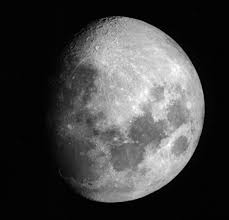
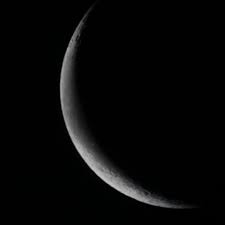
How does the position of the moon affect the tides of the ocean?
its gravitational pull or tidal force affects the tide of the ocean
the light reflected off the moon impacts the tide of the ocean
the moons orbital velocity changes the tides of the oceans.
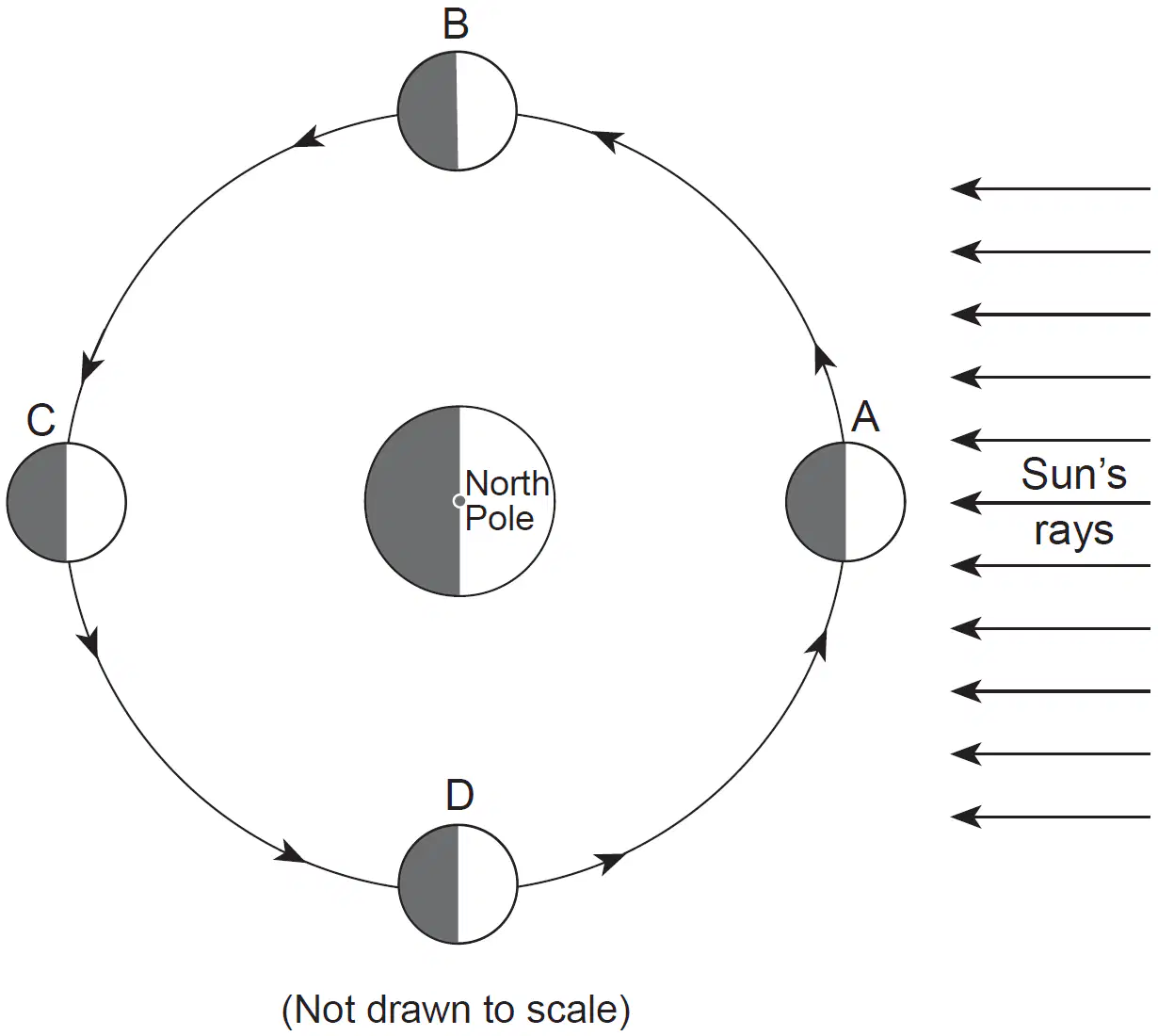
At which two positions can an eclipse occur?
A and B
A and C
A and D
Which moon phase would an observer view a solar eclipse on Earth?
New Moon
First Quarter
Third Quarter
Full Moon
The path of Foucault's Pendulum provides evidence that Earth
has an elliptical orbit
is tilted on its axis
revolves in its orbit
rotates on its axis



