
 Worksheets
savaas chem test review
Total questions: 26
Worksheet time: 16mins
the ways in which electrons are arranged in various orbitals around the nuclei of atoms
noble gas configuration
electron configuration
electron disposition
Bohr model

What is the arrow pointing at ???
subshell, which is represented by the coefficent and variable (1s)
configuration, which is represented by the coefficent and variable (1s)
superscript, which is represented by the coefficent and variable (1s)
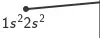
What is the arrow pointing at??
the exponent, which represents the number of electrons in each subshell
the superscript, which represents the number of electrons in each subshell

T OR F??
electrons pair only after each subshell is full??
TRUE
FALSE
TRUE
FALSE
where do electrons occupy first?
highest energy subshells
lowest energy subshells
middest energy subshells
desiree's energy subshells
a quantum mechanical property of electrons that may be thought of as clockwise or counterclockwise orientation
electron configuration
spin
vertical
unstable arrangements tend to ????
become less stable by losing energy
become more stable by losing energy
become more stable by adding energy
T or F
electrons repel each other, which is why it is more stable to have only one electron in each orbital
TRUE
FALSE
TRUE
FALSE
the period, or row, number is the value of the principal energy shell,
(number of orbitals/number of rings around the nucleus)
(a)
T or F
filled energy levels are more stable than partially filled sub-levels, half-filled sublevels are more stable than other configurations
TRUE
FALSE
TRUE
FALSE
in noble gases, the subshells in the valence shell (valence electrons ring) are ??????????
full
empty
half-full
valence electrons determine ?????
desiree's happiness
many atom's physical qualities
many atom's chemical properties
if two elements are in the same group, they have the same number of ?????
orbitals
periodicals
valence electrons
how to find the maximum number of electrons an energy shell can hold
2n^2
2n^2
n-1
n^2-1
T or F
to find the relative atomic mass of an element, you multiply the mass of each isotope by its natural abundance, expressed as a decimal, and then add the products.
EX: (% abundance x mass 1)/100 + (% abudance x mass 2)/100
TRUE
FALSE
TRUE
FALSE
Bohr thought electrons had ????????????? paths
nonexistent
circular
rectangular
when atoms absorb energy, they ????
when atoms lose energy, they ????
absord -> fall to lower energy levels and emit light
absord -> move to higher energy levels and don't emit light
lose -> fall to lower energy levels and emit light
lose -> move to higher energy levels and emit light
T or F??
diffraction grating -> instrument to help reflect light
emission spectrum -> light reflected
TRUe
FALSE
TRUEF
FALSE
why are orbitals spherical? and does the probability of finding an electron at a given distance depend on direction??
orbitals are spherical because i said so
orbitals are spherical because the probability of finding an electron at a given distance does not depend on direction
All shells except the ?????????????? one have three p orbitals, which are dumb-shell shaped and very easy to find electrons in
second
first
third
worst
which orbital order is right ???
1. p
2. s
3. d
4. f
1. d
2. f
3.p
4.s
1.s
2.p
3.d
4.f
WHAT IS LIGHT ??????????????????
electromagnetic radiation
ultraviolet radiation
gamma rays
A: Amplitutde -
λ: Wavelength -
ν: frequency -
A: Amplitutde - frequency
λ: Wavelength - height from base to top
ν: frequency - distance from start to end of wave
A: Amplitutde - height from base to top
λ: Wavelength - frequency
ν: frequency - distance from start to end of wave
A: Amplitutde - height from base to top
λ: Wavelength - distance from start to end of wave
ν: frequency - correspondence to the light we see (up and down lines)
C (wave speed) = ν (frequency) x λ (wavelength)
because ????????? frequency = ?????????????? wavelength
lower frequency = longer wavelength
higher frequency = longer wavelength
higher frequency = shorter wavelength
n=1 represents the lowest energy level, what is that called??
sky state
high state
my state
ground state
describing the probability of finding an electron at various locations around the nucleus ???
desiree
atomic orbital
electronic configuration
quantum mechanical model kind of
(while the atomic orbital describes a region, the quantum mechanical model describes the full 3D plane)

