wayground logo

Free Printable Worksheets

Font size

S
M
L
XL
Worksheets

Congruence (Unit 3)

Total questions: 61

Worksheet time: 2hrs 42mins

Name
Class
Date
1.
Translations, reflections and rotations are all known as ________________________.
a)
Geometry
b)
Transformations
c)
Congruent
2.
When you translate, you ______ a number to x and y.
a)
Add or subtract
b)
Multiply or divide
c)
Add or multiply
d)
Subtract or divide
3.
Write a rule for the translation.
a)
 (x -1, y  + 2)
b)
 (x -2, y  + 1)
c)
 (x +2, y  - 1)
d)
(x +1, y  -  2)
4.
Identify the transformation from ABC to A'B'C'.
a)
90o clockwise rotation
b)
90o counter clockwise rotation
c)
Reflection across the y-axis
d)
Reflection across the x-axis
5.
Point (-5,2) is reflected over the y axis.  Where is the new point located?
a)
(5,2)
b)
(-5,-2)
c)
(-5,2)
d)
(5,-2)
6.
Describe the transformation shown in the graph.
a)
Reflect over x-axis
b)
Reflect over y-axis
c)
Rotate 270 degrees CCW
d)
Rotate 90 degress CCW
7.

Given C(2, 9), under which reflection is C'(2,- 9)?

a)

reflected in the x-axis

b)

reflected in the y-axis

c)

reflected in the line x = 2

d)

reflected in the line y = x

8.
If you were to rotate ABCD 180°  about the origin, what would the coordinate of A' be?
a)
(-5, 5)
b)
(-3, -5)
c)
(-5, 3)
d)
(-3, 3)
9.
The point that is to be transformed is called the:
a)
Pre-Image
b)
Image
c)
Post-Image
d)
Transformation
10.
After being transformed the new point is called a(n):
a)
Pre-Image
b)
Post Image
c)
Transformed
d)
Image
11.
What would the new point be if you rotated the point (3,-5) 270° clockwise?
a)
a.  (-3,-5) 
b)
b.  (-5,-3) 
c)
c.  (5,3)
12.
When you translate, (x-4,y) will move _____.
a)
4 units right
b)
4 units left
c)
4 units up
d)
4 units down
13.

Elijah is drawing the line y=7y=7 This line is drawn in which direction?

a)

Horizontally, @ the point @ the point  y=7y=7  

b)

Vertically, @ the point  y=7y=7  

14.

Which of the following describes the sequence of transformations shown?

a)

Reflect across the x-axis and then rotate -90 degrees around the origin

b)

Rotate -90 degrees around the origin and then translate down.

c)

Reflect across the x-axis and then reflect across the y-axis.

d)

Translate up and then rotate 90 degrees about the origin.

15.

When an image is reflected across the x-axis, which values are changed in the coordinates?

a)

x-values

b)

y-values

16.

Which rule describes the translation?

a)

(a,b)(a6,b2)\left(a,b\right)\rightarrow\left(a-6,b-2\right)

b)

(a,b)(a6,b+2)\left(a,b\right)\rightarrow\left(a-6,b+2\right)

c)

(a,b)(a+6,b+2)\left(a,b\right)\rightarrow\left(a+6,b+2\right)

d)

(a,b)(a+6,b2)\left(a,b\right)\rightarrow\left(a+6,b-2\right)

17.

Which rule describes the reflection?

a)

(a,b)(a,b)\left(a,b\right)\rightarrow\left(-a,b\right)

b)

(a,b)(a,b)\left(a,b\right)\rightarrow\left(a,-b\right)

18.

Which rule describes the reflection?

a)

(a,b)(b,a)\left(a,b\right)\rightarrow\left(b,a\right)

b)

(a,b)(a,b)\left(a,b\right)\rightarrow\left(-a,b\right)

c)

(a,b)(a,b)\left(a,b\right)\rightarrow\left(a,-b\right)

19.

Which rule describes the reflection?

a)

(a,b)(b,a)\left(a,b\right)\rightarrow\left(b,a\right)

b)

(a,b)(a,b)\left(a,b\right)\rightarrow\left(-a,b\right)

c)

(a,b)(a,b)\left(a,b\right)\rightarrow\left(a,-b\right)

20.

How many lines of symmetry does a circle have?

a)

0

b)

1

c)

infinitely many

d)

2

21.

Which of the following shapes does not have a line of symmetry?

a)
b)
c)
d)
22.

How many lines of reflection does this image have?

a)

0

b)

1

c)

2

d)

4

23.

A rectangle has ________ lines of symmetry

a)

one

b)

two

c)

three

d)

four

24.

How many lines of symmetry does this shape have?


This a regular octogon, an 8 sided figure.

a)

2

b)

4

c)

6

d)

8

25.

How many lines of symmetry does the picture have? 


This is an equilateral triangle.

a)

0 lines of symmetry

b)

1 line of symmetry

c)

2 lines of symmetry

d)

3 lines of symmetry

26.
What are the angles of rotation for an octagon?
a)
multiples of 45
b)
multiples of 51.4
c)
multiples of 60
d)
multiples of 72
27.
What are the angles of rotation for a rectangle?
a)
multiples of 45
b)
multiples of 90
c)
multiples of 180
d)
360
28.
What are the angles of rotation for a trapezoid?
a)
multiples of 90
b)
multiples of 180
c)
multiples of 270
d)
360
29.

A transformation that does not change the size or shape of a pre-image (pre-image and image are congruent) is called

a)

isometry

b)

reflections

c)

rotations

d)

dilation

30.
How many lines of symmetry does this shape have?
a)
1
b)
2
c)
4
d)
6
31.
What order of rotation and angle of rotation does the picture have?
a)
order = 0,    360⁰
b)
order = 1,    360⁰
c)
order = 2,    180⁰
d)
order = 3,    120⁰
32.

Determine whether the figure has line symmetry, rotational symmetry, both, or neither.

a)

Rotational

b)

Reflectional

c)

Both

d)

Neither

33.

Which one of these completes the statement:

ΔFHGΔ\Delta FHG\cong\Delta  ___

a)

KML

b)

LKM

c)

MLK

d)

KLM

34.
∆ABC≅∆XYZ
which is true?
a)
AB≅XY
b)
AB≅YX
c)
AB≅XZ
d)
BC≅CB
35.

Given: ΔABCΔDEF\Delta ABC\cong\Delta DEF   Select ALL the true statements.

a)

CE\angle C\cong\angle E  

b)

CADFCA\cong DF  

c)

EB\angle E\cong\angle B  

d)

BCDFBC\cong DF  

e)

AD\angle A\cong\angle D  

36.

Given that ΔPQR ≅ Δ LJK,  PR=2x+6, JL= 10 units,  LK= 3x-6, find the measure of side PQ.  Hint... sketch and label a picture.

a)
12
b)
10
c)
2
d)
30
37.

Solve for xx given ABCMNO∆ABC≅∆MNO , AC=34AC=34 , AB=14xAB=14-x , and MO=3x2MO=3x-2 . Hint.... sketch a picture.

a)

12

b)

-20

c)

4

d)

34

38.

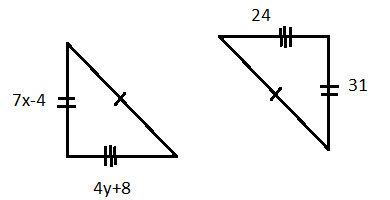
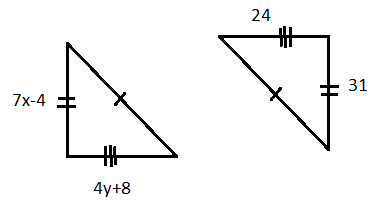
Find y.

a)
2
b)
3
c)
4
d)
5
39.

Find x.

a)
5
b)
4
c)
3
d)
2
40.
State if the two triangles are congruent.  If they are, state how you know.
a)
A
b)
B
c)
C
d)
D
41.
State if the two triangles are congruent.  If they are, state how you know.
a)
A
b)
B
c)
C
d)
D
42.
State if the two triangles are congruent.  If they are, state how you know.
a)
A
b)
B
c)
C
d)
D
43.
State if the two triangles are congruent.  If they are, state how you know.
a)
A
b)
B
c)
C
d)
D
44.
State if the two triangles are congruent.  If they are, state how you know.
a)
A
b)
B
c)
C
d)
D
45.
What additional information is required for the 2 triangles to be congruent by ASA?
a)
A
b)
B
c)
C
d)
D
46.
a)
A
b)
B
c)
C
d)
D
47.
a)
A
b)
B
c)
C
d)
D
48.
What does CPCTC stand for?
a)
Congruent parts of congruent triangles are congruent
b)
Corresponding parts of congruent triangles are congruent
c)
Corresponding parts of corresponding triangles are corresponding
d)
Corresponding parts of congruent triangles are Canadian.
49.
What postulate proves these triangles congruent?
a)
HL
b)
SSS
c)
SAS
d)
ASA
50.

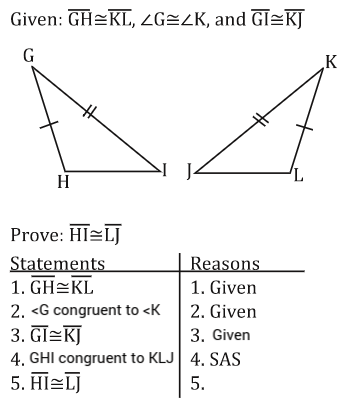
What is the correct choice for Statement 4?

a)

⊿GHI ≅ ⊿JKL

b)

⊿GHI ≅ ⊿KLJ

c)

⊿GHI ≅ ⊿LJK

d)

⊿GHI ≅ ⊿LKJ

51.

What is the correct choice for Reason 5?

a)

SAS

b)

Definition of Congruence

c)

Prove

d)

CPCTC

52.
What are the 2 missing pieces of information?
a)
Transitive Property, SAS(Side-Angle-Side)
b)
Reflexive Property, SAS(Side-Angle-Side)
c)
Transitive Property, SSS(Side-Side-Side)
d)
Reflexive Property, SSS(Side-Side-Side)
53.

What is #4 Statement?

a)

∠MNL ≌ ∠ONP

b)

MN ≌ ON

c)

N ≌ N

d)

MO ≌ OM

54.

Which of the following is NOT enough to prove two triangles are congruent?

a)

SSS

b)

SAS

c)

SSA

d)

ASA

e)

AAS

55.

Match the triangles to the congruence theorem.

a)
1.

SSS

b)
2.

AAS

c)
3.

SAS

d)
4.

ASA

56.

Are the triangles shown congruent?

a)

Yes, by HL

b)

Yes, by SAS

c)

Yes, by SSS

d)

Not enough information

57.

Put the 4 steps of this proof in the correct order.

a)

AB CB, AC\overline{AB}\ \cong\overline{CB},\ \angle A\cong\angle C and DB\overline{DB} bisects ABC\angle ABC by the Given.

b)

ABDCBD\angle ABD\cong\angle CBD by the definition of angle bisector

c)

ΔABDΔCBD\Delta ABD\cong\Delta CBD by ASA

d)

ADCD\overline{AD}\cong\overline{CD} by CPCTC

1)
2)
3)
4)
58.

Which of these are justifications you can use in a proof? Select all that apply.

a)

Given information

b)

Definitions

c)

Appearance

d)

Theorems/Postulates

e)

Properties

59.

In ΔBCD\Delta BCD , what is the included angle of  BC \overline{BC}\  and  CD\overline{CD}  ? 

a)

B\angle B  

b)

C\angle C  

c)

D\angle D  

60.

In  ΔABC\Delta ABC , what side is the included side of angles A and B?  

a)

AB\overline{AB}  

b)

AC\overline{AC}  

c)

BC\overline{BC}  

61.

Based on the given markings, what else would I need to know to prove the triangles congruent by SAS? 

a)

DBCEDB\angle DBC\cong\angle EDB  

b)

CE\angle C\cong\angle E  

c)

BDCEBD\angle BDC\cong\angle EBD