
 Worksheets
Earth Systems Topics 2 & 3 Test Review
Total questions: 35
Worksheet time: 18mins
Name
Class
Date
1.
What is the rock cycle?
a)
A model that illustrates how igneous rocks are formed
b)
A model that illustrates how weathering and erosion change rocks
c)
A model that illustrates how minerals turn into rocks
d)
A model that illustrates how rocks slowly change from one form to another through time
2.
What theory states that continents are slowly moving to their present positions on Earth?
a)
subduction
b)
erosion
c)
continental drift
d)
seafloor spreading
3.
Who is the scientist that suggested that the continents were once joined together at some point in time? He called this supercontinent Pangaea.
a)
Albert Einstein
b)
Alfred Wegener
c)
Steven Hawking
d)
Charles Darwin
4.
Describe types of boundaries
a)
strike, rift valley, and folded mountain boundary
b)
normal fault, mid-ocean ridge, and continental boundary
c)
continental, oceanic plate, and mountain boundary
d)
divergent, convergent, and transform boundary
5.
The most likely cause of volcanic activity on the island of iceland is ______________?
a)
the strength of the Atlantic Ocean's currents
b)
the pulling apart of the tectonic plates due to a divergent boundary
c)
the colliding of the tectonic plates due to a convergent boundary
d)
the cooling of the Earth's core leading to the sudden stop of convection currents in the mantle
6.
Which is the Earth's thinnest layer?
a)
crust
b)
mantle
c)
inner core
d)
outer core
7.
Heat in the mantle and the core cause ________________ which helps to cycle material on Earth.
a)
convection currents
b)
counter currents
c)
convergent currents
d)
volcanoes
8.
Evidence of continental drift includes:
a)
The same fossils being on two different continents
b)
Landforms that appear to be on two different continents
c)
The same waters being on two continents
d)
The same rocks being on two continents
e)
The same weather appearing on two different continents
9.
This type of continental drift evidence explains why palm tree fossils have been found in very cold regions of the Earth where they don't currently grow
a)
fossil evidence
b)
landform/rock evidence
c)
climate evidence
d)
photosynthesis evidence
10.
Originally, the continental drift theory was not well received by other scientists. Why?
a)
There was another theory that was more believable
b)
There was no evidence that the continents were moving
c)
There was no explanation for how the continents were moving
d)
Scientists thought Alfred Wegener's data was unreliable
11.
Which layer of the Earth is solid and made of Iron and Nickel?
a)
crust
b)
mantle
c)
outer core
d)
inner core
12.
Which layer is made up of two different kinds of layers: oceanic and continental?
a)
crust
b)
mantle
c)
outer core
d)
inner core
13.
The youngest rocks on the ocean floor are located ______________.
a)
near the continents
b)
at mid-ocean ridges
c)
far from ocean ridges
d)
near Asia
14.
Seafloor spreading occurs because of _______________.
a)
earthquakes
b)
sediments building up on the ocean floor
c)
magma forces its way to the surface and moves the ocean floor apart at a mid-ocean ridge creating a new seafloor
d)
volcanoes spitting out magma, which turns to lava and settles on the seafloor and hardens
15.
The correct order of the layers of the Earth going from the center of the Earth to the outermost layer are:
a)
crust, mantle, outer core, inner core
b)
inner core, outer core, mantle, crust
c)
outer core, inner core, crust, mantle
d)
mantle, crust, inner core, outer core
16.
Plates move apart at _____________ boundaries.
a)
convergent
b)
transform
c)
divergent
d)
subduction zone
17.
Plates slide past one another at _______________ boundaries.
a)
convergent
b)
transform
c)
divergent
d)
subduction zone
18.
The boundary between two plates moving toward one another is called a ______________ .
a)
divergent boundary
b)
convergent boundary
c)
transform boundary
d)
convection currents
19.
_________________ are formed when two continental plates collide.
a)
volcanoes
b)
transform boundaries
c)
mountains
d)
rift valleys
20.
The ________________ is an example of a transform boundary.
a)
Appalachian Mountains
b)
Himalayan Mountains
c)
Mid-Ocean Ridge
d)
San Andreas Fault
21.
A ________________ forms where two oceanic plates collide.
a)
hot spot
b)
volcano
c)
transform boundary
d)
mid-ocean ridge
22.
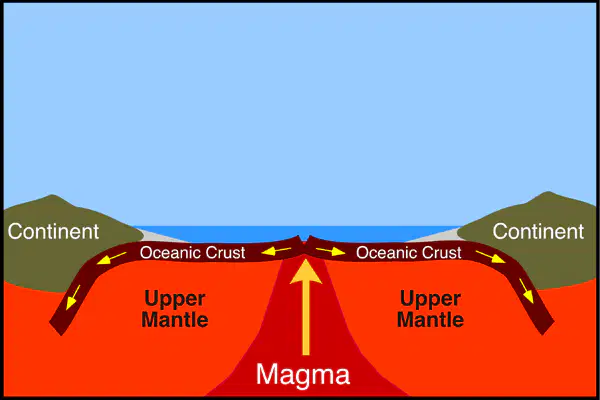
What type of landforms are formed in the type of divergent boundary shown?
a)
valley
b)
mid-ocean ridge
c)
volcano
d)
mountain
23.
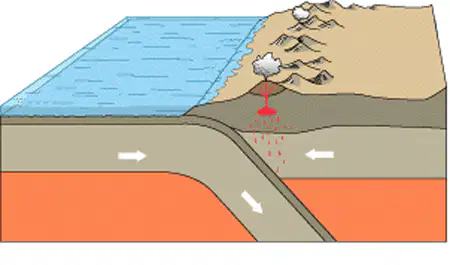
What type of boundary is shown in the following picture?
a)
transform
b)
divergent
c)
convergent
d)
continental crust
24.
The San Andreas Fault is a ____________________ boundary.
a)
divergent
b)
convergent
c)
ocean to ocean boundary
d)
transform
25.
Which process acts on Earth's surface to break rock into pieces?
a)
compaction
b)
deposition
c)
erosion
d)
weathering
26.
Which evidence supports Wegener's hypothesis? Choose the three that apply.
a)
evidence of similar fossils in different locations
b)
evidence of similar coal deposits in different locations
c)
evidence of tropical plants in locations that are now cold
d)
evidence from scientists looking at the animals now living in those locations
e)
evidence from drilling deep beneath Earth's surface to find fossils in all of Earth's layers
27.
The presence of the same ____________________ on several continents supports the hypothesis of continental drift.
a)
fossils
b)
rocks
c)
neither a or b
d)
both a and b
28.
What is a step in the process of a rock changing from sedimentary to igneous?
a)
crystallization
b)
deposition
c)
erosion
d)
melting
29.
Which of the following leads most directly to the production of igneous rock?
a)
formation of magma
b)
cementation of rocks
c)
weathering of rocks
d)
deposition of sediment
30.
Read each word or phrase that describes different types of crust. Choose the four that describe oceanic crust.
a)
underwater
b)
bottom of the ocean
c)
dense
d)
made of mostly basalt
e)
less dense
31.
Metamorphic rocks can undergo all of the following changes except __________________.
a)
a change in structure
b)
melting
c)
the formation of new characteristics in the rock due to intense heat
d)
the flattening of mineral grains that result in bands in the rock due to pressure
32.
Currents that are found in the mantle and cause the tectonic plates to move are called ____________________.
a)
ocean currents
b)
convection currents
c)
atmospheric currents
d)
magma currents
33.
Evidence that supports the hypothesis of continental drift included fossils, land features, and _______________.
a)
ocean currents
b)
solar activity
c)
climate clues
d)
presence of bacteria
34.
Minerals must have the following criteria: solid, naturally occuring, inorganic, fixed chemical formula, and orderly arrangement of atoms (crystals)
a)
True
b)
False
35.
Name the Earth's thickest layer.
a)
crust
b)
mantle
c)
outer core
d)
inner core
100 %

