
 Worksheets
Philosophy 1st Quarter
Total questions: 61
Worksheet time: 31mins
the word “philosophy” comes from two Greek words, philo meaning
“_____” and sophia , meaning “_____”
To love and wisdom
knowledge and intelligence
Theories and Ideas
To acknowledge and Responsibilities
philosophers uses his natural capacity
to think or simply, human reason alone or the so-called unaided reason
Natural Light of Reason
Science
Study of all things
sets the distinction between philosophy from
other sciences. A philosopher studies human beings, society, religion,
language, God and plants. The reason is that philosophy is not one
dimensional or partial. In short, he questions almost anything, if not
everything. It is multidimensional or holistic.
Natural Light of Reason
Science
Study of all things
everything is its own being, and
not being is not being.
Principle of Identity
Principle of Non- Contradiction-
Principle of Excluded Middle
Principle of Sufficient Reason
it is impossible for a thing to be and not be at the same time and at the same respect.
Principle of Identity
Principle of Non- Contradiction-
Principle of Excluded Middle
Principle of Sufficient Reason
a thing is either is or is not; everything must be either be or not be; between
being and not-being, there is no middle ground possible.
Principle of Identity
Principle of Non- Contradiction-
Principle of Excluded Middle
Principle of Sufficient Reason
nothing exist without a
sufficient reasons for its being and existence.
Principle of Identity
Principle of Non- Contradiction-
Principle of Excluded Middle
Principle of Sufficient Reason
means “after physics”. The only extension of fundamental and necessary drive in every
human being to know what is real. To understand the world in terms of appearance and reality, we
try to make things comprehensible by simplifying or reducing
the mass of things we call appearance to a relatively fewer
number of things we call reality.
Metaphysics
Ethics
Epistemology
Logic
derived from the Greek term epistēmē, meaning “knowledge”. It deals with nature, sources, limitations and validity of knowledge. How we know what we claim to know; How can we find out what we wish to know; and How we can differentiate truth from falsehood.
Metaphysics
Ethics
Epistemology
Logic
logic comes from the Greek word logike and was coined by Zeno, the Stoic. Etymologically, it means a treatise on matters pertaining to the human thought. Reasoning is the concern of logician
Metaphysics
Ethics
Epistemology
Logic
derived from the Greek term aisthetikos, meaning “sensitive”. It is the science of the beautiful in its various manifestations including the sublime, comic, tragic, pathetic and ugly. it vitalizes our knowledge (makes our knowledge of the world alive and useful), it helps us to live more deeply and richly (it is not something merely like craft of applied arts but something of weight and significance to humankind) and it bring us in touch with our culture (the answer of great minds in the past to these problems are part of our culture)
Metaphysics
Aesthetics
Epistemology
Logic
The first Greek philosopher, often regarded as the Father of Philosophy, was a thinker who sought to understand the natural world and various phenomena without relying on supernatural explanations and divine components.
Thales
Heraclitus
Anaximander
Anaximenes
Wondered about the beginning of the universe and where it came from. Claimed that the universe was formed from boundless.
Thales
Heraclitus
Anaximander
Anaximenes
Argued that air was the fundamental element through process of refraction or compression
Thales
Heraclitus
Anaximander
Anaximenes
Claimed the Unity of Opposite.
"No man cannot step on the same river twice."
Thales
Heraclitus
Anaximander
Anaximenes
Claimed that there is a single God. He did not agree with the idea of anthropomorphic God.
Xenophanes
Pythagoras
Anaximander
Anaximenes
Cosmos is a structured system ordered by numbers. Nature can be quantified.
Xenophanes
Pythagoras
Anaximander
Anaximenes
He made contributions to the field of ethics, particularly in formulating the Socratic Method, also known as Elenchus. This method involves examining a topic by devising a series of questions that lead the learner to examine and analyze their knowledge and views about the topic.
Socrates
Plato
Aristotle
A student of Socrates, his lasting contribution to learning was his founding of the Academy, an institution of higher learning that was the first of its kind in the West. He believed that knowledge through concepts is the only true knowledge, emphasizing that concepts or ideas are the only true reality. One of his famous works is "The Republic," in which he explores these philosophical ideas and discusses how the senses are often deceitful.
Socrates
Plato
Aristotle
A student of Plato, this philosopher was involved in a variety of disciplines, including zoology, psychology, ethics, and politics. His studies in logic led to the formulation of a process of analysis that gave rise to deductive reasoning. He believed that perceptual and cognitive faculties are dependable and that human beings philosophize because they wonder about the world.
Socrates
Plato
Aristotle
Philosophical Reflection is a tool in doing philosophy which the act of giving time to think about
meaning and purpose of life.
True
False
one's perception is limited by other factors or based
on a single factor. (ex: My brother told me that his girlfriend is kind and
beautiful yet it is different from my opinion so I told him that his just in
love.)
Partial Point of View
Holistical Point of View
view-having a view where we understand both the whole
and the parts of something, and, we understand how the parts, when brought
together, make up the whole. (ex: As a teacher it is important to know the
personal background of my whole class rather than some of the class.)
Partial Point of View
Holistical Point of View
A provable statement is something that is known to have happened or to exist. Something for which proof exists.
Fact
Opinion
Expresses
personal belief,
ideas or feelings
that is not
provable.
Fact
Opinion
Truth is _______ to a fact.
Truth consist in a relation to reality.
Correspondence
Coherence
Pragmatic
The truth of a belief on the degree to which it
coheres or “hang together” with all other beliefs. This is when one JUSTIFIES another
Correspondence
Coherence
Pragmatic
The truth of the statement can be define in terms of utility of accepting it. this is when someone or a belief helps them throughout their everyday life or benefits them.
Correspondence
Coherence
Pragmatic
Analysis based from facts, measurable and observable. One does not influenced by emotion, opinion or personal feelings. Based on facts, in things quantifiable and measurable.
Objective
Subjective
Fallacy
Based on personal opinions, interpretations, points of view, emotion, and judgment, one remains open to greater interpretation based on personal feelings, emotion, and aesthetics.
Objective
Subjective
Fallacy
Defect in an argument other than it’s having false premises. Required to examine the argument’s content.
Objective
Subjective
Fallacy
A specific kind of appeal to emotion is when someone attempts to gain support for an argument or idea by exploiting their opponent's feelings of pity or guilt.
Appeal to Pity
Appeal To Ignorance
Equivocation
Composition
The principle that whatever has not been proved false must be true, and vice versa.
Appeal to Pity
Appeal To Ignorance
Equivocation
Composition
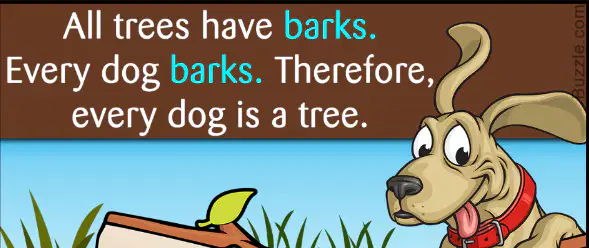
A logical chain of reasoning involves repeating a term or a word several times while assigning a different meaning to the particular word each time.
Appeal to Pity
Appeal To Ignorance
Equivocation
Composition
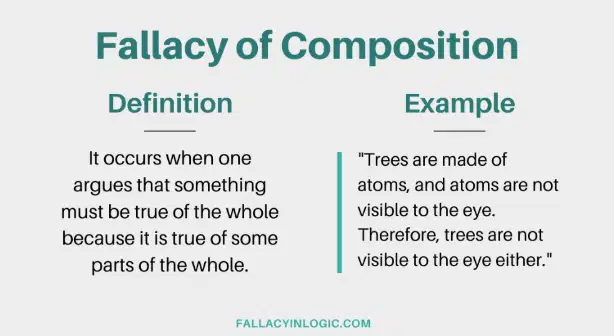
infers that something is true of the whole from the fact that it is true some part of the whole.
Division
Against the Person
Appeal to Force
Composition
One reasons logically that something true of a thing must also be true of all or some of its parts.
Division
Against the Person
Appeal to Force
Composition
Linking the validity of a premise to a characteristic or belief of the person advocating the premise.
FALSE CAUSE (POST HOC)
Against the Person
(ARGUMENTATUM AD HOMINEM)
Appeal to Force
Composition
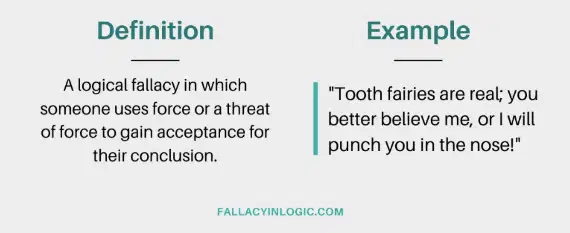
An argument where force, coercion, or the threat of force is provided as a justification for a conclusion.
FALSE CAUSE (POST HOC)
Against the Person
(ARGUMENTATUM AD HOMINEM)
Appeal to Force
Composition
An argument that appeals to or exploits people's vanities, desire for esteem, and anchoring on popularity.
FALSE CAUSE (POST HOC)
Appeal To People (ARGUMENTATUM AD POPULUM)
Appeal to Force
Hasty Generalization
One commits errors if one reaches an inductive generalization based on insufficient evidence.
FALSE CAUSE (POST HOC)
Appeal To People (ARGUMENTATUM AD POPULUM)
Appeal to Force
Hasty Generalization
Since that event followed this one, that event must have been caused by this one.
FALSE CAUSE (POST HOC)
Appeal To People (ARGUMENTATUM AD POPULUM)
Appeal to Force
Hasty Generalization
A type of fallacy in which the proposition to be proven is assumed implicitly or explicitly in the premise is known as "___________" or "circular reasoning."
FALSE CAUSE (POST HOC)
Appeal To People (ARGUMENTATUM AD POPULUM)
Begging The Question
Hasty Generalization
- The body and spirit are distinguishing his/her limitations and the possibilities of his/ her transcendence.
Human Embodiment Spirit
Limitation of a Human
Spatial Temporal Beings
The Body as Intermediary
- _________ enables us to do and experience all the things that make us human persons The Human Person as an Embodied Spirit Human existence is embodied existence.
Human Embodiment Spirit
Limitation of a Human
Embodiment
The Body as Intermediary
refers to the things in our life that are already given. refers to all details that surround us in the present: our environment, our language, our past decisions, our past and present relationships and even our future deaths.
Human Embodiment Spirit
Facticity
Spatial Temporal Beings
The Body as Intermediary
- our most obvious limitation is our finitude–our finite quality or state.- as spatial beings, we are limited by our bodies to be present in two or more places at the same time. - We are limited by space and time.
- This sets our preconditions of understanding
Human Embodiment Spirit
Facticity
Spatial Temporal Beings
The Body as Intermediary
Our body serves as an intermediary between us and the physical world. Our body limits our experience of the world to our world. This imposes limitations concerning communication and expression.
Human Embodiment Spirit
Facticity
Spatial Temporal Beings
The Body as Intermediary
is the ability to change, be dynamic, and continually redefining one’s self which
works with our facticity to create change.
Transcendence
Facticity
Spatial Temporal Beings
The Body as Intermediary
one of the oldest Eastern traditions, which has been practiced by hundreds of millions of people for about 5000 years. This Religion believes in a formless, changeless, infinite, eternal, and genderless concept of Brahman, beyond space and time, and at its core, it emphasizes the human quest for absolute truth. The soul is seen as eternal but bound by the law of Karma and subject to reincarnation until spiritual progress is achieved.
Hinduism
Buddhism
ST. AUGUSTINE & ST. AQUINAS
In this Religion, humanity is expected to do good and refrain from evil. Innocence of heart and purity are believed to be attainable only through the grace of God. To maintain and live daily with purity of heart, mind, and body, individuals are encouraged to engage in practices like prayer, modesty, fasting, and other measures that the Church recommends, or that God provides as a means of achieving this spiritual purity.
Hinduism
Buddhism
ST. AUGUSTINE & ST. AQUINAS
an Eastern tradition rooted in the teachings of its founder, Siddharta Gautama, also known as the Buddha. Gautama's journey began with a quest to find answers to the riddles of life's sufferings, disease, old age, and death. While meditating under a tree, he attained Enlightenment, realizing that the solution lay within his own mind. His life was then dedicated to sharing his Dharma, the Law of Salvation. The teachings of this religion are traditionally encapsulated in the Four Noble Truths, which lead to the Eightfold Path. Following this path provides assurance of entering Nirvana, a state of liberation, at death.
Hinduism
Buddhism
ST. AUGUSTINE & ST. AQUINAS
_________ is a human-centered point of view. In this worldview, humans are regarded as the sole or primary bearers of moral standing, and nature is predominantly seen in terms of its value to humanity. _______ underscores the belief that humans are the most significant and valuable entities in the Universe.
ANTHROPOCENTRISM
Humanism
Ecofeminism
Pathocentrism
________ is a progressive philosophy of life that affirms the ability and responsibility of individuals to lead ethical lives and seek personal fulfillment without relying on theism or supernatural beliefs. Organizations like the American Humanist Association and publications like The Humanist Magazine promote this worldview.
ANTHROPOCENTRISM
Humanism
Ecofeminism
Pathocentrism
- A philosophical position regarding the difference or similarities in the reaction to pain in humans and animals.
ANTHROPOCENTRISM
Humanism
Biocentrism
Pathocentrism
All living organisms, not just humans, are deserving of equal and moral and ethical consideration.
The belief that the rights and needs of humans are not more important than those of other living things.
ANTHROPOCENTRISM
Humanism
Biocentrism
Pathocentrism
places ecology at the core of the Earth's significance and promotes a value system based on nature. It recognizes the unique abilities of humans to care for other species on Earth while emphasizing the intrinsic value of all entities within the natural world
Ecocentrism
Holism
Biocentrism
Pathocentrism
____ comes from the Greek word "holos" meaning "all" or "total."
- The idea that all the properties of a given system cannot be determined or explained by its component parts alone, but the system as a whole determines in an important way how the parts behave.
Ecocentrism
Holism
Biocentrism
Pathocentrism
The controlling attitude of humankind
is extended to nature, when in fact,
humanity is part of nature.
Deep Ecology
Social Ecology
Ecofeminism
- Destroying nature is a reflection wherein few people overpower others while exploiting the environment for profit or self-interest.
Deep Ecology
Social Ecology
Ecofeminism
- This theory argues that ecological crisis is a consequence of male dominance.
- In this view, whatever is “superior” is entitled to whatever is “inferior”.
Deep Ecology
Social Ecology
Ecofeminism
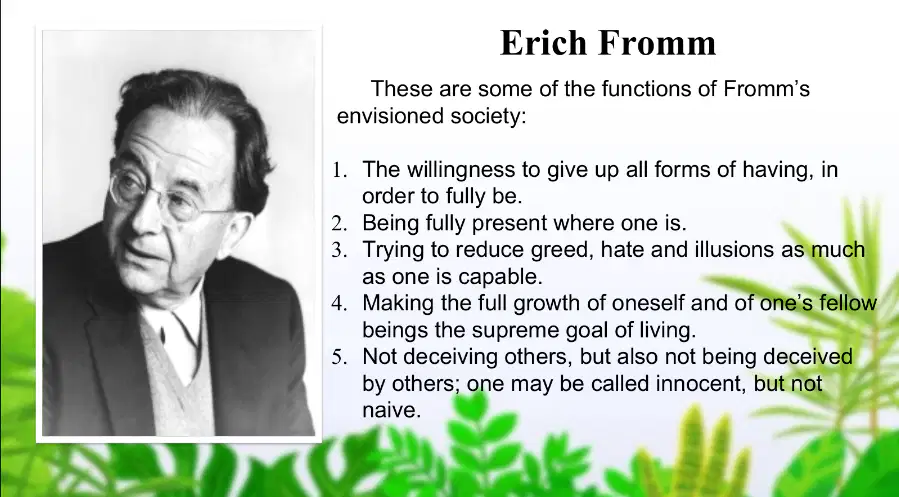
6. Freedom that is not arbitrariness but the possibility to be oneself, not as a bundle of greedy
desires, but as a delicately balanced structure.
7. Happiness in the process of ever-growing aliveness.
8. Joy that comes from giving and sharing, not from hoarding and exploiting.
9. Developing one’s capacity for love, together with one’s capacity for critical, unsentimental thought.
10. Shedding one’s narcissism and accepting that tragic limitations inherent in human existence.
BONUS ANSWER AND KNOWLEDGE: ERICH FROMM
Erich Fromm
Philosophy, love of wisdom!
Goodluck Next Round

