Worksheets
Atoms and nuclear practice
Total questions: 33
Worksheet time: 43mins
J.J. Thomson is credited with the discovery of the first subatomic particle, the electron. To make his discovery, Thomson conducted several experiments with cathode ray tubes and analyzed the bright beam that went across the tube. Which of the following is not an accurate conclusion that Thomson drew from his experiment?
The beam was made of particles because it was bent by a simple magnet
The beam was negatively charge since it was attracted to a positive charged.
The beam was much smaller than hydrogen based on the mass to charge ratio.
The beam was emitted from the nucleus of atoms because light was given off.
Which scientist was the first to conclude through experimentation that the positve charge in an atom is concentrated in the middle and the rest of the atom is mostly empty?
Bohr
Dalton
Mosely
Rutherford
Who determined the amount of charge on an electron with his oil drop experiment?
(a)
Bohr hypothesized that electrons are located in
the nucleus
inside protons
electron cloud
circular orbits around the nucleus

Developed an atomic theory of matter.
Chadwick
Millikan
Rutherford
Dalton


Complete the following equation:
146C --> 0-1e + ________
In the symbol 167N what the 7 stand for?
Mass number
Atomic number
Atomic mass
Number of neutrons
Carbon has 3 isotopes, C-12, C-13, and C-14. it has an average a tomic mass of 12.011 amu Which isotope is the most abundant?
They all are equal
The half-life of a radioactive isotope is 20.0 minutes. What is the total amount of a 1.00-gram sample of this isotope remaining after 1.00 hour?
0.500g
0.333g
0.250g
0.125g

What type of decay occurs in all isotopes whose neutron:proton ratio is too low (not enough neutrons)?
alpha
beta
gamma
positron emission
What type of decay occurs in nuclides whose neutron:proton ratio is too high (too many neutrons)?
alpha
beta
gamma
positron emission
What type of decay is just energy and not particles?
alpha
beta
gamma
positron emission

This is a symbol for what type of particle?
alpha particle
beta particle
gamma ray
positron

This is a symbol for what type of particle?
alpha particle
beta particle
gamma ray
positron

What kind of decay would neon-25 most likely go through?
alpha decay
beta decay
positron emission or electron capture
It would be stable and would not decay.
What kind of decay would uranium-235 most likely go through?
alpha decay
beta decay
positron emission or electron capture
It would be stable and would not decay.
What kind of decay would nitrogen-14 most likely go through?
alpha decay
beta decay
positron emission or electron capture
It would be stable and would not decay.
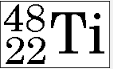
What is the average mass of this element?