
 Worksheets
Science 6_1Q Examination Review
Total questions: 25
Worksheet time: 25mins
Places where the plates meet are called ______.
plates
fault
plate boundaries
Pangaea
Some scientists believe that at one time, earth could have been a single land mass called _____.
plates
fault
plate boundaries
Pangaea
They are breaks in the earth's surface along which rock can move.
plates
fault
plate boundaries
Pangaea
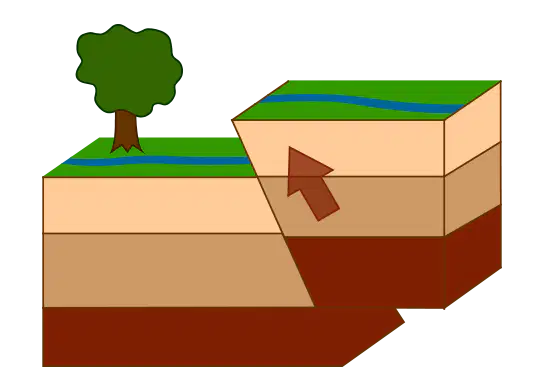
Identify which kind of fault is shown in the image.
rocks moving toward each other
normal fault
reverse fault
strike-slip fault
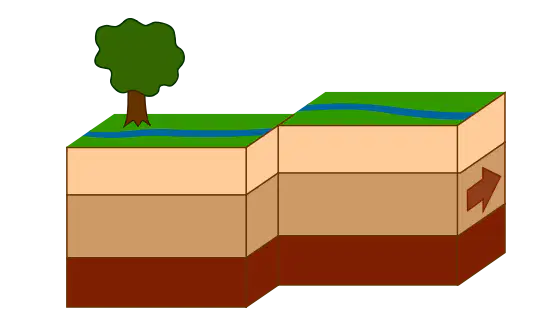
Identify which kind of fault is shown in the image.
rocks moving horizontally
normal fault
reverse fault
strike-slip fault
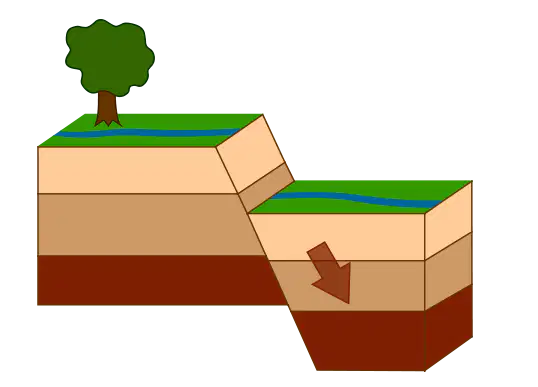
Identify which kind of fault is shown in the image.
rocks moving apart
normal fault
reverse fault
strike-slip fault
How is P wave different from S wave?
S waves moves faster than the P wave, as it moves up and down
P wave is the fastest moving body wave. It travels in a straight path and zig zag pattern
S wave moves more slowly than the P wave. It moves in an up and down, zigzag pattern
It is the fastest moving surface waves. It moves in a side-to-side zigzag pattern
P-wave
S-wave
Love wave
Rayleigh wave
It moves slowly the P wave and in an up-and-down zigzag pattern.
P-wave
S-wave
Love wave
Rayleigh wave
It moves in a rolling motion like ocean waves.
P-wave
S-wave
Love wave
Rayleigh wave
It is the fastest moving body wave. It travels in a straight path by a push-and-pull motion.
P-wave
S-wave
Love wave
Rayleigh wave
They are the beautiful formations in caverns, form as the dissolved calcite is deposited out of the water
Speleothems
Stalactites
Stalagmites
Spelunkers
They hang from the ceiling and look like stone icicles.
Speleothems
Stalactites
Stalagmites
Spelunkers
They grow up from the ground as a result of the dripping dissolved calcite.
Speleothems
Stalactites
Stalagmites
Spelunkers
Leaf litter and humus compose this top layer of soil called ______.
A horizon or topsoil
B horizon
C horizon
O horizon
This horizon consists mainly of larger weathered fragments of the bedrock. It contains clay and sand particles but very little organic materials
A horizon or topsoil
B horizon
C horizon
O horizon
To which category of weathering does abrasion belong?
chemical weathering
mechanical weathering
To which category of weathering does acid rain belong?
chemical weathering
mechanical weathering
To which category of weathering does acid rain belong?
chemical weathering
mechanical weathering
To which category of weathering does exfoliation belong?
chemical weathering
mechanical weathering
Geothermal energy uses steam to turn turbines to produce electricity.
True
False
Hydroelectric energy uses windmills to control the flow of water.
Yes
No
Is natural gas renewable or nonrenewable?
Nonrenewable resource
Renewable resource
Is geothermal energy renewable or nonrenewable?
Nonrenewable resource
Renewable resource
Is nuclear energy renewable or nonrenewable?
Nonrenewable resource
Renewable resource

