
 Worksheets
Unit 3 Practice
Total questions: 113
Worksheet time: 1hrs 26mins
What are the two types of broadcast radio?
AM and FM
AM and PM
FM and PM
AM and EM
Why do AM radio waves travel further at night?
Because the ionosphere disappears at night
Because FM radio waves bounce off the ionosphere at night
Because the sun gives off more radiation at night
Because the wavelength of AM radio waves is longer
Why can FM radio only be picked up within line-of-sight of the broadcast tower?
Because FM radio waves are absorbed by the ionosphere
Because FM radio waves are too short to travel long distances
Because FM radio waves are blocked by buildings and obstacles
Because FM radio waves are only transmitted during the day
What is the main advantage of FM radio over AM radio?
Higher quality transmission
Longer range
Lower frequency
Better nighttime broadcasting
What is the main disadvantage of AM radio in terms of signal reception?
AM radio is more susceptible to interference
AM radio has a shorter range
AM radio has a lower frequency
AM radio has a narrower bandwidth
What is the primary factor that determines the range of an FM radio station?
The height of the broadcast tower
The frequency of the station
The power of the transmitter
The location of the listener

Which type of electromagnetic radiation has the shortest wavelength?
Radio Waves
Visible Light
Microwaves
Gamma Rays
Which type of electromagnetic radiation has the shortest wavelength?
Radio Waves
Visible Light
Microwaves
Gamma Rays

Which type of visible light has the highest energy?
Red
Yellow
Green
Violet

Which type of radiation has a frequency closest to 105?
Radio
Infrared
Ultraviolet
X-Ray

Which type of electromagnetic radiation has a wavelength near 10-8?
Microwave
Infrared
Visible
Ultraviolet

Which of the following types of radiation has the shortest wavelength and the highest frequency?
Radio Waves
Infrared
Visible
X-Rays

Which of the following types of electromagnetic radiation has a wavelength near 10-5?
Radio
Microwave
Infrared
Visible

What wavelength of light can the human eye perceive?
103
10-6
10-10
1013

Which type of radio wave has a larger wavelength?
FM
AM
A __________ is a piece of information that is communicated through using the senses.
wave
signal
circuit
notification
This is wireless method of sending information uses radio waves
analog
WiFi
landline
GPS
The use of light and cables to transfer electric signals over long distances
WiFi
GPS
fiber optics
landline
To translate information into the form of code
transmit
encode
signal
encrypt
The passing on, or transfer, of information
transmit
encode
signal
encrypt

Change continuously over time; represented by a continuous smooth curve; can be a range of values
analog signals
digital signals
wireless signals
electric signals

Is discrete and not continuous; represented by two values - either on or off
analog signals
digital signals
wireless signals
electric signals
A signal to or from a computer is encoded into _________________, such as the two values - on (1) or off (0).
analog signal
digital signal
binary numbers
electricity
A single unit of information in quantitative or qualitative form
signal
encryption
data
wave
the unwanted modification of a signal
encryption
noise
analog
modulation

a signal whose frequency is modulated
FM
AM
PM
IM

a signal whose amplitude is modulated
FM
AM
PM
IM
Analog encoding sends or stores information using quantities that
can vary continuously.
can only have specific values.
are separated by consistent numbers.
store waves’ crest and trough sizes in small steps.
Digital encoding sends or stores information using quantities that
can vary continuously.
can only have specific values.
have no numeric gaps between one another.
create smooth curves inside a sound wave.
Which of the following is NOT an analog device?
a light knob that can adjust brightness between fully on and off
a mouse connected to your computer controlling your cursor
an FM radio tower broadcasting music
a runner’s watch that can time to thousandth-second intervals
Which of the following is an advantage of digital over analog?
Digital controls allow you more control over exact movement and direction.
Digital calculations give you more accurate measurements.
Digital controls move objects in predictable, exact increments.
Digital devices generate stronger, more precise signals and waves.
A signal is
a radio wave with an unchanging amplitude and frequency.
a radio wave with an unlimited range.
a wave that can only be generated in analog.
anything that carries information and can be detected.
AM and FM radio stations
switch between analog and digital signals to broadcast sound waves.
transmit sound using multiple frequency ranges, including radio waves, visible light, and ultraviolet light.
change the amplitude or frequency of waves to encode sounds.
convert broadcasts into binary code.

Why is the weak analog signal harder to hear?
The weak signal’s sound and clarity decrease corresponding to its amplitude.
Radios have trouble distinguishing between weak signals and random noise.
Increased distance causes wavelengths and frequencies to change.
Radios have trouble connecting with lower-energy waves.
Radio noise is
unwanted, random signals interfering with the intended signal.
a natural result of waves decreasing in energy and amplitude over long distances.
caused by radio receivers being unable to interpret waves with low amplitudes.
intentionally added to radio waves.
If your analog radio is NOT producing static,
your radio receiver has successfully filtered out other signals at other amplitudes.
you are in an area where radio noise is not present.
the radio noise has a different frequency, so you can only hear it on other radio stations.
interfering radio noise is still present, but drowned out by a strong radio signal.
Binary digital signals differ from analog signals because
their amplitude values stay the same no matter the distance.
digital encoding smooths out radio waves from their original sound, improving sound quality.
their radio waves can only have two amplitude values—large and small.
All of the above
Why are digital signals less likely to be affected by noise than analog signals?
There are more sources of analog noise than digital noise.
Digital waves have higher amplitudes, and thus overpower noise
Non-binary noise can be easily filtered out by digital systems.
Analog radios add noise to the signals they receive to improve sound quality.
Binary code
is made up of only two values, such as 1s and 0s.
can be separately interpreted as text, sounds or images.
signals when electrical switches in digital devices should activate.
all of the above
Why can’t analog radios typically tune into digital signals?
Digital signals are typically too weak for analog radios to pick up.
Digital signals can only be sent through fiber-optic cables, not radio waves.
Analog radios cannot decode the digital signals as sound.
If radios are tuned to the right frequency, digital signals can be heard.
Sound waves travel as _________ waves.
transverse
electromagnetic
longitudinal
surface
Sound is made when a source of energy forces the matter to _________.
shake
vibrate
move
stay still
A back-and-forth motion causing particles to move close together generates a _______.
rarefaction
surface wave
transverse wave
compression
A rarefaction is generated when particles move ______.
together
closer
under
apart
Sound waves cannot travel through which of these ____.
paper
milk
outer space
hydrogen
In which of these types of media will sound travel faster?
solid
liquid
gas
vaccum
The elasticity of a substance describes how fast or slow its particle bounce back-and-forth as ______ move through the object.
vibrations
chemicals
electrons
surface waves
Which physical property of a medium is defined by how close the particles of the substance are to each other?
elasticity
temperature
density
amplitude
Which temperature causes sound to travel more slowly?
hot
cold
Which of these is not a property of a sound wave?
amplitude
elasticity
loudness
pitch
The amount of energy a sound wave carries per sound through a unit of area is its ____.
pitch
amplitude/intensity
loudness
frequency
The ____ of a wave increases with increased energy.
wavelength
amplitude
Loudness of waves is measure in ______
Hertz (Hz)
Decibels (Db)
Watts
Meters/second (m/s)
Frequency of waves is measure in _____.
Hertz
Decibels
Watts
Meters/second
High frequency sounds have ______ pitch.
high
low
sound wave
longitudinal wave that can only travel through matter
compression
when particles in a wave are packed closely together
rarefaction
when particles in a wave are spread apart
pitch
the perception of how high or low a sound seems
echo
when a sound wave is reflected
Materials generally become warmer when light is ___.
reflected
refracted
absorbed
transmitted
The color that you see in an object is the color it is __.
reflecting
absorbing
When light is bouncing off a surface, we say the light is __.
refracting
reflecting
absorbing
transmitting
__ is the change in the direction of a wave that occurs as the wave changes speed when moving from one medium to another.
Refraction
Reflection
Absorption
Transmission

This illusion of the pencil in water is caused by __.
reflection
refraction
transmission
absorption
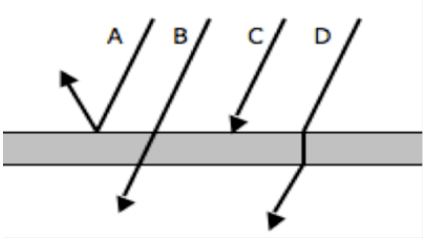
Ray A represents __.
reflection
refraction
transmission
absorption
Ray B represents __.
reflection
refraction
transmission
absorption
Ray C represents __.
reflection
refraction
transmission
absorption
Ray D represents __.
reflection
refraction
transmission
absorption
How are we able to perceive an object as being the color white?
All colors of visible light are absorbed by an object and then reflected into our eye.
All colors of visible light are reflected off an object and then to our eye.
All colors of visible light are absorbed by an object and no light is being reflected into our eye.
How are we able to perceive an object as being the color black?
All colors of visible light are absorbed by an object and then reflected into our eye.
All colors of visible light are reflected off an object and then to our eye.
All colors of visible light are absorbed by an object and no light is being reflected into our eye.
How are we able to perceive an object as being the color yellow?
All colors of visible light are absorbed by an object and then yellow light is reflected into our eye.
All colors of visible light are transmitted to an object, but only yellow light is absorbed by the object.
All colors of visible light are transmitted to an object, but only yellow light is reflected to our eye by the object.
Does light require a medium to transmit from its source to an object?
YES
NO
Which term best describes something that moves in straight lines in all directions from its source?
radiant
origin
energy
centric
Which wavelength of visible light is the shortest?
red
yellow
blue
violet
Which wavelength of visible light is the longest?
red
yellow
blue
violet
Light __ travel through a vacuum.
can
cannot
Which color has a wavelength longer than yellow?
orange
green
blue
violet
Which color of visible light is a combination of all wavelengths of visible light?
white
black
yellow
brown
Which statement accurately describes what a prism does?
A prism refracts and separates white light into the individual colors of light.
A prism reflects white light until the individual colors of light are produced.
A prism absorbs certain wavelengths of visible light on one side and transmits them out of the other end.
A prism transmits light through its structure and separates white light into the individual colors of light.

A rug sits in a sunny place on the floor for a long time. Kiara thinks that light from the sun can cause the rug’s color to fade over time. Can light from the sun cause the rug’s color to fade?
No. Light is not a physical thing, so it cannot change physical things like rugs.
No. Light can only change things by warming them up, so it cannot cause the rug’s color to fade.
Yes. The rug can absorb energy from the light, causing the rug’s color to fade.
Yes. Light from the sun can pull energy out of the rug, causing the rug’s color to fade.
Your friends say that they saw a special nail polish that changes color when it is out in the sun. Can light from the sun cause the nail polish to change color?
No. Light is not a physical thing, so it cannot change physical things like nail polish.
Yes. Light from the sun can pull energy out of the nail polish, causing it to change color.
Yes. The nail polish can take in energy from the light, causing it to change color.
No. Light can only change things by warming them up, so it cannot cause the nail polish to change color.
Light ...
can only be reflected
only comes in one form
carries energy from one place to another, even through empty space
is a type of wave that carries energy from one place to another, even through empty space
In order for light to change an object, that object must _______ the light and its __________.
reflect, wavelength
transmit, amplitude
reflect, energy
absorb, energy


the measurement from one wave's crest to another crest or it's trough to another trough
crest
trough
amplitude
wavelength
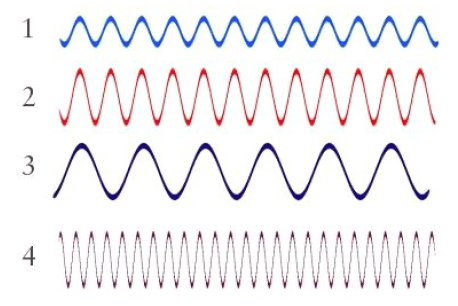
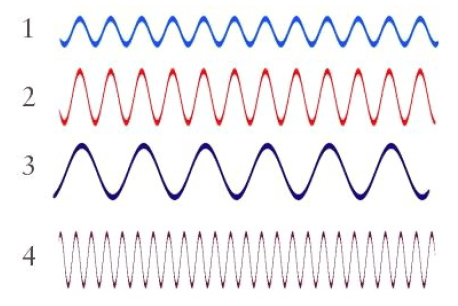


What do waves carry and transfer?
Nothing
Only Sound
Only sunlight
Energy

Which wave has the greatest wavelength?
Red Wave
Orange Wave
Green Wave
Purple Wave

Which wave has the lowest wavelength?
Red
Violet
Orange
Green

Which wave has a higher frequency.
A
B
frequency is...
the distance it takes for one wave cycle to occur
how often a wave occurs in a given amount of time
measurement of the height of a wave
amplitude is...
the distance it takes for one wave cycle to occur
how often a wave occurs in a given amount of time
measurement of the height of a wave
Longitudinal waves must have a __________ to transfer energy
Medium
Formula
Balanced Force
oscillation
The vibrations in a longitudinal wave are __________ to the direction of energy transfer.
parallel
perpendicular
Up and Down
Backwards
Sound waves can travel through a vacuum because they don't require particles.
True
False

In longitudinal waves, the parts where the coils are spread apart (B) are called what?
rarefactions
compressions
wavelengths
longitudes

In a longitudinal wave, the parts where the coils are close together (A) are called what?
longitudes
rarefactions
compressions
wavelengths



