
 Worksheets
WCF Neuro Quiz
Total questions: 17
Worksheet time: 10mins
The nurse is caring for a hospitalized infant at risk for developing increased intracranial pressure. Which assessment finding(s) would the nurse communicate to the health care provider for further intervention? Select all that apply.
Increased head circumference
Pulse rate of 60 beats/min and regular
Vomiting
Blood pressure at baseline
Parent states, "My infant does not act right."
The nurse is collecting data on an 18-month-old child admitted with a diagnosis of possible seizures. When interviewing the caregivers, which questions would be most important for the nurse to ask?
“Is your child up to date on his immunizations?”
“Has anyone in your family been sick recently”
“What type of activities was your child doing today?”
“Have you checked your child's temperature?”
A child is brought to the emergency department after sustaining a concussion. The child is to be discharged home with his parents. Which of the following would the nurse NOT include in the child's discharge instructions? Select all that apply.
“Expect his headache to get worse initially and then disappear.”
“Wake him every 2 hours to check his movement and responses.”
“Call your medical provider if he vomits more than 4 times.”
“Any watery fluid draining from his ears is normal.”
“Stay with the child for the first 24 hours & closely watch for days after.”
Which is the most common type of seizure seen in a 2-year-old?
Febrile seizure
Tonic-clonic seizure
Petit mal seizure
GTCS
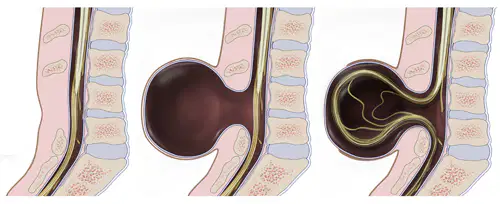
According to the picture, what would the condition on the far right be called?
Spina bifida occulta
Myelocele
Meningocele
Myelomeningocele
Which of the following are signs and symptoms that patients with spinal bifida may experience? Select all that apply.
Weakness of the legs or being unable to move the legs
Problems with the feet, knees, hips, legs, or spine
Problems controlling bladder or bowel
Problems with learning, attention and memory
Problems building relationships
A lumbar puncture can be used to diagnose or rule out:
Meningitis
Pancreatitis
Lewy Body Dementia
Osteosarcoma
The school nurse notes a 6 year old running across the playground with his friends. The child stops mid-stride, freezing for a few seconds. Then the child resumes his progress across the playground. The school nurse may suspect what in this child?
Which of the following MOST accurately describes what the patient will experience during the postictal state that follows a seizure?
Hyperventilation and hypersalivation
A rapidly improving level of consciousness
Confusion and fatigue
A gradually decreasing level of consciousness
Febrile seizures:
often result in permanent brain damage.
are also referred to as absence seizures.
are usually benign but should be evaluated.
occur when a child's fever rises slowly.
The nurse is caring for a child with an infectious disorder and the following vital signs: temperature 103.1°F (39.5°C), pulse 106 bpm, respiratory rate 24 breath/minute, and oxygen saturation 93% on room air. The child reports pain 4/10 using the Wong-Baker FACES scale. Which nursing intervention is priority?
Administer acetaminophen orally for fever.
Provide ibuprofen orally as needed for pain.
Apply oxygen via nasal cannula at 2 L/min.
Don appropriate personal protective equipment (PPE).
A nurse working with a pediatric patient suspects a patient's allergic reaction to latex is associated with their medical condition. Which of the following medical diagnoses would be the MOST likely to have latex allergies?
Myelomeningocele
Cerebral palsy
Down Syndrome
Muscular dystrophy
The nurse understands that if a client receives an 8 or less on the Glasgow Coma Scale then the client is...
A&Ox3
in a coma
able to maintain airway
able to eat small meals
A patient with possible bacterial meningitis is admitted to the ICU. What assessment finding would the nurse expect for a patient with this diagnosis? Select all that apply.
Pain upon ankle dorsiflexion of the foot
Neck flexion produces flexion of knees and hips
Inability to stand with eyes closed and arms extended without swaying
Eye discomfort in a brightly lit room
Numbness and tingling in the lower extremities
The nurse is administering mannitol for a pediatric client with increased cerebral swelling. Which of the following should the nurse assess for while the patient is taking this medication? Select all that apply.
Hypotension
Hypertension
I's & O's
MAP and CPP
ALT and AST
A pediatric patient with no known seizure history presents to the physician’s office with a high fever. While sitting in the waiting room, the child goes unconscious and begins to experience tonic/clonic movements that do not stop after several minutes. Which of the following actions should the medical assistant take?
Provide a cool wash cloth to the parent to help bring down the fever.
Place a tongue blade inside the child’s mouth to prevent the tongue from occluding the throat.
Ensure immediate patient and environment safety and activate EMS.
Obtain a full set of vital signs while holding the patient down.
A pediatric patient with a recent history of chicken pox presents to the clinic with Reye's Syndrome. When reviewing the patient’s chart, which of the following is the most likely contributor to the Reye’s Syndrome?
calamine lotion
varicella immunization
acetaminophen
aspirin

