
Font size
 Worksheets
Rights
Total questions: 85
Worksheet time: 2hrs 54mins
Which document contains the Bill of Rights?
United States Constitution
Emancipation Proclamation
Declaration of Independence
Magna Carta
How many amendments are there in the Bill of Rights?
10
20
15
5
Which amendment protects the freedom of speech?
First Amendment
Second Amendment
Fourth Amendment
Tenth Amendment
Which amendment protects the right to bear arms?
Second Amendment
First Amendment
Third Amendment
Fourth Amendment
Which amendment protects against unreasonable searches and seizures?
Fourth Amendment
Second Amendment
Fifth Amendment
First Amendment
Which amendment guarantees the right to a fair trial?
First Amendment
Fifth Amendment
Second Amendment
Sixth Amendment
Which amendment protects against self-incrimination?
First Amendment
Fourth Amendment
Second Amendment
Fifth Amendment
Which amendment guarantees the right to a jury trial in civil cases?
Fourth Amendment
Seventh Amendment
Tenth Amendment
First Amendment
Which amendment prohibits cruel and unusual punishment?
First Amendment
Eighth Amendment
Second Amendment
Fifth Amendment
Which amendment protects rights not specifically mentioned in the Constitution?
First Amendment
Second Amendment
Tenth Amendment
Ninth Amendment

What are Human Rights?
laws we must follow
laws enforced by police
rights we all have
rights for men

What organization developed the Declaration of Human Rights
United States
United Nations
Human Rights Watch
started after World War 2

Discrimination means...
money that is paid for work
belongs to a country
innocent until proven guilty
unfair difference in treatment
When the United States was founded in 1776, what THREE details did a person need to have to vote? They had to be...
male
white
a landowner
35 years old or older
a member of the government
Match the following groups with the year they gained the right to vote:
1961
Residents of Washington D.C.
1920
Women
1971
18-21 Year-olds
1962
American Indians
1870
ALL Adult Men
When the Voting Rights Act passed, all American citizens had the right to vote protected regardless of race, gender, etc. What year was this law passed?
1965
1964
1870
1776
What is a test administered before voting to see if a person can read and write?
literacy test
poll tax
suffrage
grandfather clause
What is a special fee that a person had to pay in order to vote?
literacy test
poll tax
suffrage
grandfather clause
What is the right to vote called?
literacy test
poll tax
suffrage
grandfather clause
I am a woman living in New York City in the year 1924. I am 25, married, and have two children. Can I vote?
Yes
No
I am a woman living in Montana in the year 1910. I’m 65 years old, married, and have three kids and seven grandkids. Can I vote?
Yes
No
I live in Washington, D.C. just down the street from the White House. The year is 1955. I am a 35 year old woman with two children. Can I vote?
Yes
No
I just graduated from high school in Maryland, Class of 1967! I am 18 years old and just got drafted to fight in the war in Vietnam. Can I vote?
Yes
No
I am 35 and am an American Indian living on the Cherokee reservation in North Carolina in 1945. Can I vote?
Yes
No
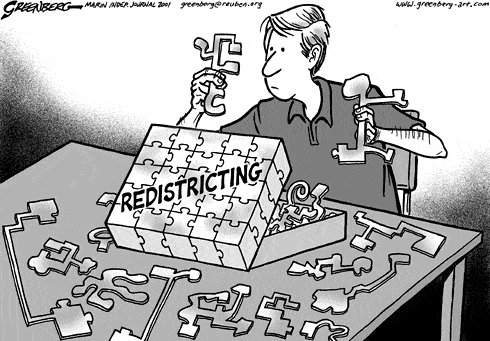
Gerrymandering affects:
The House of Representatives
The Senate
The Presidency
Congress as a whole
What do we call the official count of the population?
Reapportionment
Census
Century
Redistricting
What does the federal census affect?
Reapportionment in the House
Reapportionment in the Senate
Reapportionment in both houses
It does not affect Congress.

What Amendment is represented in this picture?
The 2nd Amendment: The right to bear arms.
The 3rd Amendments: No quartering soldiers in our houses.
The 8th Amendment: No cruel or unusual punishment
The 9th Amendment: The rights not stated in the Constitution belong to the individuals.

What Amendment is represented in this picture?
The 4th Amendment
The 5th Amendment
The 6th Amendment
The 7th Amendment

What amendment guarantees the freedom to assemble peacefully?
1st
2nd
3rd
4th


Which amendment gave African-Americans the right to vote?
13th
14th
15th
19th

Which amendment banned the use of poll taxes?
26th amendment
17th amendment
23rd amendment
24th amendment

Which amendment set the voting age to 18?
26th amendment
24th amendment
19th amendment
23rd amendment

Which amendment gave women the right to vote?
13th amendment
15th amendment
19th amendment
26th amendment
Which is a requirement for a person to become a naturalized U.S. citizen?
Marrying a U.S. citizen and having a child with that person
Being a legal resident of the U.S. for at least five years
Gaining employment in the U.S. for at least two years
Reaching age eighteen while living in the U.S. capital
Male U.S. citizens age 18 - 26 must register with...
the Selective Service
the county voter registry
the FAFSA application
SS.7.C.2.3
The list below identifies several activities.
-Attending a school board meeting
-Voting in a primary election
-Helping on a phone bank for a mayoral candidate
-Putting a candidate's sign in your yard
-Registering voters at a community college
What do these activities illustrate?
ways that citizens can run for political office
opportunities for citizens to participate in national elections
opportunities for citizens to influence political action committees
ways in which citizens actively participate in the political process

SS.7.C.2.1
The diagram above shows the requirements for becoming a naturalized citizen.
Which statement completes the diagram?
Pay federal income tax
Have an annual income of $20,000 or more
Have resided in the United States for five years
Have a close relative (parent, spouse or child) who is a U.S. citizen
The excerpt below is from a constitutional amendment.
"The right of citizens of the United States.....to vote shall not be denied .... on account of age."
Amendment 26, U.S. Constitution
How did this amendment affect participation in the American political process?
The amendment allowed college students to vote
The amendment allowed more U.S. citizens to register to vote
The amendment created age requirement changes in selective service
The amendment created the requirement that all citizens be registered with selective service.

The newspaper details an important step in amending the U.S. Constitution.
How did the passage of this amendment to the U.S. Constitution impact the political process in the United States?
Women were allowed to contribute to political campaigns
Women were allowed to hold citizenship rights
Women were allowed to hold public offices
Women were allowed to vote in national elections
Which is requirement for a person to become a naturalized U.S. citizen?
passing a U.S. history and government exam
working in the U.S. for at least five years
being born to American parents
serving in the U.S. military
Because of this case, every level of court has to provide a public defender
Miranda vs. Arizona
Gideon vs. Wainwright
Tinker vs. Des Moines
Brown vs. Board of Education
Ben was prosecuted and convicted in state court for speaking out publicly against the governor. During his trial, he was denied the counsel of a lawyer. Two years later, the U.S. Supreme Court overturned his conviction, explaining that the state had not guaranteed Ben’s constitutional rights. Which amendments apply to this case?
Amendment I (free speech) and Amendment VI (due process)
Amendment I (free press) and Amendment IV (search and seizure)
Amendment IX (unenumerated rights) and Amendment VI (due process)
Amendment IX(unenumerated rights) and Amendment IV (search and seizure)
Anne Tracy works as a journalist for The Daily Mouth. She wrote a story about how Senator Jones cheated on a law school exam. She interviewed witnesses who saw the senator cheating. The story ran on the front page. Senator Jones denied the charges. Then he resigned from office. He plans to sue The Daily Mouth for damages. Under what circumstances could he sue the paper and win his lawsuit?
He could sue the paper for libel and could win the case if he proved that Tracy had a grudge against him.
He could sue the paper for slander and could win the case if he proved that Tracy had a grudge against him.
He could sue the paper for libel and could win the case if he proved that the accusations were untrue and his reputation was hurt.
He could sue the paper for slander and could win the case if he proved that the accusations were untrue and his reputation was hurt.
James Madison wrote that “liberty is to faction what air is to fire.” After reading this, Jack points out that the Founders would have wanted more restrictions on lobbyists, special-interest groups, and media influencing the government. What would be a good counterargument?
Elected officials are better able to measure public opinion if there are no interfering factions
Lobbyists will balance one another in government influence if they are subject to fewer laws.
Political ads, despite their biases, are best able to inform citizens when there are no regulations
The media, despite its biases, are best able to monitor the government when they are free
U.S. Supreme Court case that upheld a student's First Amendment right to engage in symbolic speech in school was
Miranda vs. Arizona
Tinker vs. Des Moines
Plessy vs. Ferguson
Gideon vs. Wainwright

The timeline attached shows events related to the death penalty.
What constitutional protections have resulted from these events?
Constitutional protections from cruel and unusual punishment are safeguarded while executions continue.
Constitutional protections from cruel and unusual punishment are limited while executions continue.
Constitutional protections of due process of law are safeguarded while executions continue.
Constitutional protections of due process of law are limited while executions continue.
Which court case had to do with the 6th amendment protection to a right to counsel (an attorney)?
Miranda vs Arizona
Brown vs. the Board of Education
Madison vs. Marbury
Gideon vs. Wainwright
Midterms have a higher turnout rate than Presidential elections?
Yes
No
What amendment to the U.S. Constitution gave women the right to vote?
15
19
24
26
Important amendment to the U.S. Constitution that says everyone born in America is a citizen and has "equal protection" and "due process"
14th Amendment 1868
12th Amendment 1808
22nd Amendment 1935
6th Amendment 1791
This amendment to the U.S. Constitution says all male citizens can now vote.
13th
15th
19th
23rd
Individuals were required to pass these in order to vote
Poll tax
Literacy tests
Jim Crow Laws
Sharecropping
What is a "Midterm Election" ?
an election held to pick the candidates for the general election
an election held in the middle of a presidential term
appoints Supreme Court judges
an election for the President of the United States
What is the importance of a Mid Term election?
can shows approval or disapproval of the president
removes the president from power
changes the balance of power in congress
elects a new governor in each state
Which of the following best describes the term citizen?
A person who is loyal to and proud of his country
An individual who is able to vote in elections
A legally recognized member of a country
An individual that exercises political authority over another
What does a person born in any U.S. territory automatically become?
A permanent resident alien
A naturalized citizen
A native-born citizen
An illegal alien
Why is attending school considered a civic duty?
Educated citizens are vital to the success of our democracy
To make sure people are able to get jobs in the future
School districts depend on having a certain number of students
Today's high-tech society needs educated employees
Why are citizens obligated to respond to such documents as Jury summons?
To guarantee court hearings remain public
To protect the constitutional right to be tried by one's peers
To guarantee courts provide probable cause
To protect the constitutional right to confront one's peers
What practice is part of the obligation of a U.S. citizen to help defend the nation?
Serve on Juries
Volunteer
Register for Selected Service
Vote in National Elections
Requirements for Naturalization
-Be of good moral character
-Read, write, and speak English
-Be at least 18 years old
-Been admitted lawfully into the U.S. (lawful permanent resident)
-???
Which requirement is missing from the list above?
Pay federal income taxes
Have a close relative who is a U.S. citizen
Have an annual income of $20,000 or more
Have lived/resided in the U.S. for five years
Why is it important to pay your taxes?
To make sure that laws are up-to-date
To pay for private universities
To make sure that people are good citizens
To provide money to pay for government services
Who of the following is a U.S. citizen?
Julia moved to the U.S. when she was 3 years old. She moved back to Mexico when she was 12.
Raymond was born in Canada and has been working in the U.S. the past 3 years.
Oscar was born in Spain. His mother is a citizen of Spain and his father is a U.S. citizen.
Nina is a foreign exchange student going to school in California.
Why does the government require qualified 18-year-old males to register for the selective service?
To allow the government to quickly draft them in times of crisis
To provide jobs for more people
To ensure that they are also registered to vote
To provide money for government services
Which term best describes a person who has left his or her home to escape danger such as war, persecution by the government, or natural disaster?
Alien
Citizen
Tourist
Refugee
Which of the following is NOT a responsibility of U.S. citizens?
Attend town meetings
Own property or land
Run for elected office
Vote
The 14th Amendment allows for equal protection under the law and it defines citizenship. According to this amendment, who is a citizen?
Someone born or naturalized in the U.S.
Someone who lives in the U.S. and has a job
Someone who owns property in the U.S.
Someone going to school in the U.S.
Steps to Naturalization
-Live in the U.S. for 5 years
-Fill out an application for citizenship
-Fingerprint and background check
-???
-Take the Oath of Allegiance
Which step is missing from the list above?
Register to vote
Wait 5 years
Make an appointment
Pass the Civics and English tests
Who of the following is eligible to apply for citizenship through the process of naturalization?
Note: all of the people below entered the country legally and follow laws
Jorge: born in Venezuela, 24 years old, has lived in Florida for for 6 years, can only speak and write in Spanish, loves playing Monopoly
Edward: born in England, 47 years old, has lived in Texas for 4 years, can only speak and write in English, loves to fish
Sara: born in Mexico, 17 years old, has lived in Arizona for 5 years, can speak and write in English and Spanish, loves Snapchat
Mary: born in Canada, 32 years old, has lived in Georgia for 9 years, can speak and write in French and English, loves Country music
Which of the following terms is defined as the legal process of becoming a U.S. citizen?
Assimilation
Adoption
Immigration
Naturalization
Which term describes a foreign-born resident of the United States who has not been naturalized?
Refugee
Alien
Citizen
Tourist
a body of people representing the states of the US, who formally cast votes for the election of the president and vice president.
Republican
Democrat
Popular vote
Electoral College
the total number of elector votes necessary to win the presidency
270
538
435
100
the tally of each individual's vote within a given geographic area
electoral college
popular vote
Senate
House of Representatives

Which word in the statement above describes this process the BEST?
primary election
party platform
general election
winner-take-all
Why is campaigning a small states like Delaware and Rhode Island necessary?
Campaign rules require it
The governors invite the candidates.
In close elections, their votes make a difference.
Party platforms require it.
____________________ is the power of voters to ENACT new laws. This allows voters to place proposed legislation on a ballot.
Executive Order
Veto
Initiative
Revolt
A ___________________________ requires that the STATE ask the people if they wish to change the state constitution.
call back
vote recount
referendum
chancellors vote
______________ is a law idea started by the people.
reciprocative law
maximal veto
legislative cancel
initiative
________________ allows people to remove a public official if they are failing to do their duty.
veto
illegal removal
annexation
recall

