
 Worksheets
Projectile Motion & Rectilinear Motion
Total questions: 10
Worksheet time: 8mins
What is projectile motion?
Projectile motion is the motion of an object floating in water
Projectile motion is the motion of an object moving in a straight line
Projectile motion is the motion of an object thrown or projected into the air, subject to only the force of gravity.
Projectile motion is the motion of an object propelled by a rocket engine
How is the range of projectile motion calculated?
R = (v * sin(θ)) / g
R = (v^2 * sin(θ)) / g
R = (v^2 * sin(2θ)) / g
R = (v^2 * cos(2θ)) / g
What is the maximum height of a projectile?
The maximum height of a projectile is (v^2 * cos^2(θ)) / (2 * g)
The maximum height of a projectile is (v^2 * sin^2(θ)) / (2 * g)
The maximum height of a projectile is (v^2 * sec^2(θ)) / (2 * g)
The maximum height of a projectile is (v^2 * tan^2(θ)) / (2 * g)
Define uniform rectilinear motion.
Motion in a circular path with varying speed
Uniform rectilinear motion is the motion of an object in a straight line with constant speed.
Motion in a zigzag pattern with constant speed
Motion in a straight line with varying speed
What is the equation for acceleration in rectilinear motion?
a = v * t
a = (v + u) / t
a = u / t
The equation for acceleration in rectilinear motion is a = (v - u) / t, where a is acceleration, v is final velocity, u is initial velocity, and t is time.
How is the range of projectile motion affected by the initial velocity?
The range of projectile motion increases linearly with the initial velocity
The range of projectile motion is inversely proportional to the initial velocity
The range of projectile motion is not affected by the initial velocity
The range of projectile motion is directly proportional to the square of the initial velocity.
What is the difference between projectile motion and rectilinear motion?
Projectile motion involves motion in one dimension, while rectilinear motion involves motion in two dimensions.
Projectile motion involves motion at a constant speed, while rectilinear motion involves motion at varying speeds.
Projectile motion involves a curved path under the influence of gravity, while rectilinear motion involves a straight line with constant velocity.
Projectile motion involves a straight line with constant velocity, while rectilinear motion involves a curved path under the influence of gravity.
How is the acceleration calculated in rectilinear motion?
Acceleration = (Initial velocity) / (Time taken)
Acceleration = (Distance traveled) / (Time taken)
Acceleration = (Force) / (Mass)
Acceleration = (Change in velocity) / (Time taken)
A soccer ball is kicked horizontally off a 22.0-meter high hill and lands a distance of 35.0 meters from the edge of the hill. Determine the initial horizontal velocity of the soccer ball.
16.50 m/s
17.00 m/s
17.50 m/s
18.00 m/s
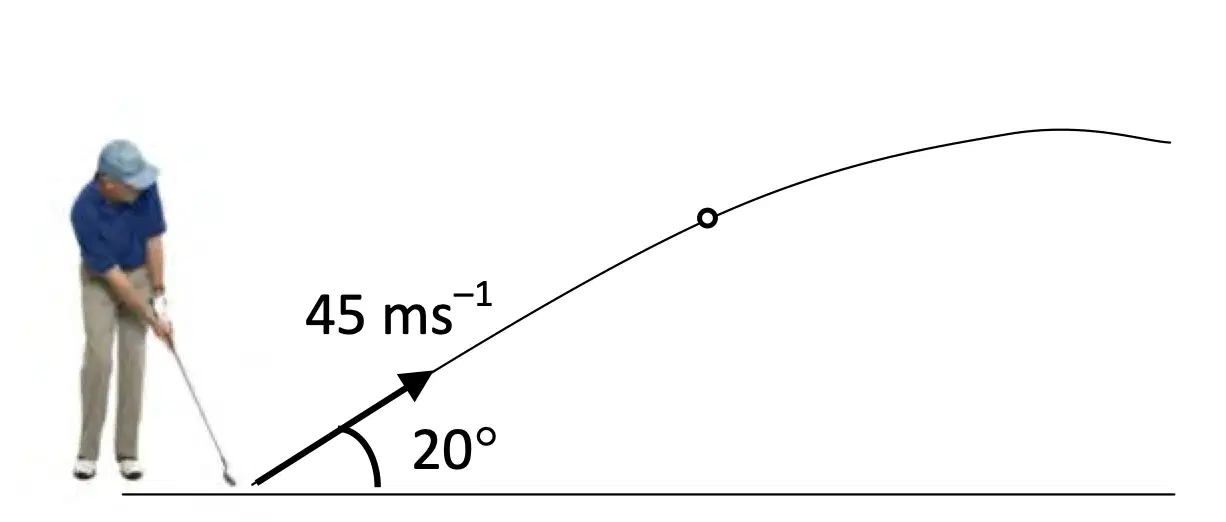
Suppose a golfer hits a ball with a velocity of 45 m s–1 at an angle of 20° to
the horizontal. Where will the ball be 2 seconds later?
86.47, 13.18
84.57, 11.18
85.47, 12.18
87.47, 14.18

