
Font size
 Worksheets
APES Soil and Biogeochemical Cycles Review
Total questions: 77
Worksheet time: 3hrs 32mins
Which pair of biogeochemical cycles are most associated with inorganic fertilizer and sewage waste?
Carbon and Nitrogen cycles
Carbon and Sulfur cycles
Phosphorus and Nitrogen cycles
Sulfur and Nitrogen cycles
Sulfur and Water cycles
Which biogeochemical cycles are directly related to acid deposition?
Carbon and Nitrogen cycles
Carbon and Sulfur cycles
Phosphorus and Nitrogen cycles
Carbon, Sulfur and Nitrogen cycles
Sulfur and Water cycles
Most energy on Earth comes from
volcanoes
the sun
trees
water
fire
Humans have a considerable effect on the hydrologic cycle. Which of the following human activities have(has a) direct effect(s) on the cycle?
I. Deforestation
II. Urbanization
III. Mining of fossil fuels
I
II
III
I and III
I, II, and III
An addition of a limiting nutrient to an ecosystem may lead to an algal bloom. What effect will this algal bloom have on the oxygen content of the water?
The algae bloom will cause the oxygen content in the water to increase overall
The algae bloom will cause the oxygen content in the water to decrease, leading to hypoxic conditions
The algae bloom will have no impact on the oxygen content of the water
The algae bloom will cause rapid fluctuations of oxygen in the water
Which is NOT a process of the water cycle?

Why do living things need nitrogen?
To get energy
To make nucleic acids
To make proteins
To make proteins AND nucleic acids
What cycle are fossil fuels part of ?
carbon
oxygen
nitrogen
phosphorus
What is the largest reservoir for water?
the ocean
rocks and minerals
the atmosphere
glaciers
Where is the largest reservoir for the phosphorus cycle?
rocks and minerals
the ocean
the atmopshere
fossil fuels
What is the largest reservoir for nitrogen?
the ocean
rocks and minerals
the atmosphere
bacteria

Photosynthesis is an important part of the ______ cycle
Carbon
Water
Phosphorus
Nitrogen

Decomposition is part of all cycles except _______
the carbon cycle
the nitrogen cycle
the water cycle
the phosphorus cycle


3. The sun provides the energy for almost all life on Earth. Approximately how much of the sun's energy captured by producers would move up to the next trophic level?
A. 90%
B. 75%
C. 10%
D. 1%
4. As energy moves within an ecosystem, how is the majority of it lost?
A. Cellular respiration
B. Light
C. Metabolism
D. Heat loss
6. A marine biologist is studying a kelp ecosystem. She notices that Sea Urchins eat the kelp and that Sea otters eat the urchins and protect the kelp forest. In this scenario, the Sea Urchin can be classified as a
A. Primary Consumer
B. Secondary Consumer
C. Decomposer
D. Autotroph
7. The most abundant element in Earth's atmosphere is
A. Water
B. Nitrogen
C. Carbon
D. Oxygen
9. Humans have altered the phosphorus cycle by
A. Clear-cutting forests.
B. Burning fossil fuels
C. Damming rivers for hydroelectric power.
D. Using fertilizers.

Which two processes release carbon dioxide into the atmosphere?
photosynthesis and cellular respiration
cellular respiration and burning fossil fuels
burning fossil fuels and decompositon
photosynthesis and decomposition
Most of the water on earth is found where?
ice caps
oceans
streams
aquifers
When deforestation (cutting down trees) occurs in an area, what immediate effect does this have on the water cycle?
More water is returned to the atmosphere by transpiration.
There is less runoff water, but more transpiration.
More photosynthesis occurs, and CO2 begins decreasing.
Less is returned to the air by transpiration.

Soil formation begins with the weathering of_______.
Humas
Subsoil
Litter
Bedock
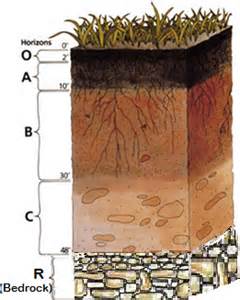
Which soil horizon is contains decomposed plants and animals?
A Horizon
B Horizon
C Horizon
O Horizon

Soil sample that is 10% clay, 20% silt, and 70% sand has which texture?
clay
clay loam
sandy loam
silt

Soil sample that is 60% clay, 30% silt, and 10% sand has which texture?
clay
clay loam
sandy loam
silt
Soil is formed by the breaking down of rocks by the action of wind, water and climate. This process is called
Humification
Weathering
Soil erosion
None of the above
Soils that have a pH of 3.7 are considered
Alkaline
Acidic
Basic
Neutral

Which of the following elements is least available at a pH of 7?
Nitrates
Iron
Phosphates
Magnesium
The best soils are a mixture of sand, silt and clay called?
Loam
Humus
Sandy Clay
Silty Sand
Which soil has the least permeability or slowest flow?
sand
silt
clay
humus
Which soil has the greatest permeability or quickest flow?
sand
silt
clay
humus
Why is soil important?
Provides nutrients for plant growth
food security
filters waste
all of the above
What are properties of the soil determined by
time
parent material
climate
topography
ALL of these determine the properties of the soil
Which of these would have the greater amount of humus?
topsoil
subsoil
bedrock
E horizon
What form of nitrogen is found in the atmosphere and then captured by nitrogen fixing bacteria?
N2
NH4
NO2
NO3

The layer(s) of soil in which most of the humus and soil organisms are contained:
1- leaf litter, horizon O
2- topsoil, horizon A
3- subsoil, horizons B and C
1 only
2 only
1 and 2 only
2 and 3 only
1, 2, and 3

If the amount of oxygen in water decreases...
Respiration rate increases
Respiration rate decreases
No effect on respiration
More photosynthesis occurs
When talking about fertilizers in Eutrophication, fertilizers contain...
(pick TWO answers)
Carbohydrates
Sulfates
Phosphates
Nitrates
What are the dangers of excessive growth of algae and plants
They might take up too much room
They block sunlight for other organisms
They do not harm other organisms
Other organisms eat them and they are toxic
Place the followng in the correct order:
1. Large amounts of Bacteria Respire
2. Other organisms have to move habitat
3. Bacteria begin to reproduce rapidly
4. Less oxygen is available for other organisms
1,2,3,4
4,3,2,1
1,4,2,3
3,1,4,2
How do agricultural activities contribute to eutrophication?
Burning of fossil fuels
Reducing water pollution
Planting more trees
Excess release of nutrients into water bodies
What are the effects of eutrophication on aquatic life?
Algal blooms, decreased oxygen levels, and harm to aquatic life
Increased oxygen levels, and benefit to aquatic life
No impact on aquatic life
Decreased algal growth, and improved water quality
What are some methods to prevent eutrophication?
Increasing the use of fertilizers
Dumping sewage and wastewater into water bodies
Destroying wetlands
Reducing the use of fertilizers, managing sewage and wastewater, protecting wetlands, and promoting sustainable agricultural practices
What is nutrient pollution in water bodies?
Low water levels in water bodies
Toxic chemicals in water bodies
Excessive nutrients entering the water system
Lack of nutrients in water bodies
How does nutrient pollution contribute to eutrophication?
Rise in oxygen levels
Increase in biodiversity
Decrease in algae growth
Excessive growth of algae and other aquatic plants, leading to oxygen depletion
What are algal blooms and how are they related to eutrophication?
Algal blooms are rapid increases in the population of algae in an aquatic system, and they are related to eutrophication because eutrophication provides excess nutrients that promote algal growth.
Algal blooms are a natural occurrence in aquatic systems, and they are related to eutrophication due to the presence of predators
Algal blooms are a result of excessive fishing in the area, and they are related to eutrophication because of overfishing
Algal blooms are caused by a lack of nutrients in the water, and they are not related to eutrophication

