
NEW
Font size
 Worksheets
Gravitation and circles
Total questions: 24
Worksheet time: 1hrs 12mins
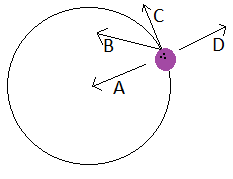
Which vector represents the acceleration of the ball?
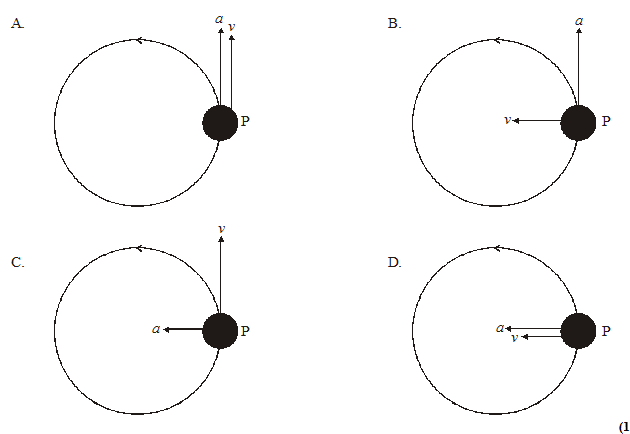
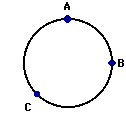

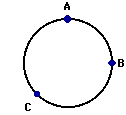


A ball is moving at constant speed around the circle. Which letter represents the acceleration of the ball?
A
B
C
D
Nonsense. The ball can't be accelerating while moving at a constant speed.

Imagine a child on a merry-go-round, spinning as it turns. If the child is holding a ball, then reaches out and releases the ball off the side of the merry-go-round, in what direction will it travel?
Toward the center of the merry-go-round
Directly opposite the center of the merry-go-round
In a straight line tangential to the circular path of the merry-go-round
Around in a circular path identical to how it was traveling prior to release
In what direction does the child feel herself being pulled while on the merry-go-round?
Toward the center of the merry-go-round
Directly opposite to the center of the merry-go-round
Tangentially along the path of the circular motion
None of these
The larger the mass of an object...
The smaller the force of gravity.
The larger the force of gravity.
Mass has no effect on the amount of gravity an object experiences.

How is the gravitational force between two objects related to their mass
They are directly proportional
They are inversely proportional
They do not affect each other
They are equal
How is the gravitational force between two objects related to their distance (radius apart)
They are directly proportional
They are inversely proportional
They do not affect each other
They are equal
Doubling the distance between two objects...
...will double the force of gravity.
...will half the force of gravity.
...will quadruple the force of gravity.
...will quarter the force of gravity.
Halving the distance between two objects...
...will double the force of gravity.
...will half the force of gravity.
...will quadruple the force of gravity.
...will quarter the force of gravity.
Doubling the mass of an object...
...will double the force of gravity.
...will half the force of gravity.
...will quadruple the force of gravity.
...will quarter the force of gravity.
If Mass 1 is doubled (2m) and Mass 2 is tripled (3m) it will..
...will double the force of gravity.
...will triple the force of gravity.
...will multiply the force of gravity by a factor of six
...will reduce the force of gravity by a factor of six
If Mass 1 is doubled (2m) and the distance between the two masses is doubled (2r) it will...
...will double the force of gravity.
...will halve the force of gravity.
...will multiply the force of gravity by a factor of four.
...will reduce the force of gravity by a factor of four.
Which type of force is the weakest though it keeps entire galaxies together?
strong
weak
electromagnetic
gravitational
Type of force that keeps atoms and molecules together and can act over infinite distance.
strong
weak
electromagnetic
gravity
The force that explains radioactive beta decay and allows the sun to continue fusion?
strong
weak
electromagnetic
gravitational
Which fundamental force is the strongest and keeps an atom's nucleus together?
strong
weak
electromagnetic
gravitational

