
 Worksheets
The Brain: Regions & Functions
Total questions: 32
Worksheet time: 32mins

Match each region of the cortex to the appropriate label.
frontal lobe
blue region
temporal lobe
green region
parietal lobe
yellow region
occipital lobe
pink region
This region contains the motor cortex & is responsible for executive functions such as judgment, reasoning, impulse-control, planning, & personality.
frontal lobe
parietal lobe
temporal lobe
occipital lobe
This region contains the sensory cortex & is responsible for spatial reasoning, perception, & arithmetic calculations.
frontal lobe
parietal lobe
temporal lobe
occipital lobe
This region contains the visual cortex & is responsible for awareness & recognition of visual stimuli.
frontal lobe
parietal lobe
temporal lobe
occipital lobe
This region contains the auditory cortex & is responsible for memory & perceptual processing as well as language comprehension.
frontal lobe
parietal lobe
temporal lobe
occipital lobe

Match each region in the diagram to its appropriate label.
Cerebrum
A
Corpus Callosum
B
Hypothalamus
F
Medulla
I
Pituitary Gland
D
Match each region in the diagram to its appropriate label.
Cerebellum
J
Amygdala
D
Thalamus
C
Pons
H
Pineal Gland
E
Letter G
Cerebellum
Corpus Callosum
Hypothalamus
Pons
Midbrain
Match the following brain areas to their function
Corpus Callosum
Links hemispheres for communication
Hypothalamus
Regulates body functions for homeostasis
Pons
Sleep, arousal, cranial nerve tracts
Thalamus
Relay station for signals except smell
Cerebellum
Coordination & procedural memory
Match the following brain areas to their function
Cerebral cortex
Complex mental activities
Midbrain
Integrates signals, reflexive eye motion
Medulla
Heart rate, blood pressure, breathing
Amygdala
Regulate fear & aggression responses
Pituitary Gland
Master of endocrine system
Organize these brain regions into the appropriate area.
Motor Cortex
Broca's Area
Somatosensory Cortex
Auditory Cortex
Wernicke's Area
Visual Cortex
Match the following brain areas to their function.
Broca's Area
speech production
Wernicke's Area
speech comprehension
Motor cortex
voluntary skeletal movement
Somatosensory cortex
touch, pain, temperature sensation
Auditory cortex
sound input

The tan area which is involved in perceptual processing, reasoning, problem-solving, & regulating body functions.
forebrain
midbrain
hindbrain
limbic system
The pink area which integrates sensory processes (i.e. cranial nerve tracts) & controls reflexive eye movement.
forebrain
midbrain
hindbrain
limbic system
The purple area which regulates autonomic functions, coordinates movement & balance, & relays sensory information for processing.
forebrain
midbrain
hindbrain
limbic system

View A
coronal plane
horizontal plane
sagittal plane
View B
coronal plane
horizontal plane
sagittal plane
View C
coronal plane
horizontal plane
sagittal plane

These structures make up the _______, involved in emotions & memory.
forebrain
midbrain
hindbrain
limbic system

Match each region of the diagram with its appropriate label.
Thalamus
A
Hippocampus
D
Amygdala
C
Hypothalamus
B

Match each region of the cerebral cortex to its name.
Broca's Area
A
Motor Cortex
B
Wernicke's Area
D
Visual Cortex
E
Somatosensory Cortex
C
Region F
Broca's Area
Pre-frontal Cortex
Auditory Cortex
Motor Cortex
The dark orange region is the
Broca's Area
Pre-frontal Cortex
Auditory Cortex
Motor Cortex
The wrinkled furrows of the cerebrum are called
sulci
gyri
lobes
cortices
The raised ridges of the cerebrum are called
sulci
gyri
lobes
cortices
Shelton fell off of a ladder while cleaning the windows. He can not stand up without assistance and is unable to catch a ball. Which is the most likely affected part of the brain?
Cerebellum
Cerebrum
Cerebral Cortex
Corpus Callosum
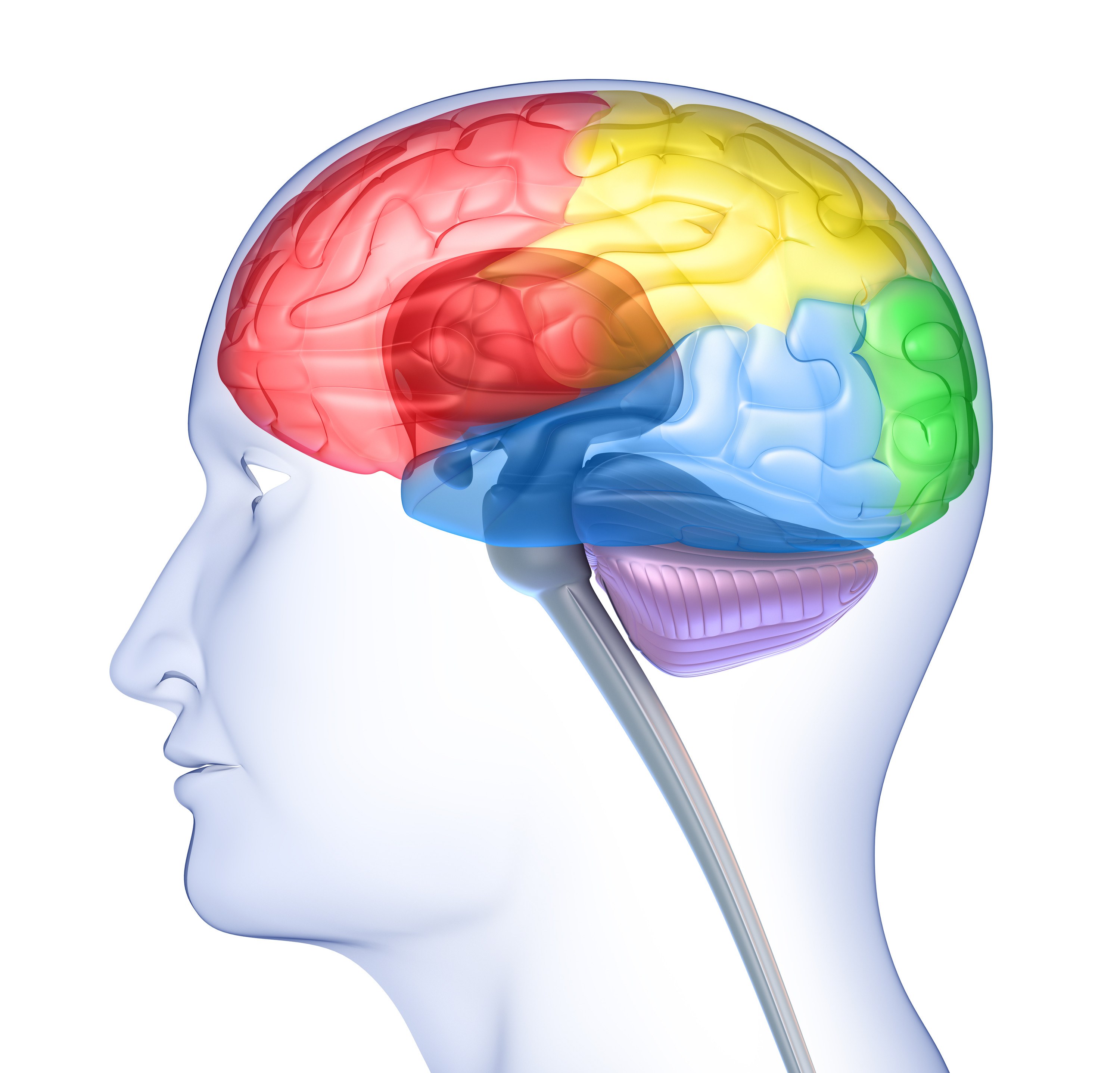
What is the significance of having such a wrinkly grooved cerebral cortex?
Having a smooth cortex surface would make neural communication more difficult.
The grooves prevent the brain from becoming dehydrated.
Place each directional label in the appropriate spot.

Gray matter in the brain refers to
White matter in the brain refers to

