
 Worksheets
Final Exam Government & Politics A Practice
Total questions: 51
Worksheet time: 27mins
Name
Class
Date
1.
The ability to cause others to behave as they might not otherwise choose to do is…
a)
Legitimacy
b)
Power
c)
Sovereignty
d)
Politics
2.
What is coercive power?
a)
Power that comes from personal characteristics
b)
Power that comes from one's organizational role or position
c)
The ability to grant a reward
d)
The ability to take something away or punish someone
3.
What is sovereignty?
a)
The ability to rule absolutely within a territory
b)
The principle that all states are considered equal
c)
The organization inside a state that controls actions and policies
d)
The ability to purchase territory from other states
4.
What is a social contract?
a)
An agreement between two countries
b)
An agreement between two individuals
c)
An agreement between people and their government
d)
An agreement between businesses
5.
Iran's official name is the Islamic Republic of Iran and it is ruled by a group of religious leaders called "Mullahs." Which of the following BEST describes something else we know about Iran?
a)
Iran is a direct democracy.
b)
Iran is a true republic
c)
Iran is a communist country.
d)
Iran is a theocracy.
6.
How do monarchs usually come to power in a monarchy?
a)
Through elections
b)
By inheritance through their family line
c)
By overthrowing the previous monarch
d)
By appointment from a council of leaders
7.
In a presidential system, the chief executive is chosen by…
a)
Directly by the people through voting
b)
By the monarch
c)
By god
d)
By the largest party in the legislature
8.
In a representative democracy, who does the day-to-day work of governing the country?
a)
Citizens
b)
Monarchs
c)
Dictators
d)
Elected representatives
9.
In which system of government are all key powers given to the central government?
a)
confederate government
b)
federal government
c)
unitary government
d)
parliamentary government
10.
Michigan is not a sovereign state in the international sense because:
a)
There are people of numerous nationalities living here
b)
Michigan cannot make its own criminal laws.
c)
It is subordinate (under the authority of) to the U.S. Constitution.
d)
Michigan does not have a constitution.
11.
America's first constitution:
a)
Magna Carta
b)
English Bill of Rights
c)
Declaration of Independence
d)
Articles of Confederation
12.
What was the government like under the Articles of Confederation?
a)
Efficient and organized
b)
Filled with strong leaders
c)
Chaotic and disorganized
d)
Highly centralized
13.
What did the Anti-Federalist want added to the Constitution before they would agree to support it?
a)
A guarantee of the rights of the people, which eventually became the Bill of Rights
b)
A section limiting the power of the states
c)
The promise that congress would be a bicameral legislature
d)
A section that the central government would be unable to regulate trade.
14.
Which of the following best outlines the structure of the US Constitution?
a)
Amendments, Signatures, Preamble, Laws
b)
Preamble, Articles, Amendments
c)
Amendments, Preamble, Laws
d)
Articles, Preamble, Amendments
15.
The Preamble to the Constitution lists which of the following?
a)
steps for amending the Constitution
b)
purpose to be served by the Constitution
c)
procedures for ratifying the Constitution
d)
guidelines for interpreting the Constitution
16.
A written change or addition to the Constitution is known as
a)
an amendment
b)
a bill
c)
a proposal
d)
a draft
17.
Why did the framers of the Constitution create three separate branches of government?
a)
to help people with different opinions cooperate
b)
to increase the power of the central government
c)
to keep any one group from gaining too much power
d)
to provide enough officials to handle the volume of work
18.
What principle of the U.S. Constitution ensures that government power is derived from the people?
a)
Popular sovereignty
b)
Limited government
c)
Consent of the governed
d)
Separation of powers
19.
What does the principle of the rule of law require?
a)
Arbitrary use of power by the government
b)
The government (and all people) to follow a system of laws
c)
Discrimination against residents of other states
d)
The government to be controlled by the people
20.
Which provision of the United States Constitution establishes that federal law prevails over conflicting state laws?
a)
First Amendment
b)
Supremacy Clause
c)
Due Process Clause
d)
Equal Protection Clause
21.
The necessary and proper clause, also known as the ___________________, gives Congress powers that are not expressly written in the constitution.
a)
Full Faith and Credit Clause
b)
Emoluments Clause
c)
Commerce Clause
d)
Elastic Clause
22.
Why can both the federal government and Michigan pass a law?
a)
Passing a law is an expressed power
b)
Passing a law is an implied power
c)
Passing a law is a reserved power
d)
Passing a law is a concurrent power
23.
__________________ writes and passes laws, but the _________________ can veto, sign or not sign them.
a)
Congress/Supreme Court
b)
Supreme Court/Congress
c)
President/Supreme Court
d)
Congress/President
24.
The __________________ can nominate a new justice to the Supreme Court, but that person must first be confirmed by _________________.
a)
President/the Supreme Court
b)
Congress/the Supreme Court
c)
President/Congress
d)
Congress/the President
25.
The __________________ branch writes and passes laws, but the _________________ branch can find them unconstitutional.
a)
Legislative/Judicial
b)
Executive/Judicial
c)
Legislative/Executive
d)
Judicial/Executive
26.
Collectively, the first ten amendments to the Constitution are known as…
a)
The Bill of Rights
b)
The Elastic Clause
c)
The Core Democratic Values
d)
The Preamble
27.
How many members are there in the Senate?
a)
50
b)
100
c)
200
d)
435
28.
How many members are there in the House?
a)
50
b)
100
c)
200
d)
435
29.
Which of the following are formal qualifications to serve in the House of Representatives?
a)
Be at least 25 years old; a citizen for at least 7 years; live in the district you represent
b)
Be at least 30 years old; a citizen for at least 9 years; live in the state you represent
c)
Be at least 30 years old; a natural-born citizen; live in the district you represent
d)
Be at least 25 years old; a natural-born citizen; live in the state you represent
30.
Which of the following are formal qualifications to serve in the Senate?
a)
Be at least 25 years old; a citizen for at least 10 years; live in the district you represent
b)
Be at least 30 years old; a citizen for at least 9 years; live in the state you represent
c)
Be at least 30 years old; a natural-born citizen; live in the district you represent
d)
Be at least 25 years old; a natural-born citizen; live in the state you represent
31.
What determines the number of representatives for each state in the House of Representatives?
a)
The population of the state
b)
The physical size of the state
c)
How long it has been a state
d)
Equal representation
32.
Each State’s representation in the Senate is
a)
based on the population of the State.
b)
based on the physical size of the State.
c)
based on how long it has been a State.
d)
equal to that of every other State.
33.
Which of these powers belongs only to the Senate?
a)
the power to conduct hearings
b)
the power to impeach officials
c)
the power to initiate tax bills
d)
the power to confirm presidential appointments
34.
How can Congress override a presidential veto?
a)
by sending the bill to a new conference committee
b)
by ignoring the President’s veto for ten days
c)
by getting the Vice President to support the bill
d)
by a two-thirds vote of the full membership of each house
35.
Once a President has been impeached in the House, what happens next?
a)
The people choose a new President.
b)
The President is tried in the Senate.
c)
The President is formally censured (reprimanded).
d)
The President is removed from office.
36.
What is the process for a bill in the House of Representatives before it can be voted on by the whole House?
a)
It must overcome a Presidential veto
b)
It must pass through committee review
c)
It must be approved by the Senate
d)
It must be signed by the President
37.
How does debate in the Senate differ from debate in the House?
a)
Debate in the Senate is strictly limited.
b)
Debate in the Senate is almost unlimited.
c)
A senator can speak only for five hours on each bill.
d)
A senator can speak only about the measure before the chamber.
38.
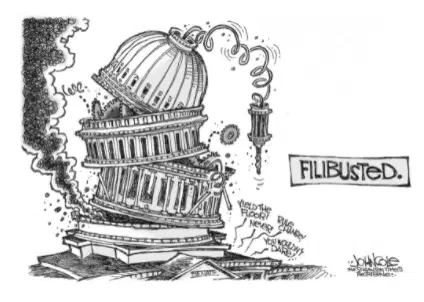
Use the cartoon above to answer the following question: What is this cartoon about?
a)
The role of the majority leader in the House
b)
The role of the majority leader in the Senate
c)
Debate in the House
d)
Debate in the Senate
39.
A bill has passed both houses of congress resulting in two different versions, a House version and a Senate version; what else is true?
a)
Only the Senate version goes to the President.
b)
Only the House version goes to the President.
c)
The version passed most recently goes to the President.
d)
The House and Senate must agree on a common version of the bill in conference committee.
40.
All of the following are enumerated powers of Congress EXCEPT…
a)
The power to declare war
b)
The power to regulate commerce between states and foreign countries
c)
The power to appoint key officials
d)
The power to establish federal courts below the Supreme Court
41.
The President must be which of the following to qualify for office?
a)
no older than 65
b)
Have prior military service
c)
a natural born U.S. citizen
d)
a college graduate
42.
After the Vice President, who is next in the line of succession to become President?
a)
Speaker of the House
b)
Secretary of Labor
c)
Secretary of Energy
d)
Chief of Staff
43.
Which is a power of the President as Commander in Chief?
a)
the power to declare war on another country
b)
the power to veto legislation
c)
the power to appoint the Secretary of State
d)
The ability to control the military
44.
What power does the president have to forgive crimes?
a)
The power to pardon
b)
The power to veto
c)
The power to enforce laws
d)
The power to appoint federal judges
45.
President Obama presiding over a ceremony marking the 10th anniversary of 9/11 is an example of him fulfilling which presidential role?
a)
Chief of State
b)
Commander-in-Chief
c)
Chief Diplomat
d)
Chief Executive
46.
President Nixon signing a treaty to limit nuclear arms production with the Soviet Union is an example of him fulfilling which presidential role?
a)
Chief of State
b)
Chief Diplomat
c)
Chief Executive
d)
Chief Legislator
47.
Which body is able to check the President if they name unqualified to their Cabinet?
a)
House of Representatives
b)
The Senate
c)
The entire congress
d)
The Supreme Court
48.
Which of the following about the Cabinet is FALSE?
a)
Cabinet secretaries are confirmed by the Supreme Court.
b)
Cabinet secretaries advise the President on the best course of action in different situations.
c)
The cabinet addresses matters like commerce, transportation, national defense and foreign relations.
d)
Cabinet secretaries lead departments that help implement the policies of the executive branch.
49.
Which of the following IS NOT part of the executive branch?
a)
The Vice President
b)
The Cabinet
c)
Independent agencies like NASA
d)
The Senate
50.
The tie-breaking vote in the Senate can be cast by the President of the Senate, aka the…
(a)
51.
The 3 branches of Government are (a) (b) (c)
Answer alphabetically
Choose from the below words
Executive
Legislative
Judicial
Federal
State
Local
Law
Bills
President
100 %

