
 Worksheets
2.8 Chemistry Combo
Total questions: 57
Worksheet time: 54mins
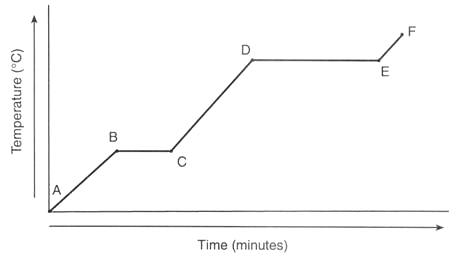
What is happening to the particles in the substance from points C to B?
Melting
Freezing
Boiling
Slowing Down
What is happening on the graph when the line is increasing or decreasing?
State of Matter
Changing Phases
Molecules are changing in number
Molecules are changing heights.
Which process requires that energy is removed from a substance for the change to occur?
melting
freezing
evaporation
What state/phase is the object likely from points A to B?
Solid
Liquid
Gas
Plasma
Which best describes the law of conservation?
The amount of matter increases after a phase change
The amount of matter decreases after a phase change
The amount of matter stays the same after a phase change
The matter is destroyed and disappears after a phase change.
temperature change
solubility
magnetism
oxidation
bubbles forming
change in pH
What is a chemical change?
A substance produced in a chemical reaction.
solute
change
A chemical reaction that indicates if a substance is an acid or base
oxidation
insulator
reactivity
How does reactivity of non-metals increase on the periodic table.
As you move up and to the left on the table
As you move up and right on the periodic table
As you move up and to the right on the table, except for the last group
As you move down and to the right on the table
How does reactivity of metals increase on the periodic table.
As you move up and to the left on the table
As you move down and to the left on the table
As you move up and to the right on the table
As you move down and to the right on the table

The purple section represents which of the following?
Lanthanide Series
Actinide Series
Transition Metals
Post Transition Metals

Which of these elements are MOST reactive?
K
Fr
V
Ra

The highlighted group represents the ______________ .
Alkali Metals
Alkaline Earth Metals
Transition Metals
Halogens

What is the name of the family that is highlighted?
Alkali Metal Family
Halogen Family
Noble Gas Family
Transition Metal Family
Which would NOT be a property of Neon (Ne)
Reactive
Dull Luster
Gas at room temperature
Poor conductor of electricity
Which would NOT be a property of Sodium (Na)
Reacts violently with water
Low density
Low melting point
Dull luster
Which would NOT be a property of Sodium (Na)
Reacts violently with water
Low density
Low melting point
Dull luster
You are designing a new travel mug that will keep your drink hot but your hands cool. What type of element might be good for this?
Metal
Nonmetal
Metalloid
Which is a property of Francium?
Dull Luster
Good Insulator
Brittle
High melting point
What is the classification of an element that conducts heat and electricity, has a shiny luster, and breaks easily?
liquid
insulator
non-metal
metal
Which would NOT be a property of Lithium (Li)
Shiny Luster
Brittle
Good conductor of heat
Very reactive

This image is a model of...
an element
a compound
a solution (homogenous)
a mixture (homogenous)

This picture is a model of...
an element
a compound
a solution (homogeneous)
a mixture (heterogeneous)

This image is a model of...
an element
a compound
a solution (homogenous)
a mixture (heterogeneous)

This picture is a model of a...
element
compound
solution (homogeneous)
mixture (heterogeneous)
All solutions are composed of which two parts __________ .
salts and water
substances and mixtures
heterogeneous and homogeneous
solutes and solvents
Which of the following explains why saltwater is considered a solution?
It is composed of one element.
It is composed of one compound.
It is composed of two or more substances and has new chemical properties.
It is composed of two or more substances and retains their own chemical properties.

Which changes MUST happen for elements to become a compound?
elements are heated
a gas becomes a liquid
elements dissolve in water
chemical bonds form between atoms.
Water (H2O), is not found on the periodic table because water is a...
atom
it is on the periodic table
mixture
compound
All solutions are composed of which two parts __________ .
salts and water
substances and mixtures
heterogeneous and homogeneous
solutes and solvents
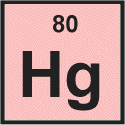
What type of matter does this picture show?
Compound
Element
Solution (Homogeneous)
Mixture (Heterogeneous)
What happens to the reactivity of metals as you move from the right to the left and down on the periodic table
the reactivity decreases
the reactivity increases
the reactivity stays the same
the reactivity is random and does not follow a pattern
Name the process used to separate brewed coffee from the ground beans.
distillation
solution
filtration
boiling
Which of the following substances are elements?
water
salt
carbon dioxide
hydrogen
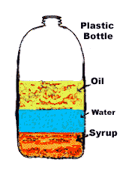

Which method would be best to separate a liquid from a solid.
Filtration
Evaporation
Mechanical
Magnetic
Which is method uses the property of boiling point to separate?
Filtration
Magnetic
Mechanical
Evaporation

