
 Worksheets
Benchmark 5
Total questions: 65
Worksheet time: 54mins
Which of the following is the collection of life's remains found in sedimentary rock?
natural selection
homologous structures
Charles Darwin
the fossil record
Analogous Structure
Same function different structure
Homologous Structure
Same structure different function
Comparative Embryology
Comparing embryological development of different species
Biochemical Evidence
Comparing DNA and amino acid sequences of different species
Vestigial Structures
Structures in the body of an organism that no longer work.


What is a shared characteristic of most animals
Carnivore
Purring
Hair
Shells

Which animals have retractable claws?
Tortoise
Leopard
Wolf
House cat

Which letter represents the most recent common ancestor of sponges and mushrooms?
A
B
C
D
E


The ______________ was when life went from simple organisms to many diverse types of life.
Silurian period
Jurassic period
Cambrian explosion
mass extinction
A herd of elephants uses their trunks to get food more than another heard. Since they are using their trunks so much they get longer and stronger. Then those elephants pass on long strong trunk genes to their kids because they used them so much. Whose idea is this and is it right or wrong?
Lemark; wrong
Lemark; right
Darwin; wrong
Darwin; right


A type of speciation caused by geographic barriers separating populations that once shared a gene pool
Sympatric
Allopatric
Chemical
Temporal

If a population of rabbits becomes divided when a massive rainstorm hits and a new river is formed. Eventually the river dries up (many years later) but the rabbits from opposites sides of the river no longer mate. What has occurred?
Reproductive Isolation
Adaptation and Natural Selection
The Endosymbiotic Theory explains
the origin of prokaryotes
how bacteria lives
the origin of eukaryotes
how species develop
_____ and _____ are organelles that arose from endosymbiosis
nucleus and cell membrane
mitochondria and chloroplasts
cell wall and chloroplasts
mitochondria and nucleus
The earliest organisms that live when Earth has NO oxygen
virus
prokaryotes
eukaryotes
multicellular organisms

Fossil A is an ancient mollusk, an organism that needs water to survive. Why do you think that the mollusk went extinct in this particular sample of the fossil record?
When the ocean levels rose in layer 4, the mollusk went extinct because they cannot live in water
For some reason, the ocean disappeared causing the mollusk to thrive
For some reason, the ocean disappeared causing the mollusk to go extinct
When the ocean level rose in layer 4, the mollusk thrived because they need water

Organisms D and C clearly lived in an aquatic (water) environment. Organism A does not look like it lived in the water. What is the most likely explanation for this?
The fossil in layer A died on land and was carried to the water
The fossils in layer C and D did not live in the same location as the fossil in layer A
The environment changed over a long period of time. It used to be under water, but is not anymore
Which of the following is an example of the bottleneck effect?
Bald Eagles are hunted until near extinction, survivors reproduce and the population recovers.
Small group of iguanas floats to an island, starts a new population.
Red fox pups are more likely to survive in a snowy environment if they are born white.
Farmer chooses seeds from largest apples to plant next year. This results in larger apples from year to year.
Which of the following is an example of the founder effect?
Bald Eagles are hunted until near extinction, survivors reproduce and the population recovers.
Small group of iguanas floats to an island, starts a new population.
Red fox pups are more likely to survive in a snowy environment if they are born with white fur.
Farmer chooses seeds from largest apples to plant next year. This results in larger apples from year to year.
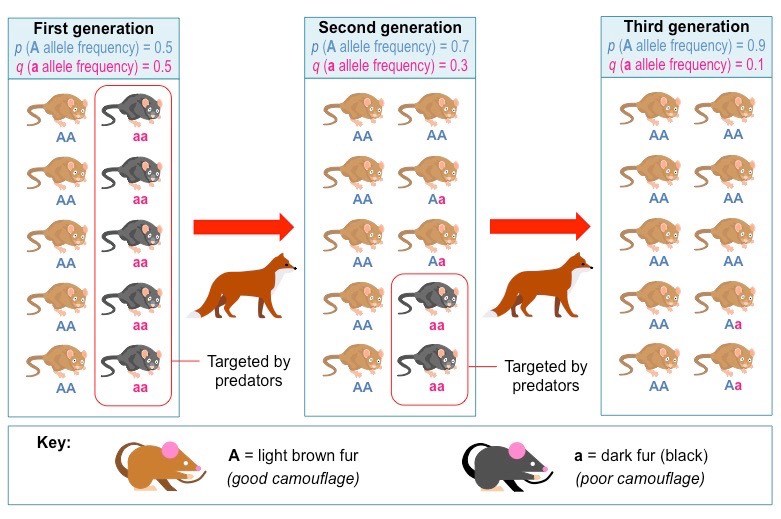
The allele frequencies of the mouse population in the picture are changing over time. Which is true?
The population is evolving.
The population is not evolving.
The population will go extinct.
The population's genetic variation is increasing.

the selection pressure favors the extreme phenotypes, dividing the population into 2 distinct groups
directional selection
stabilizing selection
geographic selection
disruptive selection

individuals with alleles for an extreme type are more likely to survive and reproduce
stabilizing selection
directional selection
disruptive selection
genetic drift

Individuals with intermediate traits are more likely to survive and reproduce
stabilizing selection
directional selection
adaptive radiation
disruptive selection
A scientist collected a population of 100 rock pocket mice. 36 had dark fur
(DD or Dd) and 64 had light fur (dd).
The alleles present in each mouse were determined.
Out of the 200 total alleles for this gene present in this population, the
gene pool contained 40 dark D alleles and 160 light d alleles.
What are the allele frequencies for the two alleles in this population?
D = 0.20; d = 0.80
D = 0.50; d = 0.50
D = 0.25; d = 0.75
D = 0.36; d = 0.64
There are 3 T alleles and 7 t alleles in a population. Calculate the frequency of the recessive allele.
30%
70%
10%
4%


(a) is a group of similar organisms that can mate with each other and produce offspring that can also mate and reproduce.
Darwin's finches had different _____ that always seemed to match their feeding habits
beaks
wings
legs
skulls
This is the process by which organisms with variations more suited to their local environment survive and leave more offspring:
artificial selection
selective breeding
common descent
natural selection

What is an example of convergent evolution?
fish tails and whale tails
bird wings and human hearts
horse hooves and horse tails
fish tails and human feet
What is convergent evolution?
evolution toward similar traits in unrelated species
evolution toward different traits in closely related species
elimination of a species from Earth
the rise of two or more species from one existing species
What comparative anatomy structure has similar form/structure but different function?
Analogous Structures
Homologous Structures
Vestigial Structures
What comparative anatomy structure has a different form/structure but the same function?
Analogous Structures
Homologous Structures
Vestigial Structures

_____________ Evolution occurs when unrelated organisms evolve traits, structures, or morphologies that carry out the same function. An example is insect flight and bird flight.
Convergent
Parallel
Divergent
___________Evolution occurs when similar organisms become more dissimilar in order to adapt to their environments. The organisms' still retain features with similar structure but different function.
Convergent
Parallel
Divergent

A type of isolation used by many species to perform different mating rituals.
temporal isolation
geographic isolation
behavioral isolation
mechanical isolation

A type of isolation in which a physical barrier is present that keep two species from mating.
temporal isolation
geographic isolation
behavioral isolation
mechanical isolation

Observe the two fish in the image. The cave fish and minnow are genetically related to each other and are similar in many ways. The cave fish lives very deep in the ocean where there is no light. It has only the remnants of eyes and is blind. Minnows live in shallow waters where the water has light. Their eye sight is important for their survival. Which statement below best describes these two fish?
The DNA of the cave fish has changed over time to differ from the minnow. Since there is no light where the cave fish lives, it was not necessary to have working eyes. Over time, mutations occurred which proved to improve the survival of the cave fish, which is why they are now blind and have only physical remnants of eyes.
The DNA has not mutated over time and despite all of the evidence that suggests these two are genetically similar, one has eyes and the other does not so they must not be related.
Cave fish must have been attacked by predators, which is why they only have the remnants of eyes.

What type of evidence are shown in the picture above?
Fossils
Embryology
Homologous Structures
Vestigial Structures


What type of evidence is shown in the image above?
Fossils
Vestigial structures
Homologous Structures
DNA
How many nucleotides make up a codon?
1
3
5
15
gene pool
the collective alleles of all members of a population
the exchange of alleles between populations by immigration and emigration
changes of allele frequencies in a gene pool due to random/chance events
cell division which forms gametes
gene pool
the collective alleles of all members of a population
the exchange of alleles between populations by immigration and emigration
changes of allele frequencies in a gene pool due to random/chance events
cell division which forms gametes
The allele frequency of p=.20 What is q?
.80
.04
.32
.64
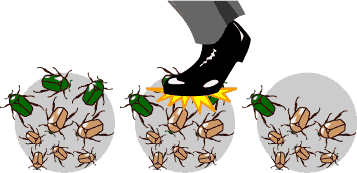
Someone steps on some bugs and randomly removes their alleles from the population. This is an example of
gene flow
genetic drift
speciation
allele frequency
What is genetic drift?
A population for which the gene frequencies do not change
A change in allele frequencies due to selection
The addition or removal of alleles in a population due to individuals entering or leaving one population for another
A change in the gene pool due to chance
Genetic mutations....
Happen every time a new cell is made
Happen randomly
Almost never happen
Can not be passed on to offspring
Why is it important to finish ALL of an antibiotic, even if you feel better?
If all of the infectious bacteria are not killed, the bacteria may continue to multiply. Some of these bacteria may have a mutation that makes them resistant to the antibiotic. This could cause resistant bacteria to spread.
If all of the antibiotic is not used, the surviving bacteria may learn how to fight off the antibiotic, causing the sickness to get even worse.
If all of the antibiotic is not used, the bacteria may begin ingesting your skin cells, causing a new sickness to arise.
If all of the antibiotic is not used, the surviving bacteria may cooperate with other infectious bacteria, resulting in two separate infections at the same time.
Why do doctors suggest that people get a flu vaccine each year?
Viruses replicate more rapidly over time.
Viruses can mutate from year to year.
Vaccines are absorbed by the body after a year.
Vaccines get stronger over time.
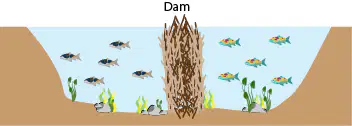
The diagram shows a population of a fish species that live in a river ecosystem.
A small part of the population are geographically isolated from the rest of the population when a dam is built. The diagram shows the populations five years after the dam has been constructed.
If the dam is removed, which statement BEST describes if the two populations could produce fertile offspring?
The two populations can produce fertile offspring because they have a common ancestor.
The two species cannot produce fertile offspring because they have different appearances.
The two populations can produce fertile offspring because they have the same resources available.
The two populations cannot produce fertile offspring because they have become two different species.

Mr. Esparra sprayed a type of pesticide in his garden to kill the insects that are eating his plants. There were very few insects for a few weeks, but then the insect population grew as they produced offspring. Mr. Esparra treated the insects again with the same pesticide. However, the pesticide did not kill as many insects. The model below shows how the insects in Mr. Esparra's garden were affected by the pesticide applications. Which of the following statements BEST explains this phenomenon?
Because of selective breeding, the insects that survived the first round of pesticide were able to choose how their offspring would react to pesticide.
Because of natural selection, the insects that survived the first round of pesticide produced offspring that were likely to resist the pesticide as well.
Because of selective breeding, the pesticide that was used only targeted certain kinds of insects to allow the rest to thrive in the garden.
Because of natural selection, the pesticide changed over time because it adapted to the garden environment in which it was sprayed.

A scientist maintains a healthy culture of a single species of bacteria in a container. She then introduces a new substance into the bacterial culture. Within a day, most of the bacteria died. Which of the following best explains why some of the bacteria survived?
They mutated and became a different species after exposure to the substance.
They had a genetic variation that gave them resistance to the added substance.
They absorbed the substance and broke it down in their digestive systems.
They were exposed to the substance long enough to develop a resistance to it.

The model below shows the initial result of treating a population of bacteria with antibiotics. The red bacteria represent mutated bacteria that are resistant to antibiotics. Which of the following describes what would MOST LIKELY happen to the bacteria population next?
No bacteria will be left after the red bacteria mutate and are killed by the antibiotic.
The red bacteria will remain but will not be able to reproduce due to their mutation.
The red bacteria will reproduce, creating an equal number of red and blue offspring.
The red bacteria will reproduce and pass on their mutation to their offspring.

