
NEW
Font size
 Worksheets
AP Unit 3 Review (Cell Respiration & Photosynthesis)
Total questions: 30
Worksheet time: 15mins
Why is cell respiration considered an EXERGONIC / CATABOLIC process?
The reactants (glucose) have more chemical potential energy than the products (H2O, ATP etc)
The reactants (glucose) have less chemical potential energy than the products (H2O, ATP etc)
Chemical bonds are constructed during RedOx
Enzymes are required to facilitate the chemical reactions of glycolysis and the citric acid cycle
Why is photosynthesis considered an ENDERGONIC / ANABOLIC process?
The reactants (H2O and CO2) have more chemical potential energy than the products (G3P)
The reactants (H2O and CO2) have less chemical potential energy than the products (G3P)
Chemical bonds are destructed during RedOx
Enzymes are required to facilitate the chemical reactions of the light-dependent reactions and the Calvin cycle
Where, in a eukaryotic cell, does GLYCOLYSIS take place?
Matrix of a mitochondria
Intermembrane space of a mitochondria
Inner membrane of a mitochondria
Cytoplasm of the cell
Where, in a prokaryotic cell, does GLYCOLYSIS take place?
Within the cell membrane
Within a ribosome
Outside of the cell
Cytoplasm of the cell
Where, in a eukaryotic cell, does the CITRIC ACID CYCLE take place?
Matrix of a mitochondria
Intermembrane space of a mitochondria
Inner membrane of a mitochondria
Cytoplasm of the cell
Where, in a eukaryotic cell, does the ELECTRON TRANSPORT CHAIN take place?
Matrix of a mitochondria
Intermembrane space of a mitochondria
Inner membrane of a mitochondria
Cytoplasm of the cell
Why is CELL RESPIRATION considered an AEROBIC process?
All reactions require oxygen
Cell respiration only takes place when oxygen is available
The maximum quantity of ATP is produced when oxygen is available
It is an ancient metabolic pathway that predates atmospheric oxygen
What is the primary function of NADH and FADH2?
They are enzymes responsible for catalyzing the chemical reactions of the citric acid cycle
They are responsible for carrying electrons from glucose to the ETC
They store energy in their chemical bonds
They generate massive amounts of ATP as they follow their energy gradient
Which products are considered the "exhaust" or the waste of cell respiration?
H2O and CO2
ATP and H2O
NADH and FADH2
O2 and ATP
What is the overall GOAL of glycolysis?
To make ATP
To make NADH
To make H2O
To split glucose and make pyruvate
What is the overall GOAL of the Citric Acid Cycle?
To make ATP
To make CO2
To make NADH and FADH2
To make Acetyl-coA
What is the overall GOAL of the Electron Transport Chain?
To make ATP
To make H2O
To make NADH and FADH2
To make CO2
Cellular respiration can be temporarily stopped (or slowed) through feedback inhibition. Which of the following best explains how cell respiration is controlled?
NADH shuts off glycolysis
Water shuts off the citric acid cycle
Pyruvate shuts off the ETC
ATP shuts off glycolysis
There are TWO potential methods for making ATP in a typical eukaryotic cell: substrate-level phosphorylation and oxidative phosphorylation.
ALL of the following statements are TRUE of substrate-level phosphorylation, EXCEPT...
FOUR ATP are made during GLYCOLYSIS
TWO ATP are made during the CITRIC ACID CYCLE
A KINASE is required to transfer the phosphate group from ADP to ATP
28 ATP are made during the ETC
There are TWO potential methods for making ATP in a typical eukaryotic cell: substrate-level phosphorylation and oxidative phosphorylation.
ALL of the following statements are TRUE of oxidative phosphorylation, EXCEPT...
It requires a proton-motive force (the diffusion of H+ ions)
ATP synthase is required to transfer the phosphate group from ADP to ATP
A KINASE is required to transfer the phosphate group from ADP to ATP
28 ATP are made during the ETC
Assume that a cell requires 1000 ATP per second to meet its metabolic needs. How many glucose molecules (approximately) are burned under aerobic conditions to meet this demand?
20
30
40
50
Assume that a cell requires 1000 ATP per second to meet its metabolic needs. How many glucose molecules (approximately) are burned under anaerobic conditions to meet this demand?
200
30
40
500
If not to produce ATP, what is the alternate purpose for cell respiration?
Heat
Intermediates
Regenerate NAD+ and FAD
All options are correct
What is the overall GOAL of the light-dependent reactions of photosynthesis?
To make G3P
To make Oxygen
To split water
To make ATP and NADPH
What is the overall GOAL of the Calvin cycle of photosynthesis?
To consume CO2
To "fix" carbon
To produce O2
To harvest electrons
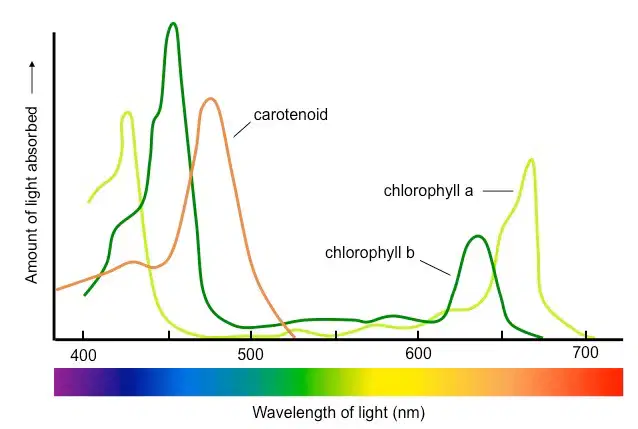
Study the figure. Which of the following best identifies a benefit of having multiple pigments within the photosystem?
The pigments are expressed in leaves, flowers and fruit.
The pigments reflect light within certain wavelengths.
The pigments increase the likelihood that a plant will be adapted to life on land.
The pigments increase the amount of energy that can be harvested for photosynthesis.
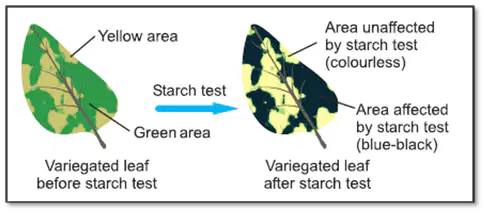
A veriegated leaf has regions that are green and regions that may be some other color, such as yellow, white or even red. In the experiment pictured here, only the green portions of the plant appear to test positive for starch. Which of the following conclusions can be made about this experiment?
The leaf is only capable of photosynthesis when light is available.
Maximum photosynthetic output is observed when white light is available.
Chlorophyll, the green pigment in plants, is required for photosythesis.
Veriegated leaves must be better adapted for survival in colder climates.

A mitochondrion and chloroplast are compared side-by-side. Which regions, in each organelle, become ACIDIC as a result of a hydrogen ion gradient produced by the ETC?
The region that is RED
The region that is GREEN
The region that is GREY
The region that is WHITE
A mitochondrion and chloroplast are compared side-by-side. Which regions, in each organelle, might have a high concentration of ATP (assuming it isn't immediately used)?
The region that is RED
The region that is GREEN
The region that is GREY
The region that is WHITE
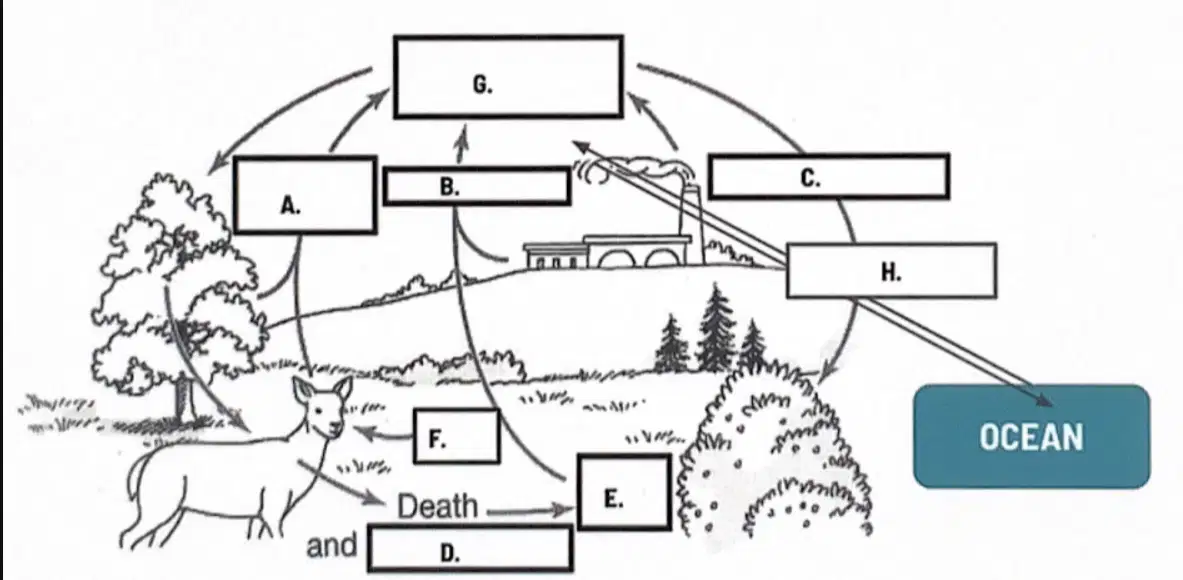
This figure illustrates the Carbon Cycle. Which of the following would be the most appropriate label for letter F?
Photosynthesis
Carbon dioxide
Cell Respiration
Oxygen
This figure illustrates the Carbon Cycle. Which of the following would be the most appropriate label for letter C?
Photosynthesis
Carbon dioxide
Cell Respiration
Oxygen
This figure illustrates the Carbon Cycle. Which of the following would be the most appropriate label for letter A?
Photosynthesis
Carbon dioxide
Cell Respiration
Oxygen
Which of the following correctly identifies a major obstacle that land plants have had to overcome?
Dehydration
Obtaining oxygen
Using visible light
Fixing carbon
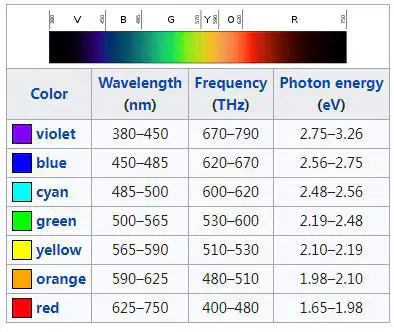
White light includes ALL colors of the rainbow but green plants cannot use all 7 colors. Which singular color would produce maximum photosynthetic output if only one color was absorbed?
red
yellow
cyan
violet
Which of the following identifies a major advantage of autotrophs?
They depend on heterotrophs
They can perform photosynthesis and cell respiration
They don't need oxygen
They never need to eat

