
NEW
Font size
 Worksheets
Geologic Processes
Total questions: 15
Worksheet time: 9mins
Which of the following statements best describes the outer core?
It is the outermost layer of Earth, made of solid rock.
It is the liquid inner layer of Earth, made of metals at extremely high temperatures.
It is the solid inner layer of Earth, made of metals at extremely high temperatures.
It is the middle layer of Earth, made of rock which varies in temperature and thickness.
Two students are discussing the processes that form the different rocks near mountains and lakes. Which choice below compares the formation of rocks at these locations?
Sedimentary rock is formed from the heat and pressure in between tectonic plates to form mountains. Rivers deliver weathered rock to lake beds and form igneous rock over long periods of time.
Igneous rock is formed by volcanoes releasing magma from the mantle, the rock cools and piles up forming a mountain. Rivers direct water to cool magma underground forming metamorphic rock under lake beds.
Metamorphic rock is formed by heat and pressure of tectonic plates is then pushed up to form mountains. Rivers deliver weathered rocks into lake beds forming sedimentary rock as more layers are added.
Mountains push weathered rocks underneath tectonic plates to form sedimentary rocks inside the mantle. Rivers erode igneous rocks over time to form metamorphic rock.
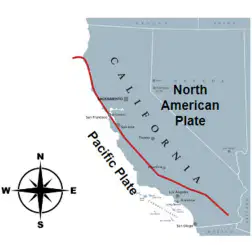
California sits at the border between two major tectonic plates:
Pacific plate, moving northwest,
North American plate, moving southeast.
Each year the California area has about 10,000 earthquakes. Which of the following describes why earthquakes are a common occurrence in California?
The two plates form a transform boundary because earthquakes are caused by plates sliding past each other.
The two plates form a convergent boundary because earthquakes are caused by plates sliding past each other.
The two plates form a convergent boundary because earthquakes are caused by the Pacific plate subducting under the North American plate.
The two plates form a transform boundary because earthquakes are caused by the Pacific plate subducting under the North American plate.
Which of Earth's layers would be described as being rocky and having the lowest density?
crust
mantle
inner core
outer core
The Andes Mountains are the world's longest range of mountains and runs north to south along
the Pacific Ring of Fire. It is known for its several volcanoes including the world’s highest active
volcano, Nevados Ojos del Salado. How are volcanoes like this formed?
Divergent plate boundaries cause mountains to separate, leaving room for the convecting magma below to enter.
Convergent plate boundaries carve out an opening at the top of the mountains, which allows convecting magma in the ground to rise.
Divergent plate boundaries cause plates to collide, causing subduction where convection in the mantle forces magma to the surface.
Convergent plate boundaries cause plates to collide. Oftentimes, this collision forces the denser plate to subduct while convection in the mantle forces magma to the surface.
Which option describes how heat and the movement of Earth's tectonic plates contribute to the formation of an ocean basin?
Heat from the mantle forms convection currents causing the plates to transform.
Heat from the mantle conducts through the tectonic plates causing the plates to converge.
Heat from the mantle forms convection currents causing the tectonic plates to diverge.
Heat from the mantle conducts through tectonic plates causing them to melt.
How does the flow of heat through the mantle affect the movement of Earth's tectonic plates?
Heated material in the mantle rises towards the crust through convection which causes plate motion.
Heated material in the mantle rises to the surface by radiation, which causes the crust to harden and move the plates.
Heat conducted from the Earth's mantle moves tectonic plates due to the gravitational pull from the Earth's core.
Heat is transferred from the mantle to the crust by radiation, which then causes the plates to move on the surface.
A group of scientists is studying two tectonic plates. When they analyzed the data, they noticed that the two plates have been pushing against each other over the past ten years. What will most likely occur between the two plates?
The plates will slowly subduct causing an earthquake.
The plates will slowly converge causing a mountain to form.
The plates will quickly transform causing the formation of a canyon.
The plates will quickly diverge forming an ocean basin.
Which of the following correctly compares Earth's inner core and mantle?
The inner core is thinner than the mantle.
The inner core is a liquid and the mantle is a solid.
The inner core is less dense than the mantle.
The inner core is closer to the crust than the mantle.
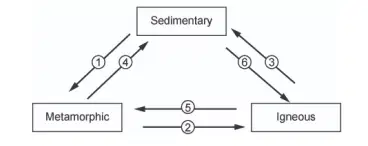
Use the following rock cycle model to answer the following question.
Which of the following events must occur at point 6 in order to transform sedimentary rock into igneous rock?
Rising oceans erode mountains of sedimentary rock into particles, which sink and get compacted into layers that form igneous rock.
Extreme winds and storms weather the sedimentary rock into particles, which collect in rivers and are compacted into igneous rock.
Shifting tectonic plates push the sedimentary rock toward the poles, where it freezes and hardens into igneous rock.
Tectonic plates push against each other, driving sedimentary rock under Earth's surface, where it melts into magma and turns into igneous rock as it cools.
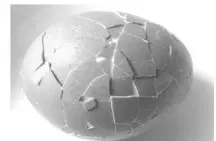
Alisha's science teacher asked each student to create a model of the Earth's tectonic plates.
Alisha decided to use a hard-boiled egg, like the one pictured below.
A. The egg white under the shell represents the mantle.
B. The shape of the egg matches the shape of the Earth.
C. The cracks on the shell represent the tectonic plate boundaries.
D. The eggshell “plates” are able to move like the Earth’s tectonic plates.

The map below shows some of Earth’s plate tectonic boundaries.
Based on the map, volcanic activity would most likely be found at which location?
A. Location W
B. Location X
C. Location Y
D. Location Z
Which type of plate movement will result in a volcano forming at a subduction zone?
A. When two continental plates collide.
B. When two continental plates move apart.
C. When an oceanic and a continental plate collide.
D. When an oceanic and a continental plate move apart.

Below is a model of the rock cycle.
Which of the following options best identifies a limitation of the model?
A. The model does not show an image of the rocks.
B. The model includes a path of formation of the rocks.
C. The model does not include what is needed for rocks to form.
D. The model includes how temperature and pressure affect how a rock is formed.
Mauna Loa Volcano is one of five volcanoes that form the Island of Hawaii in the U.S. It is
among one of Earth's most active volcanoes. What conclusion can you draw about the rocks
formed around Mauna Loa?
A. Igneous rocks were formed by cooling.
B. Metamorphic rocks were formed by compaction.
C. Igneous rocks were formed by heat & pressure.
D. Sedimentary rocks were formed by weathering & erosion.

