Worksheets
Earth Science Midterm
Total questions: 38
Worksheet time: 30mins
Which event occurred approximately 4.6 billion years ago?
evolution of the earliest fish
evolution of stomatolites
formation of the oldest known Earth rocks
formation of Earth and our solar system
Which two characteristics do all Jovian planets have in common?
small diameters and low densities
small diameters and high densities
large diameters and low densities
large diameters and high densities
Which planet takes more time to complete one rotation on its axis than to complete one revolution around the Sun?
Mercury
Venus
Mars
Jupiter
Approximately 97% of Venus's atmosphere is carbon dioxide. Describe how carbon dioxide contributes to the unusually high average surface temperature of Venus.
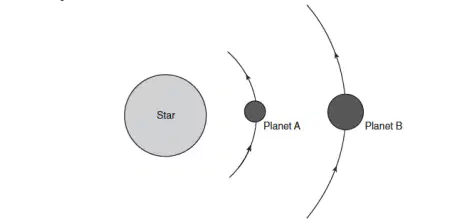
The diagram below represents planets A and B, of equal mass, revolving around a star. Compared to planet A, planet B has a
weaker gravitational attraction to the star and a shorter period of revolution
weaker gravitational attraction to the star and a longer period of revolution
stronger gravitational attraction to the star and a shorter period of revolution
stronger gravitational attraction to the star and a longer period of revolution
Compared to the oceanic crust, the continental crust is (for your referense, felsic and granitic are the same thing, same with basaltic and mafic)
less dense and more basaltic
less dense and more felsic
more dense and more granitic
more dense and more mafic
Which landmass is moving northward with Australia as part of the same tectonic plate?
India
Antartica
North America
South America
Earth's internal heat is the primary source of energy that
warms the lower troposphere
melts glacial ice at lower altitudes
moves the lithospheric plates
pollutes deep groundwater with radioactivity

The epicenter of an earthquake is located 6500 kilometers away from a seismic station. If the first S-wave arrived at this seismic station at 1:30 p.m., at what time did the first P-wave arrive?
1:20 pm
1:22 pm
1:38 pm
1:40 pm

The Aleutian Islands extend westward from southern Alaska to form the northern boundary of the Pacific Ocean. These volcanic islands were formed by the nearby
subduction of a continental plate
subduction of an oceanic plate
divergence of a continental plate
divergence of an oceanic plate
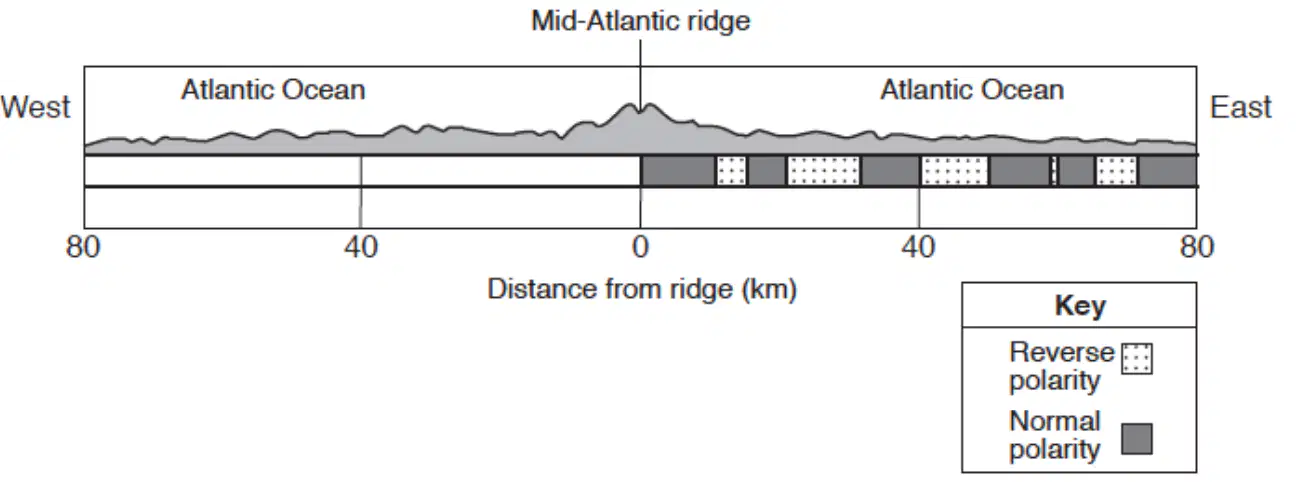
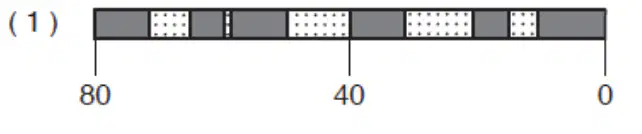
The cross section below represents a pattern of magnetic field reversals preserved in the igneous bedrock of the oceanic crust east of the Mid-Atlantic ridge.
Which cross section best represents the magnetic field pattern west of the Mid-Atlantic ridge?
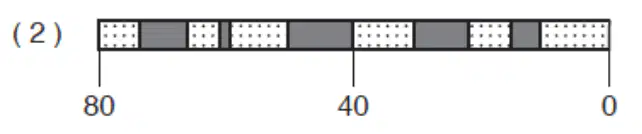
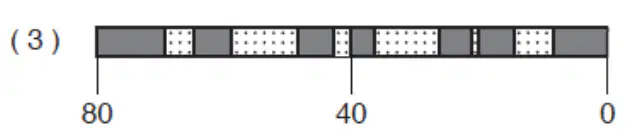

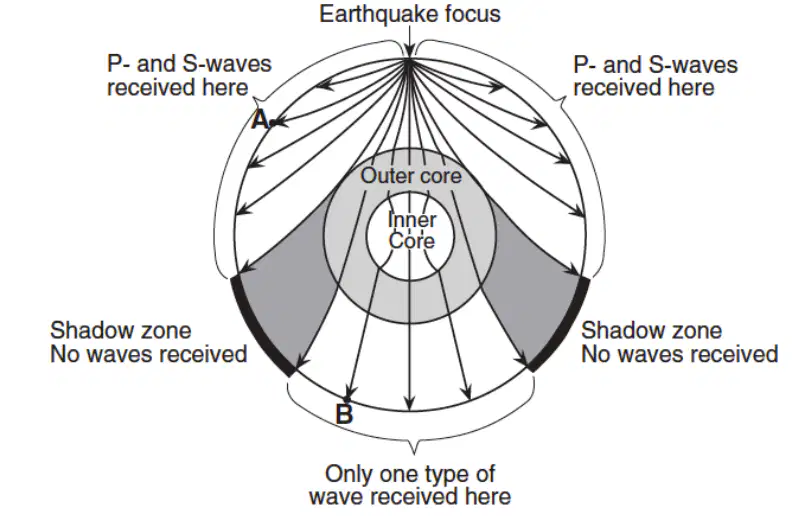
The cross-sectional view of Earth below, which shows seismic waves traveling from the focus of an earthquake. Points A and B are locations on Earth’s surface.
Which statement best explains why only one type of seismic wave was recorded at location B?
S-waves cannot travel through the liquid outer core.
S-waves cannot travel through the liquid inner core.
P-waves cannot travel through the solid outer core.
P-waves cannot travel through the solid inner core.
Base your answers on the passage below. Crustal Activity at Mid-Ocean Ridges Mid-ocean ridges are found at one type of tectonic plate boundary. These ridges consist of extensive underwater mountain ranges split by rift valleys. The rift valleys mark places where two crustal plates are pulling apart, widening the ocean basins, and allowing magma from the asthenosphere to move upward. In some cases, mid-ocean ridges have migrated toward nearby mantle hot spots. This explains why mid-ocean ridges and mantle hot spots are found together at several locations.
Which type of tectonic plate boundary is located at mid-ocean ridges?
convergent
transform
divergent
complex
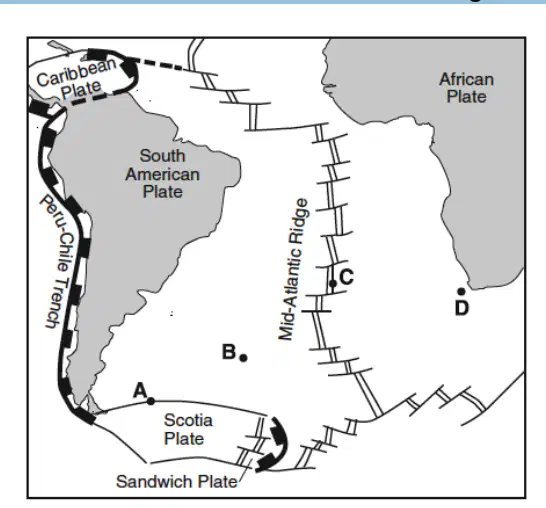
The map below shows a part of Earth’s surface. Points A through D are locations on the ocean floor.
At which location is the temperature of the ocean floor bedrock most likely highest?
A
B
C
D
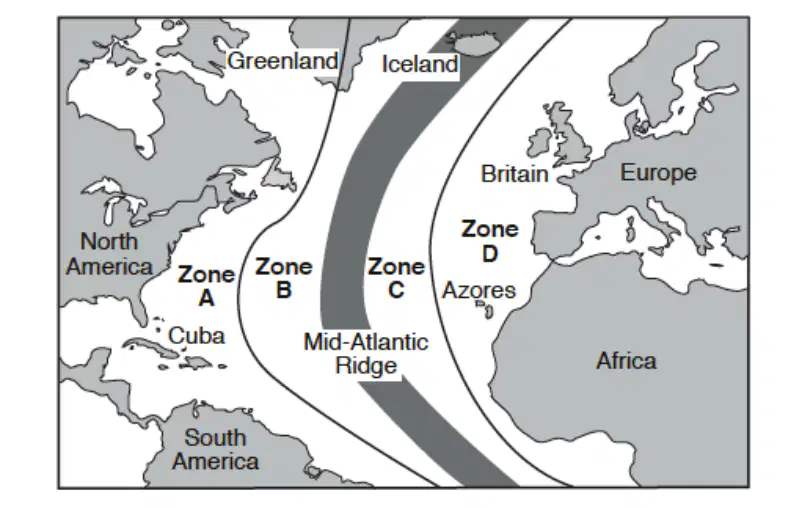
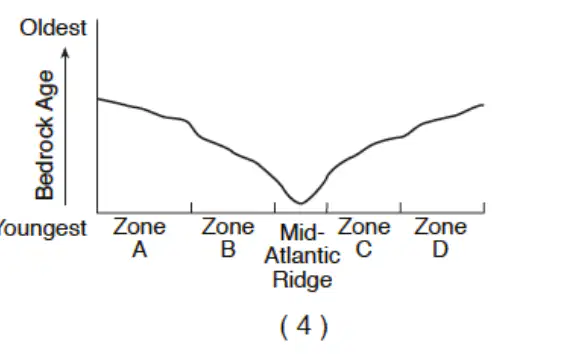
The map below shows the Atlantic Ocean divided into zones A, B, C, and D. The Mid-Atlantic Ridge is located between zones B and C.
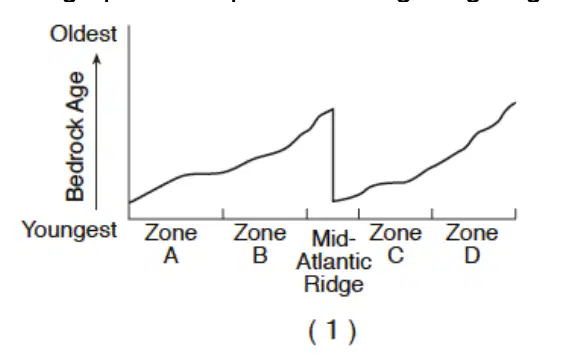
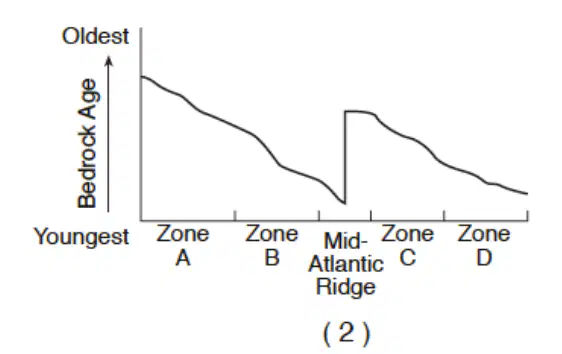
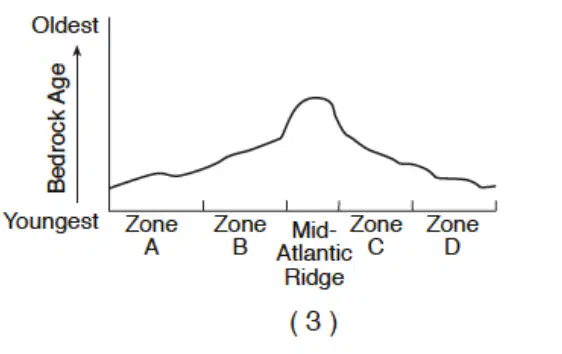
Which graph best represents the geologic age of the surface bedrock on the ocean bottom?
Which sequence correctly lists the relative sizes from smallest to largest?
our solar system, universe, Milky Way Galaxy
our solar system, Milky Way Galaxy, universe
Milky Way Galaxy, our solar system, universe
Milky Way Galaxy, universe, our solar system
Which set of events is most common along tectonic plate boundaries?
Earthquakes and volcanoes
Erosion and earthquakes
Tidal waves and volcanoes
Hurricanes and tsunamis
Convection currents happen in the mantle. The outer core heats magma around it and causes it to become less dense. Because the magma is less dense than the material around it, it starts to rise toward the crust. Since the crust is not hot, the magma starts to cool as it gets close to the crust. Since it is cooling, it gets denser and starts to sink back down toward the outer core.
Use the information above to answer the following question: Which of the following TWO things happen to magma causing it to rise?
It gets cooler.
It gets warmer.
It gets denser.
It gets less dense.
What is the thinnest and outer most layer of the Earth, that we live on?
Outer Core
Crust
Mantle
Inner core
Which layer of the Earth is solid iron and nickel?
Mantle
Crust
Inner Core
Outer core
What was the name given to all the continents when they were joined as one super continent?
Supreme Continent
Eurasia
Plate tectonics
Pangaea


The luminosity of a star describes its ______________.
brightness
temperature
age
color
What color are the coolest stars?
red
blue
white
orange
Whether a star ends up as a red dwarf or a neutron largely depends on what characteristic of the star?
its color
its mass
its location
its temperature

main sequence>
red giant >
white dwarf
main sequence>
white dwarf>
red giant
protostar>
white dwarf>
red giant
red giant >
main sequence>
white dwarf

How did the Hawaiian islands form?
tectonic plates sliding past one another
two oceanic plates colliding to form an island arc
an oceanic plate moving over a hot spot
lava flowing over Earth's surface where two plates move apart (divergent boundary)