
 Worksheets
Chapter 5 Quiz
Total questions: 23
Worksheet time: 12mins
What fact supported John Adams's defense of the British soldiers who took part in the Boston Massacre?
The mob attacked the soldiers with snowballs, ice, and clubs.
Many Boston citizens were angry because British soldiers were taking their jobs.
John Adams was a leading Patriot, which guaranteed the trial would be fair.
The soldiers became the villains of illustrated broadsides and ballads.
Besides colonial tea merchants, who suffered direct losses because of the Tea Act of 1773?
King George III
Members of the British Parliament
Members of the British East India Company
Colonial smugglers
What idea did the believers of the Great Awakening share with John Locke?
Governments depend on the consent of the governed.
Individuals have the right to question a leader's authority.
People should fear the judgment of God.
Church leaders should be the moral authority.
How did Samuel Adams' committee of correspondence contribute to anti-British sentiment in the colonies?
By encouraging colonists to train in the arts of war
By listing and publishing British offenses against the colonies' rights
By organizing boycotts of tea and paper products
Against quartering British troops in colonists' homes
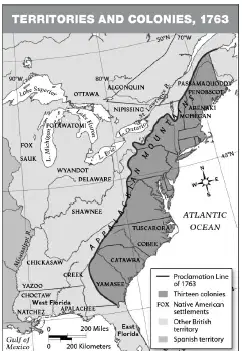
According to the map, which geographic feature did the Proclamation Line of 1763 run through?
Atlantic Ocean
Appalachian Mountains
Gulf of Mexico
Lake Michigan
Why did the Sugar Act reduce the duties on imported molasses?
To discourage trade with French trappers
To solidify treaties with local tribal leaders
To encourage merchants to stop smuggling
To reinforce British control over the colonies

Where were the thirteen colonies located?
Along the coast of the Gulf of Mexico
East of the Proclamation Line of 1763
West of the Proclamation Line of 1763
West of the Mississippi River

According to the map, who owned the territory west of the Mississippi River?
Britain
British colonists
Native Americans
Spain
Why did King George III try to limit contact between the citizens of the British colonies and Native Americans?
To keep peace on the frontier
To open better transportation routes
To protect colonial property rights
To grant British rights to Native Americans
What group organized a boycott and orchestrated the Boston Tea Party?
Daughters of Liberty
Whigs
Loyalists
Sons of Liberty

What was the primary purpose of the Stamp Act imposed by the British Parliament?
To establish British military presence in the colonies
To raise revenue from the American colonies
To regulate colonial trade
To punish the colonies for the Boston Tea Party
Which event directly led to the Intolerable Acts being passed by the British Parliament?
The Boston Massacre
The Battle of Lexington and Concord
The Boston Tea Party
The signing of the Declaration of Independence
What was the significance of the First Continental Congress in 1774?
It coordinated a colonial response to the Intolerable Acts
It negotiated peace with Native American tribes
It established a colonial army
It declared independence from Britain
What was the main reason for the British Parliament to pass the Townshend Acts?
To promote trade with other European nations
To raise revenue by taxing essential goods
To establish a new colonial government
To punish the colonies for the Boston Tea Party
Which event marked the beginning of open hostilities between the American colonies and Britain?
The signing of the Declaration of Independence
The Boston Tea Party
The Battles of Lexington and Concord
The Battle of Bunker Hill
What was the purpose of the Quartering Act imposed by the British Parliament?
To provide housing and supplies for British soldiers in the colonies
To enforce the Proclamation Line of 1763
To collect taxes on imported goods
To establish a colonial navy
What was the main objective of the Declaratory Act of 1766?
To provide financial aid to the colonies
To assert British authority to legislate for the colonies
To reduce taxes on imported goods
To establish a colonial assembly
Which event was a direct result of the Intolerable Acts?
The formation of the First Continental Congress
The signing of the Treaty of Paris
The Boston Massacre
The drafting of the Articles of Confederation
What was the significance of the Olive Branch Petition?
It was a final attempt to avoid war with Britain
It declared independence from Britain
It proposed a new colonial government
It established a colonial currency
What was the primary goal of the Navigation Acts?
To establish a colonial navy
To encourage trade with Native American tribes
To restrict colonial trade to benefit England
To promote free trade among the colonies
Which event was a catalyst for the American Revolution?
The French and Indian War
The drafting of the Articles of Confederation
The Boston Tea Party
The signing of the Treaty of Paris
What was the impact of the Intolerable Acts on the American colonies?
They led to increased loyalty to the British crown
They resulted in the closure of all colonial ports
They united the colonies against British rule
They established a new colonial currency

