
 Worksheets
Neuromuscular!
Total questions: 10
Worksheet time: 7mins
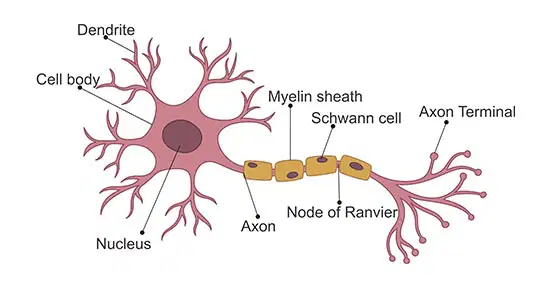
What type of cell is a neuron?
Muscle Cell
Stem Cell
Nerve Cell
Endothelial Cells

Each neuron has a process called an (a) , which extends from the cell body and can conduct electrical impulses called action potentials.
(a) establish communication networks throughout the body based on their specialized structures and functions.
Motor neurons are covered with (a) channels, which open in response to electrical signals from the brain.

What occurs at the neuromuscular junction?
A motor neuron reaches a liver cell
A motor neuron reaches a muscle cell
Select all the functions of Acetylcholine (ACh).
Activates muscles through the peripheral nervous system
Acts as a neurotransmitter through the autonomic nervous system
Uses the hippocampus to support cognitive function of targeted areas
Denotes nerve cell projects from the basal fore brain to the cerebral cortex through the central nervous system.

An ion will diffuse across a cell membrane if...
There is a concentration gradient
The membrane is permeable to the ion trying to cross it

Muscles alternate with relaxation thus causing constant movement for various parts of the body.
True
False
Which muscle cell types are affected by Acetylcholine?
Striated
Smooth
Cardiac

What happens when a motor neuron stimulates a muscle cell?
The permeability to both sodium and potassium ions increases temporarily in a pattern that results in sodium ions entering the cell faster than potassium ions leave
The permeability to both sodium and potassium ions decreases temporarily in a pattern that results in sodium ions entering the cell faster than potassium ions leave
The permeability to both sodium and potassium ions decreases temporarily in a pattern that results in sodium entering the cell slower than potassium ions leave
The permeability to both sodium and potassium ions increases temporarily in a pattern that results in sodium ions entering the cell slower than potassium ions leave

