
 Worksheets
B.4 Ecology
Total questions: 19
Worksheet time: 10mins
Name
Class
Date
1.
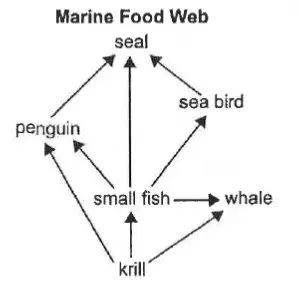
Which sequence correctly describes the flow of energy between organisms in the marine food web?
a)
from seals to penguins to krill
b)
from whales to krill to small fish
c)
from sea birds to seals to penguins
d)
from small fish to penguins to seals
2.
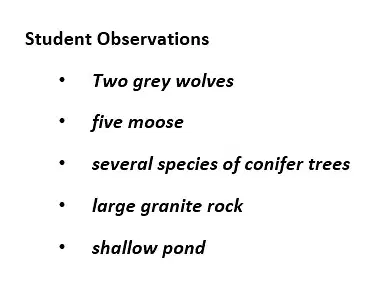
A student wrote several observations in a field notebook. Which term best classifies all of the student’s observations?
a)
population
b)
food chain
c)
ecosystem
d)
community
3.
What is the process by which bacteria living on the roots of legumes covert nitrogen gas into nitrates in the soil?
a)
nitrogen fixation
b)
excretion
c)
decomposition
d)
denitrification
4.
Carbon cycles through the biosphere through ALL processes EXCEPT:
a)
photosynthesis
b)
respiration
c)
transpiration
d)
decomposition
5.
There are 150 Saguaro cacti plants per square kilometer in a certain area of the desert. Which population characteristic does this information best refer to?
a)
exponential growth chart
b)
geographic range
c)
population density
d)
emigration
6.
Emigration is to ________________________, as immigration is to_________________________.
a)
organisms leaving a territory; organisms entering a territory
b)
organisms entering a territory; organisms leaving a territory
c)
organisms dying; the birth of new organisms
d)
the birth of new organisms; organisms dying
7.
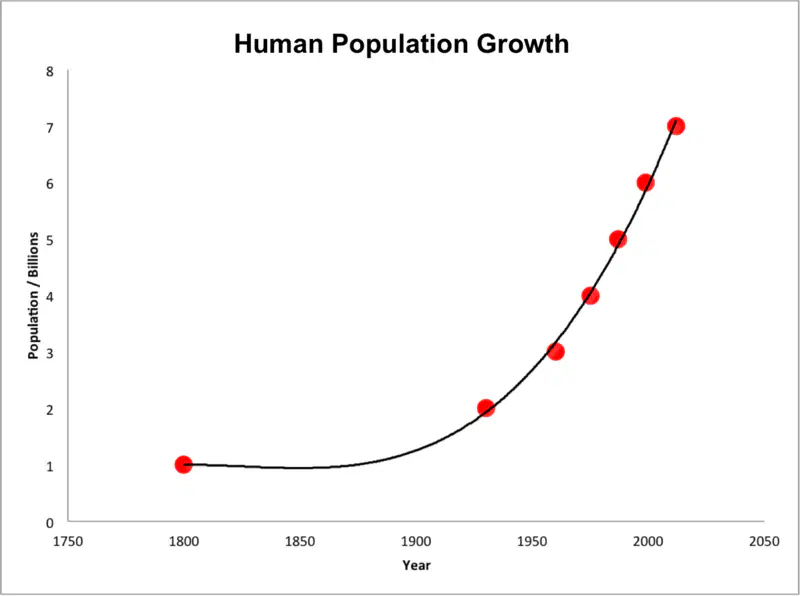
When individuals in a population reproduce at a constant rate under ideal conditions without any limitations, this behavior produces a growth pattern called:
a)
logistic growth
b)
demographic transition
c)
growth density
d)
exponential growth
8.
A student listed characteristics of a classroom aquarium ecosystem. Which characteristic is a BIOTIC component of the aquarium ecosystem?
a)
The water temperature is 23°C.
b)
The pH of the water is usually between 6.5 and 6.8.
c)
Two types of bacteria help to control the ammonia levels.
d)
The lighting is supplied by natural sunlight and a fluorescent light bulb.
9.
Tadpoles grown in ponds with high densities of tadpoles have lower survival and growth rates than tadpoles grown in ponds with lower densities of tadpoles. Which interaction between tadpoles grown in high-tadpole-density ponds would most likely cause the decreased survival and growth rates?
a)
symbiosis
b)
mutualism
c)
competition
d)
commensalism
10.
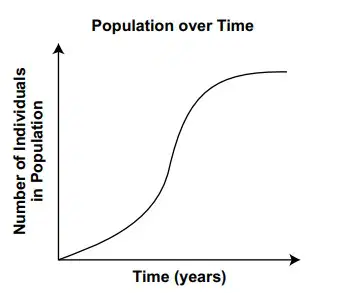
Which population description is most likely represented by the graph?
a)
A population of birds quickly increases but then becomes stable due to limiting factors in the environment.
b)
A population of mice slowly increases but then fluctuates seasonally as predators raise their young and limit prey populations.
c)
A population of fish quickly increases in the spring when there is plenty of food but then decreases quickly in the fall when food is limited.
d)
A population of wolves slowly increases because of limiting factors in the environment but then increases constantly when additional prey migrate into the environment.
11.
Which sequence best orders ecological categories from the one with the fewest number of individuals to the one with the greatest number of individuals?
a)
ecosystem, population, community, biome
b)
population, community, ecosystem, biome
c)
biome, population, community, ecosystem
d)
community, biome, population, ecosystem
12.
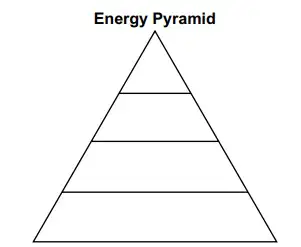
Energy pyramids describe food and energy relationships within an ecosystem. Which factor most likely limits the number of levels an energy pyramid can have?
a)
biomass of the top-level organisms
b)
predation by the top-level organisms
c)
energy loss between each level of organisms
d)
chemical energy being decomposed at each level of organisms
13.
Orchids living in tropical rainforests often grow on the branches of trees to access sunlight. The trees are not affected by the orchids. Which term best classifies the relationship between the orchids and the trees?
a)
predation
b)
parasitism
c)
competition
d)
commensalism
14.
A student studying the biosphere makes a list of biotic and abiotic characteristics of various biomes. Which characteristic is considered a biotic factor?
a)
dry, sandy, nutrient-poor soil in a desert
b)
less than 25 cm of precipitation in a desert
c)
evergreen trees present in a coniferous forest
d)
temperature range of -40 to 40°C in a grassland
15.
Which example describes a mutualistic relationship between organisms?
a)
Young wasps prey on caterpillars.
b)
Crabs eat the remains of dead fish.
c)
Ants protect a tree on which they feed.
d)
Tapeworms feed on food in the intestines of cats
16.
Most of the water on Earth is located in the oceans and has a salinity of about 3.5%. Which statement best explains why rain is fresh water and has a very low salinity?
a)
When water precipitates from oceans, most of the salt remains in the oceans.
b)
When water evaporates from oceans, most of the salt remains in the oceans.
c)
When water precipitates from clouds, most of the salt remains in the clouds.
d)
When water evaporates from clouds, most of the salt remains in the clouds.
17.
Why are nonnative species often considered a disturbance in an ecosystem?
a)
They increase mutations.
b)
They compete for resources.
c)
They have special growth needs.
d)
They cause increased biodiversity.
18.
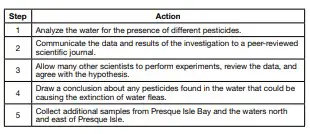
Which sequence of steps is needed for the scientist’s hypothesis about the absence of amphipods to eventually become a theory?
a)
3, 2, 4, 1, 5
b)
4, 3, 5, 1, 2
c)
5, 1, 4, 2, 3
d)
5, 4, 3, 2, 1
19.
Asian carp are an invasive species of fish. These large fish eat up to 40% of their body weight per day by feeding on phytoplankton. The carp also reproduce quickly. If these fish were to enter Lake Erie, how would the Presque Isle coastal ecosystem most likely be affected?
a)
Producers in the ecosystem would grow at a faster rate, and smaller fish such as yellow perch would thrive.
b)
The invasive fish would prey on mollusks such as mussels, but native fish species would quickly eat the invasive fish.
c)
Consumers in the higher trophic levels would suffer stress, but crustaceans such as amphipods would be unaffected.
d)
Most consumers in the ecosystem would face a shortage of food, and larger fish, such as walleye, would be unable to thrive
100 %

