
 Worksheets
IMPULSE-MOMENTUM THEOREM
Total questions: 20
Worksheet time: 11mins
What is the unit for momentum and impule?
momentum = kg.m/s2
impulse = N·s
momentum = kg.m/s
impulse = N·s
Nmomentum = kg.m/s
impulse = N/s
momentum = kg.m/s
impulse = kg.m/s
Remember p = mv.
Which has more momentum: a car stopped at a red light or a bike moving at 15 mph?
car
bike
they are equal
cannot determine using the info provided
The impulse is ______ the change in momentum
Greater than
Equal to
less than
always double
A bug flies into the windshield of a car going the opposite way. Which of the following are true?
the change in velocity of the bug is larger than the truck

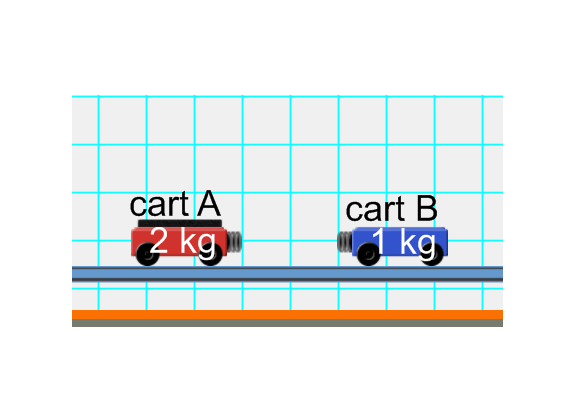
In a physics demonstration, two teams of equal-mass students are placed on each of two identical carts. A student on Cart A pushes upon Cart B. Which of the following statements describes the resulting motion of the two carts?
Cart A will remain stationary; cart B will be propelled rightward.
Cart A will move backwards slightly; cart B will be propelled rightward with a considerably greater speed.
Cart B will move forward slightly; cart A will be propelled leftward with a considerably greater speed.
Cart A and Cart B will move away from each other with the same speed.
In a physics demonstration, two teams of equal-mass students are placed on each of two identical carts. A student on Cart A pushes upon Cart B. Which of the following statements describes the force of impact acting on each of the two carts?
Both carts experience the same force.
Cart A will experience a greater force than Cart B.
Cart B will experience a greater force than Cart A.
Cart A experiences no force, only Cart B does.
Which of the following statements is true about the relationship between impact force and impact time?
Softer landing extends impact time, thus increasing impact force that creates more damage upon collision.
Softer landing lengthens impact time, thus decreasing the impact force that creates lesser damage upon collision.
Softer landing decreases impact time, thus increasing impact force that creates more damage upon collision.
Softer landing shortens impact time, thus decreasing impact force that creates lesser damage upon collision.
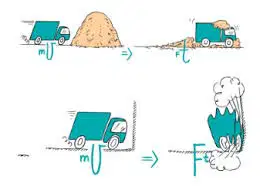
What is the difference between a car hitting a wall vs. a car hitting a haystack?
The impulse of the car hitting the wall is greater.
The force on the car hitting the haystack is greater.
The collision time of the car hitting the haystack is longer.
The change in momentum of the car hitting the wall is greater.
Which of the following experiences a longer impact time upon a collision?
follow through
punching a wall
car with bumper collides a wall
bending knees upon landing on the floor
Which of the following safety features inside the vehicle does not apply to the concept of impulse-momentum theorem and law of conservation of momentum?
Airbags deploying upon collision.
Seatbelt tensioners activating during rapid deceleration.
Crumple zones absorbing impact forces
Headrests protecting the head of the passenger when there’s a sudden start.
Which safety devices are installed in cars which increase the time of contact of the driver and the car’s interior thus decreasing the force of impact during head-on collision?
seatbelts
airbags
seatbelts and airbags
How does follow-through affect the change in momentum of a moving ball?
increases impact time thus decreases impulse = lesser change in momentum
increases impact time thus increases impulse = greater change in momentum
decreases impact time thus decreases impulse = lesser change in momentum
increases impact force thus increases impulse = greater change in momentum
Which of the following safety features of a car best applies to the impulse-momentum theorem concept?
airbags, seatbelts
bumpers, seatbelts
airbags, crumple zones
padded dashboards, airbags

