
 Worksheets
Waves: Absorption, Reflection & Transmission
Total questions: 53
Worksheet time: 29mins
Light waves bouncing off a surface is known as?
Transmission
Refraction
Reflection
Absorption
This is the term that describes when light passes through matter.
Transmission
Transparent
Translucent
Opaque
This is when light changes direction slightly when it passes from one material to another.
Transmission
Reflection
Refraction
Absorption

When you place things into water they sometimes look bent (see the image below). What is this an example of?
Refraction
Diffraction
Transmission
Absorption
Light spreads out after it travels through a keyhole.
refraction
diffraction
angle of reflection
angle of incidence
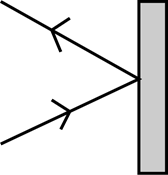
In the illustration, the light ray striking the object is-

the passage of light through a medium
transmission
reflection
diffraction
absorption
Waves carry energy AND matter.
true
false
What kind of waves REQUIRE matter to transfer energy?
x-rays
mechanical waves
(sound wave)
electromagnetic waves
light waves
The highest point on a transverse wave is called the _____.
crest
rest
trough
amplitude
The measure from crest to crest OR trough to trough is the _____.
frequency
rest
amplitude
wavelength
The number of waves passing a point in a certain amount of time is the _____.
frequency
amplitude
wavelength
compression
Frequency is measured in what units?
Hearts
Degrees
Hertz
Amps
In a longitudinal wave, the part of the wave in which the particles are close together is the ______.
contraction
rest
rarefaction
compression
Radio waves are carried from an antenna to your car radio.
This is an example of _____.
absorption
transmission
reflection
refraction
In a longitudinal wave, the area where the particles are farthest apart is the _____.
crest
compression
rarefaction
trough
When you yell in the hallway, some of the energy in the sound waves bounces back.
This is an example of _____.
refraction
reflection
diffraction
absorption
What kind of wave DOES NOT require a medium to travel?
sound wave
electromagnetic wave
mechanical wave
seismic wave
When sound waves pass through an open doorway, they change direction.
This is an example of _____.
reflection
diffraction
absorption
transmission
The substance or matter through which waves pass.
medium
compression
rarefaction
Hertz

What type of wave is shown?
longitudinal wave
transverse wave
ultraviolet ray
x-ray

What type of wave is shown?
sound wave
longitudinal wave
compressional wave
transverse wave
A type of waves that travels fastest through a solid?
Radio waves
Sound waves
Light waves
Gamma waves

A disturbance that transfers energy is know as
frequently
amplitude
wave
wavelength
Sound proof rooms use soft material to do what?
Reflection of sound
Absorption of sound
Transmission of sound
What is the only type of electromagnetic rays humans can see?
gamma rays
x-rays
visible light
ultraviolet
When no light can pass through an object it is...
opaque
translucent
transparent

Which color has the lowest frequency (longest wave-length)?
red
blue
yellow
green

Which wave has the highest frequency?
1
2
3
4
Which wave has the shortest wavelength?
1
2
3
4

Which color is the leaf reflecting?
blue
red
green
yellow

Which image is echolocation??
A
B
C
The transfer of energy from place to place is called
a spectrum
a wave
electromagnetic
motion

Which word belongs in both blanks?
wavelength
amplitude
frequency
pitch

Which material would be considered opaque?
A
B
C
all of them

This is an example of
absorption
transmission
reflection
translucent
Light waves travel most slowly (if at all) through?
Empty space
gas
liquids
solids

Sound waves travel most quickly through?
Solids
Liquids
Warm air
Cold air
When light moves from water to air, it bends away from the normal. This is an example of:
Reflection
Refraction
Diffraction
Absorption
If you increase the amplitude of a light wave, what happens to the light?
It gets dimmer.
It changes color.
It gets brighter.
It moves slower.
What does the amplitude of a light wave affect?
The speed of the light
The brightness of the light
The color of the light
The direction of the light
What does the amplitude of a sound wave affect?
The speed of the sound
The loudness of the sound
The pitch of the sound
The direction of the sound
What does the frequency of a sound wave affect?
The speed of the sound
The loudness of the sound
The pitch of the sound
The direction of the sound

What would you call this?
Bounce back
Reflection
Diffraction
Refraction


What happens to the wavelength of light waves as they enter a denser medium?
It increases.
It decreases.
It remains the same.
It becomes infinite.


