
 Worksheets
SPS6. Solutions, Acids, and Bases
Total questions: 20
Worksheet time: 10mins
Which term describes the substance that is being dissolved in a solution?
Solute
Solvent
Conductivity
Concentration
A maximum of 60g of KNO3 dissolves in 100g of water at 40oC. If 40g are stirred into 100mL of water, what type of solution will be formed?
A saturated solution, because 40g is less than the maximum solubility at this temperature.
An unsaturated solution, because 40g is less than the maximum amount that can dissolve at 40°C.
A supersaturated solution, because more than the usual amount of solute has been dissolved.
A partially saturated solution, because only part of the solute will dissolve.
Which term describes the amount of solute present in a given amount of solvent?
Solvent
Concentration
Solute
Conductivity

Which solution will have the highest conductivity?
Sugar solution, because sugar molecules dissociate into ions when dissolved in water.
NaCl solution, because NaCl dissociates into ions, which allow the solution to conduct electricity.
NaCl solution, because sugar solutions do not conduct electricity.
Sugar solution, because sugar is a better conductor than NaCl.

This picture represents a supersaturated solution of sodium acetate. After the sodium acetate stops forming crystals, what is the remaining liquid?
The remaining liquid is a supersaturated solution of sodium acetate in water.
The remaining liquid will be a saturated solution of sodium acetate in water.
The remaining liquid is an unsaturated solution of sodium acetate in water.
The remaining liquid contains only water because the sodium acetate formed crystals.
How does temperature affect the rate at which solutes dissolve in a specific solvent?
Temperature decreases the rate
Higher temperature increases the rate
Lower temperature increases the rate
Temperature has no effect
How does surface area affect the rate at which solutes dissolve in a specific solvent?
Larger surface area increases the rate
Smaller surface area increases the rate
Surface area has no effect
Surface area decreases the rate
How does agitation affect the rate at which solutes dissolve in a specific solvent?
Agitation decreases the rate
Agitation increases the rate
Agitation causes separation
Agitation has no effect
What are ways to increase the rate of dissolving a solute? Select all that apply.
Heat it
Crush it
Stir it
Vaporize it
What does a solubility curve represent?
The effect of temperature on solubility
The effect of pressure on solubility
The effect of concentration on solubility
The effect of agitation on solubility
How does temperature affect the solubility of most solid solutes?
Temperature decreases solubility
Temperature has no effect
Higher temperature increases solubility
Lower temperature increases solubility
How does temperature affect the solubility of most gaseous solutes?
Higher temperature decreases solubility
Temperature has no effect
Lower temperature increases solubility
Higher temperature increases solubility
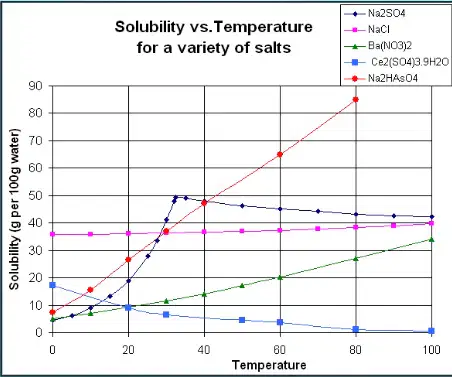
Which solutes solubility increases the most as temperature increase?
Ba(NO3)2
Ce2(SO4)
Na2HAsO4
NaCl

40 g of which substance is saturated in 100 g of water at a temperature of 300C?
KCl
NaCl
KNO3
NH4Cl
What ion is present in acids?
H+
OH-
Na+
Cl-
What ion is present in bases?
Cl-
Na+
OH-
H+
Since HCl (hydrochloric acid) is a gas, scientists have to bubble it through water to make a solution. As it bubbles through, HCl dissociates according to the formula: HCl à H+ + Cl-.
Which of the following statements accurately explains what will happen if a student places Litmus paper in this solution?
The Litmus paper will turn red because the solution has more H+ ions than OH– ions, and its pH is low.
The Litmus paper will turn red because the solution has more OH– ions than H+ ions, and its pH is high.
The Litmus paper will turn blue because the solution has more OH- ions than Cl– ions, and its pH is high.
The Litmus paper will not change color because the solution has an equal amount of H+ ions and Cl– ions, and its pH is neutral.
How can common household substances be classified as acidic, basic, or neutral?
By testing their conductivity
By using pH indicators
By measuring their temperature
By observing their color
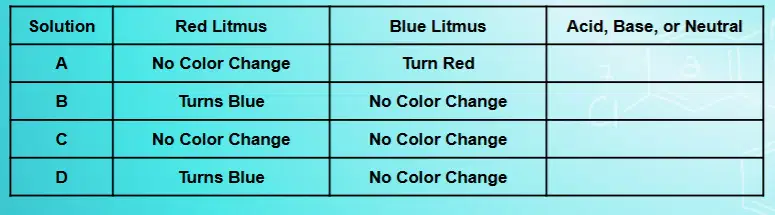
A student tests four different solutions with red and blue litmus paper. The results are recorded below.
A = _____
B = _____
C = _____
A = Acid
B = Neutral
C = Base
A = Base
B = Acid
C = Neutral
A = Base
B = Base
C = Acid
A = Acid
B = Base
C = Neutral
What would be used to neutralize a strong acid?
Weak Base
Strong Base
Weak Acid
More strong acid

