
 Worksheets
HW: Lesson 6-4 to 6-6 Review
Total questions: 113
Worksheet time: 4hrs 19mins
FILL IN:
A parallelogram has both pairs of opposite sides ____________.
Parallel
Congruent
Parallel and Congruent
FILL IN:
A parallelogram has both pairs of opposite angles _____________.
Congruent
Complementary
Supplementary
FILL IN:
Consecutive angles of a parallelogram are ________________.
Congruent
Supplementary
Complementary
CHECK ALL THAT APPLY:
All angles are right angles.
Parallelograms
Rhombuses
Rectangles
Squares
CHECK ALL THAT APPLY:
The lengths of the diagonals are congruent.
Parallelograms
Rhombuses
Rectangles
Squares
CHECK ALL THAT APPLY:
All sides are congruent.
Parallelograms
Rhombuses
Rectangles
Squares
CHECK ALL THAT APPLY:
Diagonals bisect the angles.
Parallelograms
Rhombuses
Rectangles
Squares
TRUE OR FALSE:
Squares, rhombuses, and rectangles are considered parallelograms.
True
False
TRUE OR FALSE:
A square is considered a rectangle.
True
False
TRUE OR FALSE:
A parallelogram is always a rectangle.
True
False
TRUE OR FALSE:
A square is considered a rhombus.
True
False
In order to show that a figure is a rectangle, you first have to prove it is a ....
Square
Parallelogram
Quadrilateral
Rhombus
In order to show that a figure is a rhombus, you first need to prove it is a ...
Quadrilateral
Square
Rectangle
Parallelogram
In order to show a figure is a square, you need to show it is a ...
Rhombus
Rectangle
Parallelogram
Parallelogram, Rhombus AND Rectangle

Solve for a and b.
a=7, b=4
a=14, b=4
a=7, b=8
a=7, b=5

Determine the property being used to solve the problem.
Opposite SIDES are congruent
Opposite ANGLES are congruent
Consecutive angles are supplementary
Diagonals bisect each other

Determine the property being used to solve the problem.
Opposite SIDES are congruent
Opposite ANGLES are congruent
Consecutive angles are supplementary
Diagonals bisect each other

Determine the property being used to solve the problem.
Opposite SIDES are congruent
Opposite ANGLES are congruent
Consecutive angles are supplementary
Diagonals bisect each other

Determine the property being used to solve the problem.
Opposite SIDES are congruent
Opposite ANGLES are congruent
Consecutive angles are supplementary
Diagonals bisect each other

Determine the property being used to solve the problem.
Opposite SIDES are congruent
Opposite ANGLES are congruent
Consecutive angles are supplementary
Diagonals bisect each other

Determine the property being used to solve the problem.
Opposite SIDES are congruent
Opposite ANGLES are congruent
Consecutive angles are supplementary
Diagonals bisect each other

Determine the property being used to solve the problem.
Opposite SIDES are congruent
Opposite ANGLES are congruent
Consecutive angles are supplementary
Diagonals bisect each other

Determine the property being used to solve the problem.
Opposite SIDES are congruent
Opposite ANGLES are congruent
Consecutive angles are supplementary
Diagonals bisect each other

Determine the property being used to solve the problem.
Opposite SIDES are congruent
Opposite ANGLES are congruent
Consecutive angles are supplementary
Diagonals bisect each other

Determine the property being used to solve the problem.
Opposite SIDES are congruent
Opposite ANGLES are congruent
Consecutive angles are supplementary
Diagonals bisect each other

Determine the property being used to solve the problem.
Opposite SIDES are congruent
Opposite ANGLES are congruent
Consecutive angles are supplementary
Diagonals bisect each other


HJ = 3x + 5 and IK = 5x - 9
- All sides are congruent
- Opposite sides are parallel
- Opposite angles are congruent
-Sides are not perpendicular


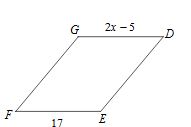
Solve for x.


Is this quadrilateral a parallelogram? If so, give a reason.
No
Yes. Opposite sides are parallel
Yes. Opposite sides are congruent
Yes. Opposite angles are congruent

Is the quadrilateral a parallelogram? If yes, state how you know.
Opposite sides parallel
Opposite sides equal
One pair of opposite sides are parallel AND equal
Not enough info
What are the properties of a parallelogram?
Opposite sides are parallel
Diagonals are congruent
Diagonals bisect each other
All sides are congruent
Consecutive angles are supplementary
What are the properties of a rectangle?
Four right angles
Opposite sides are parallel
Opposite sides are congruent
Diagonals bisect each other
Diagonals are congruent
What are the properties of a Rhombus?
All sides are congruent
Diagonals are perpendicular
Opposite angles are congruent
One pair of parallel sides
Consecutive angles are supplementary
Which quadrilateral(s) have opposite sides that are parallel?
Parallelogram
Rectangle
Square
Rhombus
Trapezoid
Which quadrilateral(s) have opposite sides that are congruent?
Parallelogram
Rectangle
Square
Rhombus
Trapezoid
Which quadrilateral(s) have opposite angles that are congruent?
Parallelogram
Rectangle
Square
Rhombus
Trapezoid
Which quadrilateral(s) have diagonals that bisect each other?
Parallelogram
Rectangle
Square
Rhombus
Trapezoid
Which quadrilateral(s) have four congruent sides?
Parallelogram
Rectangle
Square
Rhombus
Trapezoid
Which quadrilateral(s) have perpendicular diagonals?
Parallelogram
Rectangle
Square
Rhombus
Trapezoid
Which quadrilateral(s) have diagonals that bisect opposite angles?
Parallelogram
Rectangle
Square
Rhombus
Trapezoid
Which quadrilateral(s) have four right angles?
Parallelogram
Rectangle
Square
Rhombus
Trapezoid
Which quadrilateral(s) have diagonals that are congruent?
Parallelogram
Rectangle
Square
Rhombus
Trapezoid
Which quadrilateral(s) have one pair of parallel sides?
Parallelogram
Rectangle
Square
Rhombus
Trapezoid
A rectangle is a parallelogram with four right angles and two pairs of ______ sides.
Similar
Equal
Parallel
Perpendicular
Which of the following statements is false?
Quadrilaterals have four sides.
Squares are quadrilaterals.
All squares are rectangles.
All rectangles are squares.
Trapezoid
A parallelogram _____________

ABCD is a rhombus. What is the measure of angle AED?
60
45
90
180

Which describes a rhombus?
has all right angles
has all acute angles
has all equal sides
has all obtuse angles
Brayden is working on a report in which he will compare and contrast the different types of quadrilaterals. Which statement should NOT be included in his report?
All rhombuses are squares.
All squares are parallelograms.
All squares and rectangles have opposite sides that are congruent.
All parallelograms, rectangles, and squares have opposite angles that are congruent.
Select all shapes where the sum of the angles is 360o


Find the value of x.
x = 50
x = 40
x = 30
x = 90

Find the value of x.
x = 1
x = 3
x = 2
x = 0

MNKL is a square. Find the measure of angle MKN.
180 degrees
90 degrees
60 degrees
45 degrees

What are the lengths of LN and KM? Select all that apply.
14
32
48
16


A quadrilateral is a parallelogram if... One pair of opposite sides is congruent and _______________
congruent
parallel
diagonals
supplementary
A quadrilateral is a parallelogram if... One angle is ______________ to both consecutive angles
congruent
parallel
diagonals
supplementary

Is this a parallelogram?
Yes, both pairs of opposite sides are parallel
Yes, both pairs of opposite sides are congruent
Yes, both pairs of opposite angles are congruent
Yes, one pair of sides is both congruent and parallel
No


Is this a parallelogram
Yes, both pairs of opposite sides are parallel
Yes, both pairs of opposite sides are congruent
Yes, both pairs of opposite angles are congruent
Yes, one pair of sides is both congruent and parallel
No

Is this a parallelogram
Yes, both pairs of opposite sides are parallel
Yes, both pairs of opposite sides are congruent
Yes, both pairs of opposite angles are congruent
Yes, one pair of sides is both congruent and parallel
Yes, the diagonals bisect each other

Is this a parallelogram
Yes, both pairs of opposite sides are parallel
Yes, both pairs of opposite sides are congruent
Yes, both pairs of opposite angles are congruent
Yes, one pair of sides is both congruent and parallel
No

Determine the value of x that would classify this quadrilateral as a parallelogram.
(a)

Find the values of x and y that make the quadrilateral a parallelogram.
x = 4, y = 3
x = 3, y = -2
x = 1, y = 4
x = 3, y = 4
Which of the following are parallelograms?


Show that the quadrilateral is a parallelogram. Select all that apply.
All of the angles are congruent.
All of the side lengths are congruent.
The opposite sides are parallel.
The opposite sides are congruent.

Find the value of x that makes the quadrilateral a parallelogram.
(a)

Which method will NOT prove the quadrilateral is a parallelogram.
Show that a pair of sides are congruent and parallel.
Show that both pairs of opposite sides are congruent
Show that both pairs of opposite sides are parallel
Show that a pair of sides are parallel

Find the value of z.
(a)

State which method we can use to show that the quadrilateral is a parallelogram.
Both pairs of opposite angles are congruent.
Both pairs of opposite sides are congruent.
Both pairs of diagonals bisect each other.
Both pairs of opposite sides are parallel.
Which is NOT a property of a parallelogram?
Diagonals bisect each other
Diagonals are congruent
Both pairs of opposite sides are parallel
Both pairs of opposite angles are congruent

Determine whether the figure is a parallelogram. If so, state the reason.
Yes, quadrilateral with 2 pairs of opposite sides ≅
Yes, quadrilateral with 2 pairs of opposite angles ≅
Yes, quadrilateral with diagonals bisecting each other
not a parallelogram

Is this a parallelogram? How do we know?
yes,opposite sides are congruent
no we can not prove it is a parallelogram
yes, one pair of sides are congruent and parallel
yes, opposite sides are parallel
yes, diagonals bisect each other
Is the quadrilateral a parallelogram? If yes, state how you know.
Opposite sides parallel
Opposite sides equal
Opposite sides parallel and equal
Not enough info

Solve for x.
x = 13
x = 15
x = 70
x = 10

Solve for y.
13
15
17
10

Is the quadrilateral a parallelogram?
Yes
No
Not enough information.
State which method we can use to show that the quadrilateral is a parallelogram.
Both pairs of opposite angles are congruent.
Both pairs of opposite sides are congruent.
Both pairs of diagonals bisect each other.
Both pairs of opposite sides are parallel.

Determine the value of x that would classify this quadrilateral as a parallelogram. (The expression are for the tick marks on the diagram).
x = 8
x = 26
x = 28
x = 38

How long is the side CD?
7
3
35
27

Is there enough information to determine that this quadrilateral is a parallelogram?
yes
no

Find m∠FHJ.
70
82
152
28

Find the value of x that makes the quadrilateral a parallelogram.
29
42
78
11

Find the value of x that makes the quadrilateral a parallelogram.
5
35
75
55

Find the value of x that makes the quadrilateral a parallelogram.
4
6
8
10
Find the value of x that makes the quadrilateral a parallelogram.
41
12
14
This quadrilateral cannot be a parallelogram.

Find the value of x that makes the quadrilateral a parallelogram.
5
35
75
180

Find the value of x that makes quadrilateral RSTU a parallelogram.
(a)

If HK=20p and JK=p+19 , find the value of p that makes quadrilateral GHJI a parallelogram.
(a)

Can you show that this quadrilateral is a parallelogram?
Yes
No

Find the values of x and y that make the quadrilateral a parallelogram. #37
x = 3, y = 2
x = 25, y = 15
x = 15, y = 25
x = 113, y = 67

Find the values of x and y that make the quadrilateral a parallelogram.
x=12, y=20
x=12, y=19.2
x=20, y=12
x=30, y=30

If you wanted to prove that Quadrilateral ABCD is a Parallelogram, what would be the best piece of evidence to use?
Length of AC = Length of BD, therefore Side AC is congruent to Side BD
Length of AC = Length of BD, therefore Side AC is parallel to Side BD
Slope of AC = Slope of BD, therefore Side AC is parallel to Side BD
The Slopes of AC and BD are opposite reciprocals, therefore Side AC is parallel to Side BD

