
 Worksheets
Review Unit 2
Total questions: 77
Worksheet time: 1hrs 10mins
A price ceiling is usually set
above the equilibrium price and quantity
at the intersection of the supply and demand curves
by subtracting the highest price for supply and the lowest point for demand on their respective curves
below the equilibrium price
none of the above
Consumer surplus is measured by
the area to the right of the supply curve but below the price equilibrium
the sum of the buyer and seller surplus
the area above the supply curve but below the price equilibrium
the quotient of percent change in quantity supplied and percent change in price
the quotient of percent change in quantity demanded and percent change in price
All of the following would influence the position of the demand curve for golf clubs EXCEPT
the price of golf clubs
the price of golf balls
the price of golf shoes
the size of the population
A and C
Another name for excess supply is
disequilibrium
equilibrium point
Gini ratio
surplus
shortage
Establishing an effective price floor would help
reduce a surplus
increase a surplus
remove the need for government regulation
decrease demand
increase government regulation
Dead weight loss (DWL) refers to
the lost benefit to society caused by the movement away from the market equilibrium
the gained benefit to suppliers caused by the increase in the market equilibrium
the incremental benefit or loss when the consumer increases consumption by one additional unit
the legal maximum price above which a product cannot be sold
the legal minimum price below which a product cannot be sold

A
B
C
D
E

A
B
C
D
E

A
B
C
D
E

A
B
C
D
E

A
B
C
D
E

A
B
C
D
E

A
B
C
D
E

A
B
C
D
E

A
B
C
D
E

A
B
C
D
E

A
B
C
D
E

A
B
C
D
E
Demand is the consumers...
willingness to buy something
ability to buy something
willingness and ability to buy something
something I need really badly
Why is the Demand curve always downward sloping?
Inverse relationship between price and quantity
Law of diminishing marginal utility
Direct relationship between price and quantity
Income Effect
Substitution Effect
Which of the following are the shifters of Demand?
Taste and Preference
Number of Consumers
Income
Price of Related Goods
Future Expectations
Which of the following will NOT shift the Demand curve?
Taste and Preferences
Number of Consumers
Price
Price of Related Goods

Which of the following would cause the increase in Demand?
Decrease in number of consumers
Price of strawberries go down
Bathing in chocolate makes you live longer
BOGO chocolate bars will happen next week
Supply is the producers...
willingness to sell something
ability to sell something
willingness and ability to sell something
something a producer should really sell
Why is the supply curve always upward sloping?
Inverse relationship between price and quantity
Income effect
Direct relationship between price and quantity
Substitution effect
Which of the following are shifters of the Supply curve?
Price of input/resource costs
Number of Sellers
Government Action
Future Expectations
Technology

What would have caused the increase in supply?
Decrease in sellers
Increase in resource costs
Decrease in resource costs
A hurricane
The point where the Demand and Supply curve is known as...
disequilibrium
equilibrium
equal point
equity
Price elasticities of demand is (a) when it is less than 1.
The formula for PED is...
% change Q / % change in Y
% change P / % change Q
% change D / % change S
% change Q / % change P
The formula for PES is...
% change Q / % change in Y
% change P / % change Q
% change QS / % change P
% change QD / % change P
XED is the...
responsiveness to change in price of a related good
responsiveness to change in price
responsiveness to change in demand of a related good
responsiveness to change in demand of supply
Price elasticity of supply is (a) when it is greater than 1.
Price ceilings are set by the government to...
protect producers by setting min price
protect consumers by setting max price
protect producers by setting max price
protect consumers by setting min price
Price floors are set (a) the equilibrium point in order to protect producers.

Which line is elastic?
Blue
Green
Quotas are set by the government to...
prevent supply
prevent harm to environment
prevent demand
protect producers
Government imposed tax will...
increase supply
decrease supply
Supply: Quantity of a good/service that producers are willing to produce for any given price. (Different from "Quantity Supplied")
Supply
Demand
Producer Preference Quantity
Thumbtacks
Assume that demand for bottled water is relatively price elastic. An increase in supply of bottled water will result in which of the following?
A decrease in price, leading to an increase in total revenue
A decrease in price, leading to a decrease in total revenue
An excess supply of bottled water
An excess demand for bottled water
A relatively small decrease in price and no change in equilibrium quantity
If a 10 percent increase in the price of a good leads to a 25 percent decrease in the quantity demanded of the good, demand is
relatively inelastic
relatively elastic
unit elastic
perfectly elastic
perfectly inelastic
Assume a 10 percent increase in price increased the market quantity supplied by 20 percent. Which of the following is true?
The value of the price elasticity of supply is 2.
The value of the price elasticity of supply is 0.5.
Supply is price inelastic.
Demand is price elastic.
This price-quantity combination violates the law of supply.
Assume that the price elasticity of supply for good Y is 0.5. If the price of good Y decreases by 30 percent, the quantity supplied of good Y will
decrease by 60 percent
decrease by 30 percent
decrease by 15 percent
increase by .5 percent
increase by .15 percent
Assume the income elasticity of demand for good Z equals -5.0. Which of the following is true?
Good Z is a normal good.
Good Z must have an inelastic demand.
An increase in income will lead to a decrease in demand.
An increase in income will lead to an increase in demand.
The income effect of a price increase will be a decrease in quantity demanded at every price.
If the income elasticity of demand for good X is negative and the cross-price elasticity of demand between good X and good Y is negative, which of the following must be true of good X?
X is a normal good and is a substitute for Y.
X is a normal good and is a complement to Y.
X is an inferior good and is a substitute for Y.
X is an inferior good and is a complement to Y.
X is a normal good and Y is an inferior good.
To alleviate a financial crisis, a university increases student fees. This action will increase university revenues if the price elasticity of demand for university education is
inelastic
unit elastic
elastic
equal to the price elasticity of supply
equal to one
If a one-of-a-kind Etruscan vase is offered for sale at an auction, which, if any, of the following correctly shows the supply curve for the vase?
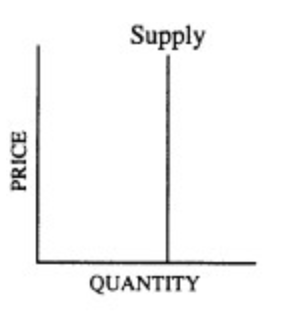
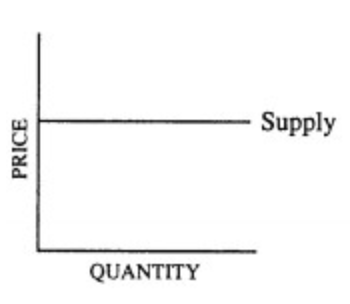
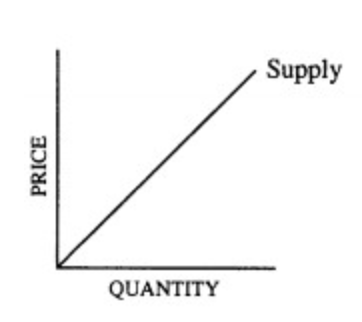
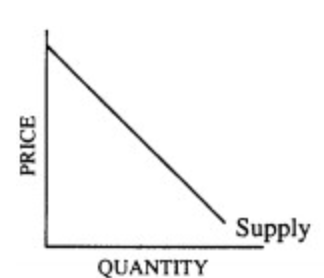
It is impossible to determine the shape of the supply curve from the given information.
Assume the income elasticity of demand for good Z equals −5.0. Which of the following is true?
An increase in income will lead to a decrease in demand.
Good Z is a normal good.
An increase in income will lead to an increase in demand.
Good Z must have an inelastic demand.

What is the DWL created by the tax?
150
100
200
250
What is deadweight loss?
Gained benefit to suppliers from voluntary exchange
Gained benefit to consumers from voluntary exchange
Lost benefit to society caused by movement away from market equlibrium
Legal maximum price that can be charged in a market
What will happen to the supply of corn if the US Government established a price floor for it.
reduce the surplus
cause a surplus
decrease supply
Shift the demand curve outwards
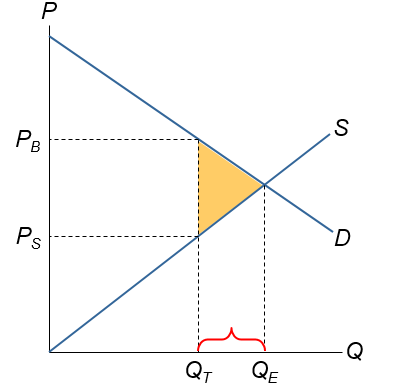
If an excise tax is imposed on a product, consumer surplus and producer surplus for this good will most likely change in which of the following ways?
CS falls and PS falls
CS falls and PS increases
CS falls and PS does not change
CS does not change and PS increases
CS does not change and PS does not change

If the government decided that only 4 units of Good X could be sold, the deadweight loss of this policy would be shown by area
ABC
ACEJ
AHJ
CFE
BGJ

On the graph, what area represents consumer surplus when the price is $10?
A
B
C
A and B
B and C

If the equilibrium price is equal to P2, consumer surplus is
fgh
fgi
ijk
hj
gi
If a country allows trade and the domestic price of a good is higher than the world price...
The country will become an exporter of the good.
The country will become an importer of the good.
The country will neither import nor export
Additional information about demand is needed to determine whether the country will export or import the good.
A tariff and import quota will both...
Increase the quantity of imports and raise domestic price.
Increase the quantity of imports and lower the domestic price.
Reduce the quantity of imports and raise the domestic price.
Reduce the quantity of imports and lower the domestic price.
Which of the following is a situation in which trade is advantageous?
Two countries produce the same goods for the same costs.
Two countries produce different goods for different costs.
Two countries are isolated.
Two countries have the same market.
None of the above.

What country is #5
Morocco
Chad
South Africa
Kenya

What country is #8
Ethiopia
Egypt
Madagascar
Mali

What country is in red?
Germany
France
Spain
Italy

What country is in yellow?
Greece
Italy
Turkey
Denmark

What country is in blue?
Israel
UAE
Jordan
Iraq

What is the brown country?
Greenland
Iceland
Ireland
Bermuda


How are seas and ocean different?
ocean is salty, a sea is not
an ocean is bigger than a sea
oceans are surround by land, but sees arent
they are not different
Which one is not apart of the seven seas?
Mediteranean Sea
Red Sea
Pacific Ocean
Black Sea
Which ocean is the largest?
Pacific Ocean
Atlantic Ocean
Indian Ocean
Artic Ocean

