

wayground logo

Free Printable Worksheets

Font size

S
M
L
XL
Worksheets

Investigation 7/8 Test

Total questions: 12

Worksheet time: 36mins
Name
Class
Date
1.
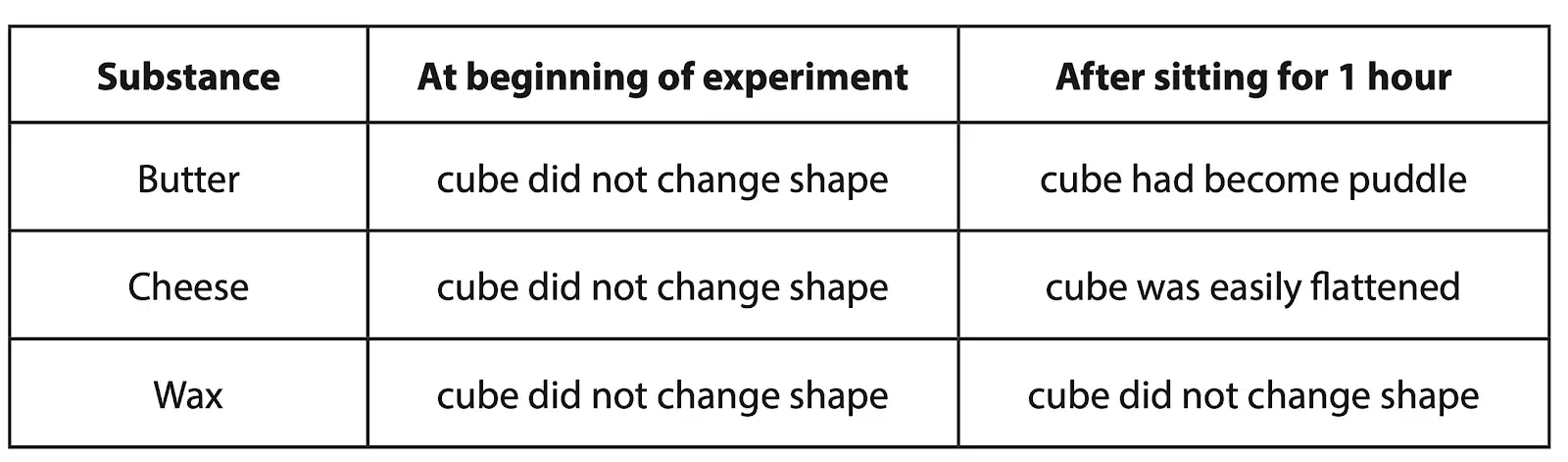
A group of students placed three equal sized-cubes of butter, cheese, & wax on a plate. They tested the hardness of each cube by gently pressing down on top of each cube and recorded their observations. They left the cubes under a warm lamp for 1 hour. They returned and tested the hardness again and recorded their results. Below is their table. In which substance(s) did the particles speed up. Pick the best answer.
a)
Only the butter
b)
The butter and the cheese, but not the wax
c)
All of the substances
d)
None of the substances
2.
The melting/freezing point of mercury is -39°C. A scientist put liquid mercury into a freezer that is kept at a constant temperature of -35°C. Will the liquid mercury freeze?
a)
Yes, because the freezer is cold enough to freeze mercury
b)
No, because the freezer isn't cold enough to freeze mercury
c)
Yes, because the particles will slow down enough for the mercury to freeze
d)
No, because there is not energy in the freezer to freeze the mercury
3.
A student dissolved 20 g of salt in a cup of water. She left the cup uncovered in an area where nobody could touch it. When she returned to the cup 10 days later, she found all the water was gone, and there were crystals in the bottom of the cup. What is the best conclusion, based on her observations?
a)
There water, evaporated, and there is 20 g of salt in the cup
b)
The water evaporated, but some salt is left in the cup
c)
There was a chemical reaction, and a new solid was left behind
d)
The water and salt separated and then the water evaporated, but there is not way to know what is left in the cup.
4.
Mrs. Stallings hangs a wet shirt on a clothesline. A bit later, the shirt is dry. What happens to the water particles as the shirt dries?
a)
The water particles are absorbed by the shirt
b)
The water particle evaporate, forming a cloud
c)
The water particles disappear and no longer exist
d)
The water particles move faster and become part of the air
5.
Freezing point is the temperature at which a substance will melt.
a)
True
b)
False
6.
Heating materials without touching is called________________.
a)
kinetic energy
b)
conduction
c)
thermal energy
7.
The melting point and freezing point for a substance are ___________
a)
different
b)
the same
c)
opposites
8.
How can you tell if water vapor is present in the air?
a)
Touch it
b)
Feel it
c)
Smell it
9.
What is is called when water vapor goes directly to ice?
a)

Evaporation

b)

Condensation

c)

Deposition

10.

Pick yes for each action that happens to particles when substances change from liquid to solid; pick no for actions that are not possible

Categorize the following

The particles are held more strongly to one another

The kinetic energy of the particles changes

The particles change shape

The particles change from soft to hard

The particles change into a new substance.

Yes
No
11.

Compare melting and dissolving; pick melt for statement that is related to melting, dissolve for a statement that is related to dissolving, and both for a statement that is true of both.

Categorize the following

Requires a chanage in kinetic energy

Requires two substances

Is a phase change

Does NOT require a chemical reaction

Melting
Dissolving
Both
12.

A student mixed together two substances that were at room temperature. The container quickly began to fill colder in the student's hand. Pick true if the statement is true and false if the statement is false.

Categorize the following

Energy was absorbed by the mixture

Energy transferred from the students hand to the container

The hand and container system is at equilibrium

Cold was released from the mixture.

True
False