
 Worksheets
Rehab Careers Cranial Nerve Quiz
Total questions: 30
Worksheet time: 15mins
Name
Class
Date
1.
Cranial Nerve V
a)
Trochlear
b)
Trigeminal
c)
Abducens
d)
Facial
2.
Sense of Hearing
a)
Hypoglossal
b)
glossopharyngeal
c)
vestibulocochlear
d)
trochlear
3.
Sense of smell
a)
Optic
b)
Olfactory
c)
Oculomotor
d)
Vagus
4.
Cranial nerve VII
a)
Abducens
b)
Trochlear
c)
Facial
d)
Vestibulocochlear
5.
Sense of Vision only
a)
Optic
b)
Olfactory
c)
Oculomotor
d)
Abducens
6.
Cranial Nerve IX
a)
Glossopharyngeal
b)
Hypoglossal
c)
Vagus
d)
Facial
7.
Controls shoulder and neck movements
a)
Facial
b)
Oculomotor
c)
Spinal Accessary
d)
Vagus
8.
Test by asking the patient to stick their tongue out (tongue protrusion)
a)
Glossopharyngeal
b)
Hypoglossal
c)
Facial
d)
Trigeminal
9.
Controls abduction of the eye, moving the eye side to side
a)
Optic
b)
Oculomotor
c)
Abducens
d)
Trochlear
10.
Receives sensations of balance and equilibrium, and hearing.
a)
Vagus
b)
Trigeminal
c)
Vestibulocochlear
d)
Facial
11.
Slows heart rate, increases digestion, contracts vocal muscles
a)
Trigeminal
b)
Vestibulocochlear
c)
Vagus
d)
Facial
12.
Sensations to the face; controls chewing movements
a)
Hypoglossal
b)
Trigeminal
c)
Glossopharyngeal
d)
Facial
13.
Smiling, Frowning, Tears
a)
Trigeminal
b)
Hypoglossal
c)
Facial
d)
Olfactory
14.
What is the order of the first 3 cranial nerves?
a)
Optic, Olfactory, Oculomotor
b)
Olfactory, Optic, Oculomotor
c)
Oculomotor, Olfactory, Optic
d)
Olfactory, Oculomotor, Optic
15.
How many pairs of cranial nerves do you have?
a)
10
b)
12
c)
14
d)
20
16.
It is important to assess cranial nerves because
a)
It is an indication of swelling in the brain
b)
To make sure you can still move your eyes
c)
Because they control breathing and other life systems
d)
So you can tell if a person's tongue is crooked
17.
Which cranial nerves can you assess together using a penlight and visual chart?
a)
Olfactory, optic, abducens, trochlear
b)
Optic, Oculomotor, trochlear, abducens
c)
Optic, Oculomotor, Trigeminal, Abducens
d)
Optic, Oculomotor, Facial, Trigeminal
18.
During a cranial nerve examination, a patient is asked to stick out their tongue. If the tongue deviates to one side upon protrusion, it may indicate a dysfunction of cranial nerve XII.
a)
True
b)
False
19.
Romberg test is used to assess which cranial nerve?
a)
Cranial nerve II
b)
Cranial nerve IV
c)
Cranial nerve VIII
d)
Cranial nerve IX
20.
In a clinical setting, the acronym PERRLA is often used to assess the pupils. What does the acronym PERRLA stand for?
a)
Pupillary Examination for Reflexes and Responses to Light Assessment
b)
Pupils Examined, Round, Reacting to Light and Accommodative Responses
c)
Pupillary Evaluation, Roundness, Reaction to Light and Accommodative Ability
d)
Pupils Equal, Round, Reactive to Light and Accommodation
21.
The vestibulocochlear nerve is responsible for motor functions ONLY related to balance and coordination.
a)
True
b)
False
22.
Which of the following activities is commonly used to assess the motor function of the accessory nerve?
a)
Testing the sense of taste on the tongue
b)
Assessing the pupillary response to light
c)
Asking the patient to shrug their shoulders against resistance
d)
Asking the patient to move their eyes in the 6 cardinal fields of gaze
23.
The term "Bell's palsy" is often associated with the dysfunction of which cranial nerve?
a)
Trigeminal nerve
b)
Facial nerve
c)
Vagus nerve
d)
Vestibulocochlear nerve
24.
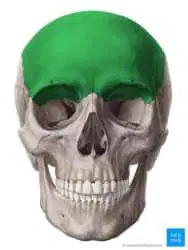
Identify the bone of the skull in green.
a)
Frontal
b)
Parietal
c)
Occipital
d)
Zygomatic
25.

Identify the skull bone in green.
a)
Parietal
b)
Mandible
c)
Maxilla
d)
Occipital
26.
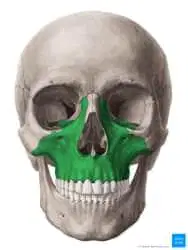
Identify the skull bone in green.
a)
Mandible
b)
Zygomatic
c)
Maxilla
d)
Ethmoid
27.
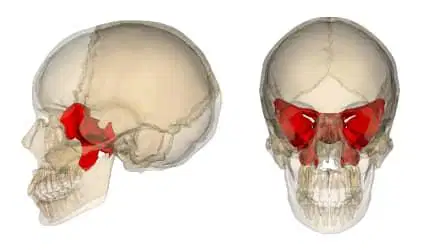
Identify the bat shaped bone of the skull in red.
a)
Ethmoid
b)
Lacrimal
c)
Sphenoid
d)
Temporal
28.

Identify the bone of the skull in green
a)
Parietal
b)
Zygomatic
c)
Temporal
d)
Nasal
29.
The bones of the skull are categorized as what type of bone?
a)
Long bones
b)
Irregular bones
c)
Flat bones
d)
Sesamoid bones
30.
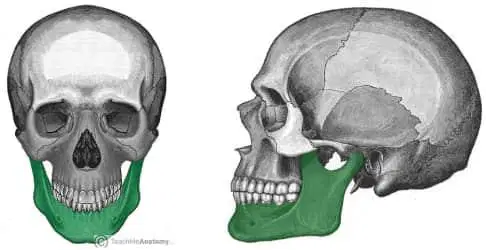
Identify the skull bone in green.
a)
Maxilla
b)
Mandible
c)
Zygomatic
d)
Frontal
100 %

