
NEW
Font size
 Worksheets
Ten on Tuesday (Session #2)
Total questions: 10
Worksheet time: 10mins
Which of the following is an example of a molecule?
(66% accuracy)
carbon
DNA
ER
heart
You would not find this structure in prokaryotic cells...
(66% accuracy)
cytoplasm
DNA
mitochondrion
ribosome
How do enzymes speed up chemical reactions? Enzymes
(55% accuracy)
lower the activation energy of chemical reactions.
raise the temperature of the cell, speeding chemical reactions.
store ATP, allowing more energy to be used in chemical reactions.
act as miniature "transfer trucks" which gather materials for chemical reactions and place them together.
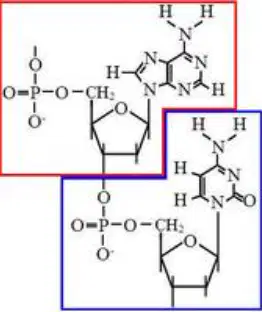
The molecule pictured is a __________ .
(59% accuracy)
amino acid
carbohydrate
lipid
nucleic acid
Which of these is the correct equation for cellular respiration?
(69% accuracy)
oxygen + glucose → water + carbon dioxide + energy
carbon dioxide + glucose → water + oxygen + energy
water + carbon dioxide + light energy → oxygen + glucose
glucose + water + carbon dioxide → energy + oxygen
There are two main ways in which molecules are transported into and out of cells: active transport and passive transport. Which of the following is an example of active transport?
(49% accuracy)
diffusion
osmosis
plasmolysis
sodium-potassium pump
Which of the following types of passive transport involves water molecules moving from a high concentration to a low concentration?
(64% accuracy)
facilitated diffusion
filtration
osmosis
simple diffusion
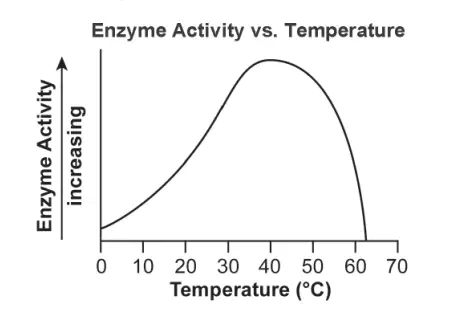
The graph shows how the activity of an enzyme changes at different temperatures. Which statement best describes what happens to the enzyme when the temperature of the reaction increases to 63 degrees Celsius?
(32% accuracy)
The enzyme is used up and the reaction stops.
The enzyme begins to decrease the rate of the reaction.
The enzyme continues to increase the rate of the reaction.
The enzyme changes shape and can no longer speed up the reaction.
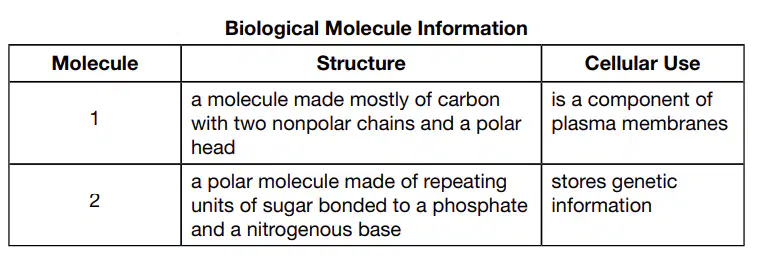
Which biological molecules are most likely represented by molecules 1 and 2?
(42% accuracy)
molecule 1: lipid and molecule 2: nucleic acid
molecule 1: carbohydrate and molecule 2: protein
molecule 1: carbohydrate and molecule 2: nucleic acid
molecule 1: carbohydrate and molecule 2: protein
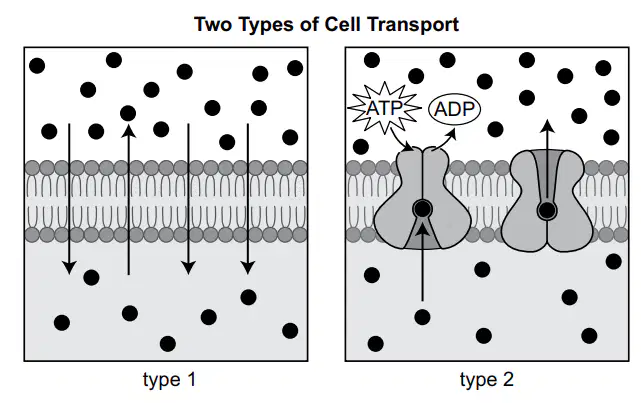
The diagram shows two types of cell transport. Which pair of statements best compares the two types of cell transport?
(62% accuracy)
Type 1 does not require energy and molecules move with their concentration gradient. Type 2 requires energy and molecules can move against their concentration gradient.
Type 1 does not require energy and molecules can move against their concentration gradient. Type 2 requires energy and molecules move with their concentration gradient.
Type 1 requires energy and molecules move with their concentration gradient. Type 2 requires energy and molecules can move against their concentration gradient.
Type 1 does not require energy and molecules move with their concentration gradient. Type 2 does not require energy and molecules can move against their concentration gradient.

