wayground logo

Free Printable Worksheets

Font size

S
M
L
XL
Worksheets

7TH ADV Q2 QSE REVIEW

Total questions: 253

Worksheet time: 4hrs 27mins

Name
Class
Date
1.
The correct equation to calculate speed is
a)
distance/time
b)
time/distance
c)
distance x time
d)
distance/time2
2.
Shona cycles at an average speed of 8km/h. How far has she travelled if she cycles for 4 hours?
a)
55km
b)
32km
c)
43km
d)
32miles
3.
How far will a person go if they jog for 2 hours at a speed of 12 km/hr?
a)
6 km
b)
0.5 km
c)
10 km
d)
24 km
4.
You walk 10 meters to math class in 20 seconds. Your average speed is
a)
2 m/s
b)
0.5 m/s
c)
200 m/s
d)
5 m/s
5.
If a cheetah runs 180 miles in 3 hours, what is its average speed?
a)
60 hours
b)
60 miles
c)
60 miles/hour
d)
60 miles/second/second
6.
A runners races in the 100 meter dash.  It takes her 10 seconds to finish.  What is her average speed?
a)
10 m/s
b)
1000 m/s
c)
100 seconds
d)
10 seconds
7.
The graph represents
a)
no motion
b)
Constant velocity
c)
Acceleration
d)
negative acceleration
8.
Find the velocity of a truck that travels 75 miles north in 2.5 hours.
a)
187.5 mph north
b)
30 mph north
c)
300 mph north
d)
200 mph north
9.
Find the velocity of a plane that traveled 3000 miles west in 5 hours.
a)
65 mph west
b)
6 mph west
c)
600 mph west
d)
6000 mph west 
10.
How far will a person go if they jog for 2 hours at a speed of 12 km/hr?
a)
6 km
b)
0.5 km
c)
10 km
d)
24 km
11.
It took 3.5 hours for a train to travel the distance between two cities at a velocity of 120 miles/hr.  How many miles lie between the two cities? 
a)
34 miles 
b)
420 miles
c)
120 miles 
d)
360 miles 
12.
According to Newton’s first law of motion, a moving object that is not acted on by an unbalanced force will
a)
remain in motion.
b)
eventually come to a stop.
c)
change its momentum.
d)
accelerate.
13.
A sled sliding on a flat, icy surface with a constant velocity is best described by
a)
Newton’s first law of motion for objects at rest.
b)
Newton’s first law of motion for objects in motion.
c)
Newton’s second law of motion.
d)
Newton’s third law of motion.
14.
Acceleration is caused by a force acting on a mass.
a)
Newton’s first law of motion
b)
Newton’s second law of motion
c)
Newton’s third law of motion
15.
Forces always act in equal and opposite pairs.
a)
Newton's 1st Law
b)
Newton's 3rd Law
c)
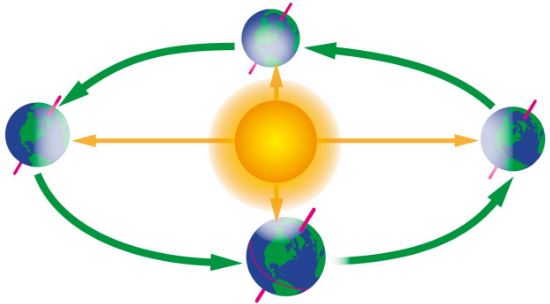
Newton's second law
16.
Which law explains when a magician pulls a tablecloth out from under dishes and glasses on a table without disturbing them.
a)
Law 1
b)
Law 3
17.
Which has more Inertia? (and more force to move) 
a)
Truck
b)
Ant
18.
Newton's 1st law is often called the _______.
a)
Newton's 2nd law
b)
action-reaction law
c)
law of equality
d)
law of inertia
19.
A person is pushed forward into their seatbelt when a car stops. Which of Newton's laws explains this motion?
a)
1st law
b)
 2nd law
c)
2 and 3 law
d)
3rd law
20.
When air rushes out of a balloon and it moves upward. This is an example of which Law of Motion. 
a)
Newton's First Law 
b)
Newton's Second Law 
c)
Newton's Third Law 
21.
A person steps out of the boat and onto the dock.  As the person moves forward onto the dock, the boat moves backward.  Which statement best describes the backward motion of the boat as the person steps forward?
a)
For every action there is an equal and opposite reaction.
b)
Every mass exerts a force on every other mass.
c)
An object at rest tends to stay at rest.
d)
Friction opposes the motion of an object.
22.
If a force of 26 N is exerted on two balls, one with a mass of 0.52 kg and the other with a mass of 0.78 kg, which ball will have the greater acceleration?  (F=ma)
a)
The one with a mass of .78 kg will have the greatest acceleration.
b)
The one with a mass of .52 kg will have the greatest acceleration.
c)
They will both accelerate at the same rate.
23.
A person in car  slides to the right when going through a very sharp left turn on the highway. 
a)
1st Law
b)
2nd Law
c)
3rd Law
24.
A crumpled piece of paper hits the ground before a flat sheet of paper because
a)
the acceleration of gravity is greater on the  crumpled paper.
b)
there is more air resistance against the flat paper.
c)
the crumpled paper is more massive
d)
the crumpled paper is less massive.
25.
The SI units for force are...
a)
Kilograms
b)
Newtons
c)
Meters per second
d)
Pounds
26.
What is the definition of "weight"?
a)
the force in which gravity pulls on an object
b)
the time it takes to get on a ride 
c)
the amount of matter in an object
d)
the size of an object
27.
If the mass of an object is 1000kg on Earth, what is it's mass on the moon?
a)
10kg
b)
100kg
c)
1000kg
d)
10,000kg
28.
An object will not have any inertia if it is _?_
a)
Accelerating
b)
Moving in a circle
c)
In space
d)
… Nonsense! All objects have inertia
29.
Newton's second law states that F=ma (force is mass times acceleration) which example would have the GREATEST?
a)
a 10 kg ball thrown with a 50 N force   
b)
a 1 kg ball thrown with a 0.5N force     
c)
a 50 kg student launched by a 100 N catapult
d)
a)  a 500 kg car accelerated by 1000 N from the engine
30.
 267.5 N unbalanced force applied to push a stuffed chair across the room, causing an acceleration of 4.2 m/s2. What is the mass of the chair?
a)
26.75 kg
b)
63.69 kg 
c)
263.3 kg 
d)
1123.5 kg
31.
To test Newton’s law of gravity, Ben and Jerry climbed the football stadium at school and dropped an egg from the very top of the bleachers. Their egg dropped data can be seen in the table According to this data, What conclusion can the boys make regarding Newton’s law of gravity?
a)
a)  No conclusion can be drawn from the data
b)
a)  The acceleration due to gravity is not constant
c)
a)  The acceleration due to gravity of 9.8 m/s2 is refuted
d)
a)  The acceleration due to gravity of 9.8 m/s2 is supported
32.
Which of these best describes why your weight (on Earth) would change on another planet?
a)
weight doesn’t change, no matter where you are
b)
different planets have different gravitational pulls
c)
In general, the smaller the planet, the greater weight
d)
dehydration effects on different planets change weight
33.
Suppose you are conducting an experiment concerning gravities effects on falling objects, and you want to minimize air resistance. Which of these would be the most useful and practical way to do these?
a)
use aerodynamic objects 
b)
se extremely dense objects
c)
conduct the experiment in vaccum
d)
conduct the experiment at various altitudes
34.
Mr. Hardens class decides to perform an experiment to determine how long it takes different objects to hit the floor when dropped from a desk. The class dropped 3 balls from a desk, one weighing 2 lbs, one weighing 4 lbs and 6 lbs. It took them all the same amount of time to hit the floor. After evaluation these results, you predict that a 10 lb ball will take 
a)
more time to hit the floor
b)
less time to hit the floor
c)
about the same amount of time to hit the floor
d)
an unknown amount of time before hitting 
35.
An empty truck and a fully loaded truck are next to each other at a traffic light. When the light turns green, the lighter truck increases speed more quickly. Which of these best explains this situations
a)
Newton's first law
b)
Newton's second law
c)
Newton's third law
d)
Conservation of momentum
36.
Which runner started out the fastest?
a)
Albert
b)
Bob
c)
Charlie
37.
What was Charlie doing between 8 seconds and 10.5 seconds?
a)
He was stopped
b)
He was accelerating
c)
He was returning to start
d)
He was traveling at a constant velocity
38.
What was Albert doing between 0 and 12 seconds?
a)
Traveling at a constant speed.
b)
Accelerating
c)
Stopped 
d)
Traveling back to start
39.
What is speed?
a)
how far you go
b)
how much distance is covered over a period of time
c)
how fast you accelerate
d)
the change in the location of a object
40.
What is the formula to calculate speed?
a)
Speed = time/distance
b)
Speed = distance/time
c)
Speed = distance x time
d)
Speed = time x distance
41.
The correct equation to calculate average speed is
a)
total distance/total time
b)
time/distance
c)
distance x time
d)
distance/time
42.
A runner races in the 100 meter dash.  It takes her 10 seconds to finish.  What is her average speed?
a)
10 m/s
b)
1000 m/s
c)
100 seconds
d)
10 seconds
43.
According to the graph how far does the person travel in the first 5 seconds?
a)
2 m
b)
10 m
c)
0 m
d)
5 m
44.
Rihanna cycles at an average speed of 8km/h. How far has she traveled if she cycles for 4 hours?
a)
55km
b)
32km
c)
43km
d)
32miles
45.
Total distance divided by total time is
a)
average speed
b)
constant speed
c)
instantaneous speed
d)
acceleration
46.

A student makes a swing move by pushing it. If a student pushes the swing harder, the swing will most likely---

a)

stop moving

b)

slow down

c)

go higher

d)

get bigger

47.
What is a force?
a)
a push or pull
b)
speed or acceleration 
c)
potential or kinetic energy
d)
balanced or unbalanced force
48.
When objects remain in the same place, it is called...
a)
gravity
b)
friction
c)
balanced force
d)
unbalanced force
49.
When an object has potential energy, it is not moving.
a)
true
b)
false
50.
What is the force that causes everything to be pulled down to the Earth?
a)
friction
b)
gravity
c)
balanced
d)
unbalanced
51.
Kinetic energy is when....
a)
energy is stored up in an object
b)
energy is released and the object moves
52.
Force is measured in....
a)
Galileos 
b)
Newtons
c)
Di Vincis
d)
Einsteins 
53.
An unbalanced force is when objects move in one direction because the force is greater from that direction.
a)
true
b)
false
54.
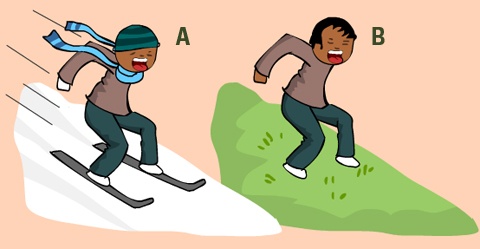
Why is it harder for the boy in Image B to get down the hill?
a)
Motion
b)
Friction
c)
Work
d)
Displacement
55.

Some students wanted to find out if a tennis ball and a baseball dropped from the same height hit the ground at the same time. This investigation tests the effect of which of the following?

a)

wind

b)

friction

c)

gravity

d)

magnetism

56.

Students wanted to see if the distance the marble rolled down a ramp changed the force it had. They allowed a marble to roll down the ramp from different starting points and strike a second marble. To determine if the force of the rolling marble changed, what should the students measure?

a)

The mass of marble #2 before and after being struck by marble #1.

b)

The distance marble #2 moves after being struck by marble #1.

c)

The time it takes marble #2 to move after being struck by marble #1.

d)

The direction marble #2 moves after being struck by marble #1.

57.

Students are investigating motion with a rubber band car. They want to know how the number of winds of the rubber band affects how the car moves. They will record the number of winds of the rubber band. What other data will they need to collect?

a)

The distance the car travels when released

b)

The length of the rubber band during each trial

c)

The amount of time it takes to wind the propeller

d)

The width of the surface on which the car moves

58.

If a student has two magnets, how might it be determined which magnet is stronger?

a)

Count how many paper clips each magnet can lift.

b)

Submerge each magnet in a bowl of water.

c)

Examine each magnet to determine the north pole.

d)

Measure the length and the mass of both magnets.

59.

Students conducted an investigation in which they rolled a soda can down a ramp that was 30 cm high and one that was 40 cm high. Which question were the students most likely trying to answer?

a)

How does mass of a soda can affect the distance it will roll?

b)

How does surface friction affect the distance a soda can will roll?

c)

How does the size of a soda can affect the distance it rolls?

d)

How does ramp height affect the distance a soda can rolls?

60.

Students create balloon rockets by taping drinking straws to balloons and running a thick string through the straw. The ends of the string are held tightly apart. When the balloon is inflated and released, it moves along the string. What should the student do to change the amount of friction that slows the motion of the balloon rocket?

a)

Try different color balloons.

b)

Use a different type of tape.

c)

Replace the string with thin wire.

d)

Hold the string ends closer together.

61.

Students conducted an investigation in which they measured the distance a toy car traveled after rolling down a ramp covered with sandpaper or wax paper. Which of these questions can the students answer by analyzing the results of their investigation?

a)

How does changing the height of a ramp affect the distance a toy car rolls?

b)

How does changing the surface of a ramp affect the distance a toy car rolls?

c)

How does mass affect the distance a toy car moves after rolling down a ram?

d)

How does the design of a toy car affect its movement after rolling down a ramp?

62.

Students conducted an investigation in which they let the same car roll down the same ramp in three different locations in their school with three different floor types, as shown in the picture. Which of the following questions was this investigation most likely designed to answer?

a)

How does the mass of the toy car affect its speed?

b)

How does friction affect the distance a toy car rolls?

c)

What mechanical advantage does an inclined lane give?

d)

Why does gravity make a toy car roll down a ramp?

63.

A student makes a swing move by pushing it. If a student pushes the swing harder, the swing will most likely---

a)

stop moving

b)

slow down

c)

go higher

d)

get bigger

64.

When the rope is pulled, in which direction will the bricks move?

a)

Outward

b)

Upward

c)

Inward

d)

Downward

65.
Edward kicks a soccer ball across the backfield. What force works to slow the ball down?
a)
pushes and pulls
b)
friction
c)
magnetism
d)
gravitation
66.
How does friction help us move from place to place?
a)
Friction does not help us.
b)
Friction keeps us from slipping and sliding.
c)
Friction only helps cats.
d)
Friction makes us slip and fall.
67.

Is this an example of a balanced or unbalanced force?

a)

Balanced force

b)

Unbalanced force

c)

I don't know

68.

In this force diagram, which arrow is representing Friction?

a)

A

b)

B

c)

C

d)

D

69.

How do you know if this object is balanced?

a)

It's not balanced; it's Net Force is 14 N

b)

It is balanced because its Net Force is 0 N.

c)

It's not balanced; it's Net Force is 10 N left and 4 N up.

d)

I don't know how to tell.

70.

According to this force diagram, is this object balanced or unbalanced?

a)

Balanced

b)

Unbalanced

c)

I don't know

71.

What is the net force on this object?

a)

80 N West

b)

80 N East

c)

40 N West

d)

40 N East

72.

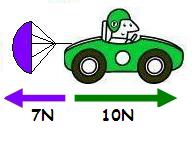
What is the net force?

a)

3 N

b)

3 N, right

c)

17 N, right

d)

3 N, left

73.

Which force is having the greatest impact on this object currently?

a)

Applied force

b)

Normal force

c)

Frictional force

d)

Gravitational force

74.

What is the Net Force on this object?

a)

11 N, right

b)

8 N, right

c)

3 N, left

d)

5 N, right

75.
What type of force is shown in the picture?
a)
The Cat force
b)
Star Wars Force
c)
Unbalanced force
d)
Balanced  force
76.
An _______ force must act on an object for it to CHANGE it's motion
a)
balanced
b)
unbalanced
c)
gravitational
d)
electrical
77.

If the net force is equal to zero, the forces acting on the object are

a)

balanced

b)

unbalanced

78.
Balanced forces do not change the objects speed or 
a)
direction
b)
distance 
c)
time
d)
mass
79.
The unit of force is
a)
m/s
b)
m/s^2
c)
newton
d)
kg
80.
What is the net force?
a)
5000 N right
b)
4000 N right
c)
40 N left
d)
4000 N left
81.
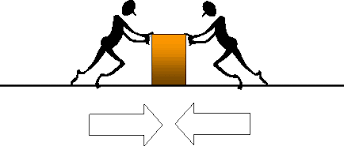
Jonny and Patty are pushing against a basketball. Both of them push against theball on opposite sides with a force of 20 N to keep the ball still. What is the net force?
a)
400 N
b)
24 N
c)
0 N
d)
40 N
82.
What is the net force in this picture?
a)
50 Newtons to the right
b)
950 Newtons to the right
c)
950 Newtons to the left
d)
50 Newtons to the left
83.
If an object is stationary (not moving) the forces acting upon it are _____________
a)
unbalanced
b)
weak
c)
balanced
d)
Hulk Smash!
84.
Which one is balanced?
a)
top
b)
bottom
c)
both
85.
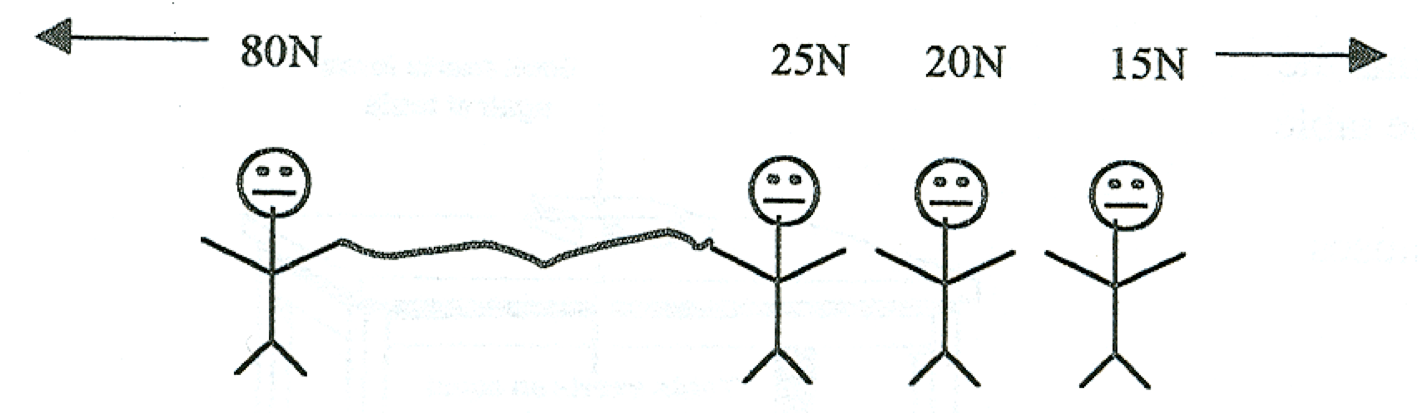
Who wins the tug of war with what net force?
a)
The person on the left with 20 N
b)
The person on the left with 80 N
c)
The people on the right with 20 N
d)
The people on the right with 100 N
86.

Two forces act on an object to the right at the same time. What force is required to bring the object into equilibrium?

a)

9 N to the right

b)

9 N to the left

c)

3 N to the left

d)

18 N to the left

87.
An astronomer observes several items in the night sky and writes down their approximate distance from Earth. What is mostly likely Object #3? 
a)
a planet, probably Jupiter or Saturn
b)
a nearby star relatively close to our solar system 
c)
a comet
d)
another galaxy 
88.
Using the chart in Question 1, what is most likely Object #2. 
a)
Venus
b)
a nearby star relatively close to our solar system 
c)
a black hole near the center of the Milky Way 
d)
another galaxy 
89.
The following picture is the Horsehead Nebula and is located about 1,500 light years from Earth in the constellation Orion. What is most likely occurring in the Horsehead Nebula? 
a)
new star formation 
b)
formation of black holes 
c)
star explosions like supernovas 
d)
the birth of new galaxies 
90.
The stars we see at night are: 
a)
in the Milky Way galaxy
b)
in the solar system
c)
in galaxies other than the Milky Way 
d)
both A and C 
91.
Use this model of the Hertzsprung-Russell diagram to answer question. 
An astronomer discovers a new star that is very hot, but not very bright. What type of star did she discover? 
a)
a red giant
b)
a young star on the main sequence 
c)
an old star on the main sequence 
d)
a white dwarf 
92.
 Our Sun is a middle-aged star with an average temperature and brightness. What type of star is our Sun according to the Hertzburg-Russell diagram? 
a)
a white dwarf
b)
a red giant
c)
a star on the upper left portion on the main sequence 
d)
a star in the middle of the main sequence 
93.
As a normal, averaged-size star progresses through its life cycle, what change will it undergo? 
a)
it becomes cooler
b)
it gets smaller
c)
it becomes brighter 
d)
its gravity increases 
94.
Which of the following galaxies is most like our own Milky Way? 
a)
A
b)
B
c)
C
d)
D
95.
Looking at the answer choices in Question#8, which answer choice could best be classified as an asymmetrical galaxy? 
a)
Galaxy A
b)
Galaxy B
c)
Galaxy C
d)
Galaxy D
96.
 Pulsars are dense, rotating stars that emit strong electromagnetic radiation with a wavelength around 6 mm. Using the chart below, what type of telescope would be best suited for observing pulsars? 
a)
radio telescopes 
b)
infrared telescopes 
c)
optical telescopes 
d)
ultraviolet telescopes 
97.
You hear an astronomer on television mention that an object in space is about 10 light-years away from planet Earth. This object is located: 
a)
in the solar system
b)
nearby in the Milky Way galaxy
c)
on the other side of the Milky Way galaxy 
d)
in another galaxy 
98.

Which of these observations of Barnard’s Star is most likely accurate?

a)

Barnard's star is less bright than sun and cooler

b)

Barnard's star is brighter than the sun but hotter

c)

Barnard's star is less bright than our sun but hotter

d)

Barnard's star is equal in brightness and temperature to the sun

99.
In the diagram given, what happens as we move to the left?
a)
Stars Get Larger
b)
Stars get Colder
c)
Stars get hotter
100.
Which of these stars is hottest?
a)
Red Star
b)
Yellow Star
c)
Orange Star
d)
Blue Star
101.
Which star is the coldest?
a)
Yellow Star
b)
Red Star
c)
Orange Star
d)
Blue Star
102.
Compared to the rest of the stars, our sun is considered...
a)
Extremely Large and Cold
b)
Small with a medium temperature
c)
Medium size with medium temperature
103.
Which category is our Sun located in?
a)
White Dwarfs
b)
Supergiants
c)
Main Sequence
d)
Giants
104.
The category that contains the most stars is...
a)
Main Sequence
b)
Supergiants
c)
Giants
105.
As a whole, Giants are considered hotter than White Dwarfs.
a)
True
b)
False
106.
Red stars are the _____________.
a)
hottest
b)
coolest
c)
biggest
d)
brightest
107.
Blue stars are the _____________.
a)
hottest
b)
coolest
c)
smallest
108.
Look at the H-R diagram. Which star is
sort of cool, dim (not too much light), and red?
a)
Betelguse
b)
Sirius B
c)
Procyon B
d)
Barnard's star
109.
Which star has the lowest temperature?
a)
A
b)
B
c)
C
d)
D
110.
Which spectral class does our star, the sun, belong to?
a)
M
b)
K
c)
G
d)
F
111.

Which best describes stars located in area A

a)

Bright and Hot

b)

Cooler and bright

c)

Dim and hot

d)

Dim and colder

112.

Which description best describes area B

a)

Brighter and Hotter

b)

Brighter and Cooler

c)

Dimmer and cooler

d)

Dimmer and Hotter

113.

Which best describes stars in area C

a)

Brighter and Hotter

b)

Brighter an Cooler

c)

Dim and Hotter

d)

Dim and Cooler

114.

Which best describes area D?

a)

Brighter and Cooler

b)

Brighter and Hotter

c)

Dimer and Cooler

d)

Dimmer and Hotter

115.

A system of stars, gas, dust, and dark matter bound together by gravity is called -

a)

an asteroid

b)

a moon

c)

a galaxy

d)

a nebula

116.

Which of the following describes a nebula?

a)

A cloud of gas and dust where new stars form

b)

An oval-shaped cluster of densely packed stars

c)

An explosion at the end of a giant star’s life

d)

A star and all the planets that revolve around it

117.

A system of stars, gas, dust, and dark matter bound together by gravity is called -

a)

an asteroid.

b)

a moon.

c)

a galaxy.

d)

a nebula.

118.

Elliptical, spiral, and irregular are all classifications of the overall shape of which of the following?

a)

stars

b)

galaxies

c)

nebulae

d)

comets

119.

A spiral galaxy is best described as an extremely large group of stars -

a)

arranged in arms encircling a dense center.

b)

all packed into a spherical, dense center.

c)

arranged in the shape of a flattened ball.

d)

and gases arranged in no specific shape.

120.

Which of the following best describes a star? A star is a celestial body -

a)

composed of rock and metal with a very high density.

b)

that is too big to be an asteroid, but too small to be a planet.

c)

that rotates on an axis and revolves around the Sun.

d)

composed of gases that emit light due to nuclear reactions.

121.

Which of the following best describes a nebula? A nebula is -

a)

a region in the solar system that is occupied by irregularly shaped bodies

b)

a large and icy celestial body with an irregular orbit around the Sun.

c)

a natural satellite created by the collision of two large asteroids.

d)

an interstellar cloud of dust, hydrogen, helium and other gases.

122.

Which of the following best describes a galaxy? A galaxy is -

a)

a particle of debris in the solar system that does not act as a satellite of any planet.

b)

a visible body of liquid or frozen crystal droplets suspended above a planetary surface

c)

a massive system of stars, gas, dust and dark matter bound together by gravity.

d)

the visible path of a meteoroid as it enters Earth’s atmosphere.

123.

Stars are made mostly of which two elements?

a)

hydrogen and helium

b)

mercury and strontium

c)

iron and potassium

d)

krypton and bismuth

124.

A system of stars, gas, dust, and dark matter bound together by gravity is called -

a)

an asteroid

b)

a nebula

c)

a galaxy

d)

a moon

125.

A large celestial body made of gases that emits light due to nuclear reactions is called -

a)

a galaxy

b)

a nebula

c)

a comet

d)

a star

126.

Galaxies are classified into all of the following types by their shapes EXCEPT -

a)

spiral

b)

elliptical

c)

lenticular

d)

crescent

127.

Which of the following is an accurate description of the relationship between components of the universe?

a)

Stars always contain galaxies.

b)

Galaxies contain many stars.

c)

Stars contain several nebulae.

d)

Nebulae contain many galaxies.

128.

A characteristic of a nebula is that it -

a)

is at the center of the solar system.

b)

is a region where stars are born.

c)

forms halfway through a star’s life cycle.

d)

has the coolest temperature in space.

129.

Which of the following components of the universe is best described a system of stars, gases, and dust held together by gravity?

a)

a nebula

b)

a planet

c)

a meteor

d)

a galaxy

130.

Galaxies are classified by their shapes into all of the following types EXCEPT -

a)

spiral galaxy

b)

irregular galaxy

c)

oblong galaxy

d)

elliptical galaxy

131.

The stars and all the other matter in a galaxy are held together by which of the following?

a)

Dark matter

b)

Inertia

c)

Gravity

d)

Magnetism

132.

Which of the following components of the universe is best described as an interstellar cloud of dust and gases where stars can form?

a)

a nebula

b)

a planet

c)

a meteor

d)

a galaxy

133.
Which celestial body is know for its intense pull of gravity?
a)
nebula
b)
black hole
c)
Super Giant
d)
A Galaxy
134.
The Milky Way galaxy is described as a disk of stars orbiting a central point on the disk. Which of these best explains why people on Earth cannot see the entire shape of the Milky Way?
a)
Earth is a part of this galaxy
b)
Many more stars exist outside the galaxy
c)
The stars in the center of the galaxy are extremely small.
d)
The center of the galaxy consists of a dense cluster of stars.
135.
The universe has may different components.  Which list places four components of the universe in the most likely order from smallest to largest.
a)
Planets, Stars, Galaxies, Nebulae
b)
Nebulae, Stars, Planets, Galaxies
c)
Galaxies, Stars, Planets, Nebulae
d)
Planets, Stars, Nebulae, Galaxies
136.
The Milky Way galaxy is described as a disk of stars orbiting a central point on the disk. Which of these best explains why people on Earth cannot see the entire shape of the Milky Way?
a)
Earth is a part of this galaxy
b)
Many more stars exist outside the galaxy
c)
The stars in the center of the galaxy are extremely small.
d)
The center of the galaxy consists of a dense cluster of stars.
137.
What type of galaxy is this?
a)
Spiral
b)
Elliptical
c)
Irregular 
d)
Irrational
138.
A system of stars, gas, dust, and dark matter bound together by gravity is called ---
a)
an asteroid
b)
a nebula
c)
a galaxy
d)
a moon
139.
Stars are made up mostly of which two elements?
a)
Hydrogen and Helium
b)
Mercury and Strontium
c)
Iron and Potassium
d)
Krypton and Bismuth
140.
The stars and all the other matter in a galaxy are held together by which of the following?
a)
Dark Matter
b)
Inertia
c)
gravity
d)
magnetism
141.
Galaxies are classified by their shapes into all of the following types except
a)
spiral galaxy
b)
irregular galaxy
c)
oblong galaxy
d)
elliptical galaxy
142.
Which of the following is an accurate description of the relationship between components of the universe?
a)
Stars always contain galaxies
b)
Galaxies contain many stars
c)
Stars contain several nebulae
d)
Nebulae contain many galaxies
143.
Which of the following best describes a star?  A star is a celestial body ---
a)
composed of rock and metal with a very high density
b)
that is too big to be an asteroid, but too small to be a planet.
c)
that rotates on an axis and revolves around the Sun
d)
composed of gases that emit light due to nuclear reactions
144.
Which of the following best describes a nebula.  A nebula is
a)
a region in the solar system that is occupied by irregularly shaped bodies
b)
a large and icy celestial body with an irregular orbit around the Sun
c)
a natural satellite created by the collision of two large asteroids
d)
an interstellar cloud of dust, hydrogen, helium and other gases
145.
Which of the following best describes a galaxy?  A galaxy is ---
a)
A particle of debris in the solar system that does not act as a satellite of any planet
b)
a visible body of liquid or frozen crystal droplets suspended above a planetary surface
c)
a massive system of stars, gas, dust and dark matter bound together by gravity.
d)
the visible path of a meteoroid as it enters Earth's atmosphere
146.
An interstellar cloud of dust and gases that serves as a location for the formation of new stars is
a)
a meteor
b)
a planet
c)
a galaxy
d)
a nebula
147.
Galaxies are classified into all of the following types by their shapes except --
a)
spiral
b)
elliptical
c)
lenticular
d)
crescent
148.
A characteristic of a nebula is that it
a)
is at the center of the solar system
b)
is a region where stars are born
c)
forms halfway through a star's life cycle
d)
has the coolest temperature in space
149.
Which of the following components of the universe is best described as a system of stars, gases, and dust held together by gravity.
a)
a nebula
b)
a planet
c)
a meteor
d)
a galaxy
150.
Which of the following components of the universe is best described as an interstellar cloud of dust and gases where stars are formed?
a)
a nebula
b)
a planet
c)
a meteor
d)
a galaxy
151.
Why does Earth get more energy from the sun than from all the other stars in the universe combined?
a)
The sun is much larger than other stars.
b)
The sun is much hotter than the other stars.
c)
The sun is much more dense 
d)
The sun is much closer than the other stars.
152.
Which of these correctly compares the masses of different objects in the universe?
a)
A moon has less mass than a star and more mass than the planet it orbits.
b)
A planet has less mass than a galaxy and more mass than the star it orbits.
c)
A galaxy has less mass than a moon and more mass than a planet.
d)
A star has less mass than a galaxy and more mass than a planet.
153.
Which term would be considered the smallest object?
a)
Sun
b)
Supercluster
c)
Galaxy
d)
Universe
154.
A large cloud of dust and gas
a)
black hole
b)
nebula
c)
Galaxy
d)
Supercluster
155.

What type of galaxy is this?

a)

Spiral

b)

Elliptical

c)

Irregular

d)

Irrational

156.

What type of galaxy is this?

a)

Spiral

b)

Elliptical

c)

Irregular

d)

Irrational

157.

What type of galaxy is the Milky Way?

a)

Spiral

b)

Elliptical

c)

Irregular

d)

Irrational

158.
Which of the following components of the universe is best described as a system of stars, gases, and dust held together by gravity.
a)
a nebula
b)
a planet
c)
a meteor
d)
a galaxy
159.

What causes the Earth to have seasons?

a)

The Earth's Tilt and revolution

b)

The Earth Rotation on it's axis

c)

The Earth Rotation on it's Axis and its tilt

d)

The Earth's revolution only

160.

The Earth's rotation takes.....

a)

1 year

b)

24 hours

c)

12 months

d)

3 years

161.

If the Earth's rotation INCREASED what would happen?

a)

the day would be longer

b)

the day would be shorter

c)

the Year would be longer

d)

the Year would be shorter

162.

When you are located on an area of Earth that is facing AWAY from the Sun, you are experiencing....

a)

day

b)

night

163.

The imaginary line that separates the 2 hemispheres on Earth

a)

Equator

b)

Axis

c)

Tilt

d)

ocean

164.

How long does it take Earth to REVOLVE around the sun?

a)

about a 1 day

b)

about 24 hours

c)

about 3 years

d)

about 1 year

165.

When is the Summer Solstice?

a)

June 21

b)

December 21

c)

March 21

d)

September 21

166.

The day of the year with the longest amount sunshine

a)

winter solstice

b)

summer solstice

c)

vernal equinox

d)

fall equinox

167.

The days that have exactly 12 hours of sunshine and 12 hours of night

a)

solstices

b)

equinoxes

168.

Earth spins on it axis. This movement is called...

a)

Day and night

b)

Seasons

c)

Revolution

d)

Rotation

169.

Rotation movement causes....

a)

Days

b)

Days and nights

c)

Nights

d)

Seasons

170.

When in the Northern hemisphere is summer in the Southern hemisphere is...

a)

Winter

b)

Autumn

c)

Spring

171.

When in the Southern hemisphere is spring, in the Northern hemisphere is...

a)

Autumn

b)

Winter

c)

Summer

172.

When in the Southern hemisphere is winter in the Northern hemisphere is...

a)

Summer

b)

Spring

c)

Autumn

173.

It is very hoy and days are longer. Choose.

a)

Summer

b)

Winter

c)

Autumn

d)

Spring

174.

It is very cold and days are shorter. Choose

a)

Spring

b)

Autumn

c)

Winter

d)

Summer

175.

The Sun's rays are stronger. Choose.

a)

Summer

b)

Winter

c)

Spring

d)

Autumn

176.

The Sun's rays are weaker. Choose.

a)

Spring

b)

Summer

c)

Winter

d)

Autumn

177.

What degree is the earth tilted?

a)

24

b)

25

c)

23.5

d)

25.5

178.
Spinning of the Earth on its axis is called...
a)
rotation
b)
revolution
c)
orbit
d)
double axis
179.

How does Earth have seasons?

a)

Earth's orbit around the sun

b)

Earth's distance from the sun

c)

Earth's tilt on it's axis

d)

Earth's moon phases

180.

Reorder the following into which the Northern Hemisphere goes through from the Summer Solstice

a)

Summer Solstice

b)

Fall/Autumnal Equinox

c)

Winter Solstice

d)

Vernal Equinox

1)
2)
3)
4)
181.

How long does a revolution take?

a)

1 month

b)

1 week ( 7 days )

c)

1 day ( 24 hours )

d)

1 year ( 365 days)

182.

Which direction does the Earth ROTATE?

(a)  

183.

Which direction does the Earth REVOLVE?

(a)  

184.

On June 21, the Northern Hemisphere....

leans ​ ​ (a)   the Sun.

has mainly ​ (b)   weather.

has ​ ​ (c)   hours of daylight than the Southern Hemisphere.

receives ​ (d)   rays. These are ​ (e)   rays.

Choose from the below words
toward
away from
warm
cold
more
direct
strong
indirect
weak
fewer
185.

Between June 21 and September 22, the Northern Hemisphere still leans toward the Sun. But every day...

the lean becomes ​ (a)  

the rays become ​ (b)   direct and spread out ​ (c)  

the days become ​ (d)   and the nights become ​ (e)  

Choose from the below words
less
greater
more
more.
less.
shorter
longer
shorter.
longer.
186.

On September 23...

the Earth's axis is tilted ​ (a)   the Sun.

the Sun's rays are ​ (b)  

​ (c)   starts in the Northern Hemisphere.

every place on earth has ​ (d)   hours of day and ​ (e)   hours of night.

Choose from the below words
neither toward or away from
toward
away from
neither direct or indirect
direct
indirect
autumn
winter
12
24
187.

The Earth revolves around the Sun in a ​ (a)   direction.

As the Earth revolves around the Sun, the tilt of the Earth's axis ​ (b)   change.

Choose from the below words
counterclockwise
clockwise
does not
does
188.

Between December 21 and March 20...

the Northern Hemisphere leans away from the Sun. But every day the lean becomes ​ (a)  

the rays become ​ (b)   slanting.

the days become ​ (c)   and the nights become ​ (d)  

Choose from the below words
less
greater
more
less.
longer
shorter
longer.
shorter.
189.

Between September 23 and December 20...

the Northern Hemisphere starts to lean ​ (a)   the Sun.

the Sun's rays become more ​ (b)   . These rays are ​ (c)  

days become ​ (d)   and nights become ​ (e)  

Choose from the below words
away from
toward
indirect
direct
weaker
stronger
shorter
longer
longer.
shorter.
190.

On December 21, the Northern Hemisphere...

leans ​ (a)   from the Sun and has mainly ​ (b)   weather.

has ​ (c)   hours of daylight than the Southern Hemisphere.

receives ​ (d)   rays. These are ​ (e)   rays.

Choose from the below words
away
cold
toward
warm
fewer
more
indirect
weak
direct
strong
191.

On March 21...

the Earth's axis is tilted ​ (a)   the Sun.

the Sun's rays are ​ (b)  

​ (c)   starts in the Northern Hemisphere.

Choose from the below words
neither toward or away from
toward
away
neither direct or indirect
direct
indirect
spring
summer
fall
winter
192.

Between March 21 and June 20...

the Northern Hemisphere starts to lean ​ (a)   the Sun.

the rays become more ​ (b)   and become ​ (c)  

the days become ​ (d)   and the nights become ​ (e)  

Choose from the below words
toward
away from
direct
stronger
indirect
weaker
longer
shorter
longer.
shorter.
193.

Is the Earth closer or farther away from the Sun during winter?

a)

closer

b)

farther

194.
Which season is taking place in the Northern Hemisphere in Position 3?
a)
Winter
b)
Spring
c)
Summer
d)
Fall
195.
Which season is taking place in the Northern Hemisphere in Position 3?
a)
Winter
b)
Spring
c)
Summer
d)
Fall
196.
Which season is taking place in the Northern Hemisphere in Position 4?
a)
Winter
b)
Spring
c)
Summer
d)
Fall
197.
The Earth's axis is tilted _____ degrees.
a)
23.5
b)
25.3
c)
30.2
d)
24
198.
At position A, which hemisphere would have summer?
a)
Northern hemisphere
b)
Southern hemisphere
199.
What happens when the area in which you live tilts away from the sun?
a)
It is summer.
b)
It is spring.
c)
It is winter.
d)
It is fall.
200.
The term equinox means....
a)
equal amount of day light and equal amount of night
b)
Equal amount of winter and summer
c)
Equal amounts of hot dogs for everyone
d)
The longest day of the year
201.
What do June 21 and December 21 have in common?
a)
equinox dates
b)
the moon is full
c)
solstice dates
d)
the cold fronts blow in
202.
What is the longest day of the year?
a)
winter solstice
b)
summer solstice
c)
fall equinox
d)
spring equinox
203.
Why do we experience the changing of the season on the earth?
a)
distance from the sun
b)
rotation of the earth
c)
change in solar output
d)
tilt of the earth's axix
204.
Why is the Equator warmest?
a)
Because it is closest to the sun.
b)
Because it receives the most direct sunlight
c)
Because no clouds form here.
d)
Because it is far from the sun
205.
In spring/summer, the axis of the earth is pointed away or toward the sun?
a)
towards
b)
Neither away or toward
c)
away
206.
Which season is taking place in the Southern Hemisphere in Position 1?
a)
Winter
b)
Spring
c)
Summer
d)
Fall
207.
Which season is taking place in the Northern Hemisphere in Position 1?
a)
Winter
b)
Spring
c)
Summer
d)
Fall
208.
Which season is taking place in the Northern Hemisphere in Position 2?
a)
Winter
b)
Spring
c)
Summer
d)
Fall
209.
Object spinning on its axis. 
a)
revolution
b)
rotation
210.
The hemisphere where you live
a)
northern
b)
southern
211.
What season is depicted in the picture?
a)
summer
b)
winter
c)
fall 
d)
spring
212.
What season is depicted in the picture?
a)
summer
b)
winter
c)
fall 
d)
spring
213.
What causes more heat,  indirect sunlight or direct sunlight?
a)
indirect
b)
direct
214.
What does the rotation of the earth cause us to experience?
a)
seasons
b)
year
c)
day & night
d)
eclipse
215.
How long does it take the earth to revolve once around the sun?
a)
12 hours
b)
24 hours
c)
30 days
d)
365.25 days
216.
What is the longest day of the year?
a)
winter solstice
b)
summer solstice
c)
fall equinox
d)
spring equinox
217.
Equinox means - 
a)
Equal night and day
b)
Longest day
c)
Shortest day
d)
Tilt
218.
Earth's axis is tilted at - 
a)
23.5 degrees
b)
33.5 degrees
c)
28 degrees
d)
90 degrees
219.
When the Northern Hemisphere is tilted toward the sun, daylight is - 
a)
shorter
b)
longer
c)
equal
220.
What happens when the area in which you live tilts away from the sun?
a)
It is summer.
b)
It is spring.
c)
It is winter.
d)
It is fall.
221.
Which season has the least amount of daylight in the Northern Hemisphere?
a)
Winter
b)
Spring
c)
Summer 
d)
Fall
222.
If its ____ in the Northern hemisphere, then its summer in the Southern hemisphere. 
a)
spring
b)
summer
c)
fall
d)
winter
223.
What season is letter A in the northern hemisphere?
a)
Winter
b)
Summer
c)
Spring
d)
Fall
224.
Why do we experience the changing of the seasons on the earth?
a)
distance from the sun
b)
rotation of the earth
c)
change in solar output
d)
tilt of the earth's axis
225.
What season is it in the southern hemisphere when the north pole is tilted away from the sun?
a)
summer
b)
winter
c)
fall 
d)
spring
226.
What season is experienced when the north pole is tilted toward the sun?
a)
summer
b)
winter
c)
fall
d)
spring
227.
Because of the direction that the Earth rotates on its axis, what direction does the sun rise every day?
a)
north
b)
south
c)
east 
d)
west
228.
Why is the Equator warmest?
a)
Because it is closest to the sun.
b)
Because it receives the most direct sunlight
c)
Because no clouds form here.
d)
Because it is far from the sun
229.
At position D in the Northern hemisphere it would be _____?
a)
Summer
b)
Winter
c)
Spring
d)
Fall
230.
In spring, is the axis of the earth pointed away or toward the sun?
a)
towards
b)
Neither away or toward
c)
away
231.
Which season is taking place in the Northern Hemisphere in Position 1?
a)
Winter
b)
Spring
c)
Summer
d)
Fall
232.
Which season is taking place in the Northern Hemisphere in Position 2?
a)
Winter
b)
Spring
c)
Summer
d)
Fall
233.
Which season is taking place in the Northern Hemisphere in Position 3?
a)
Winter
b)
Spring
c)
Summer
d)
Fall
234.
Which season is taking place in the Northern Hemisphere in Position 4?
a)
Winter
b)
Spring
c)
Summer
d)
Fall
235.
Why is it warmer in the summer?
a)
Closer to the sun
b)
More direct light from Earth's tilt
c)
Stronger light from the sun
d)
Earth spins slower
236.
What causes the seasons to change?
a)
The warming and cooling of Earth's core.
b)
The distance from the sun.
c)
Earth's revolution and tilted axis.
d)
Earth's rotation on its axis.
237.
Which movement of Earth causes day and night?
a)
rotation
b)
revolution
238.
What directions does the Earth revolve around the sun?
a)
clockwise
b)
counterclockwise
239.
The season that comes before winter is?
a)
summer
b)
winter
c)
spring
d)
fall
240.
Which season has the shortest daylight hours?
a)
Summer
b)
Fall
c)
Winter
d)
Spring
241.
Which seasons have the same amount of daylight hours?
a)
Spring & Fall
b)
Winter & Summer
c)
None of the seasons have equal daylight hours
d)
All are equal
242.
Object orbiting another object. 
a)
revolution 
b)
rotation
243.
At position C, which hemisphere would have winter?
a)
Northern hemisphere
b)
Southern hemisphere
244.
At position A, which hemisphere would have winter?
a)
Northern hemisphere
b)
Southern hemisphere
245.
Object spinning on its axis. 
a)
revolution
b)
rotation
246.
One rotation of Earth is equal to
a)
a day.
b)
a year.
247.
At position A, which hemisphere would have summer?
a)
Northern hemisphere
b)
Southern hemisphere
248.
If there was no tilt of the earth there would be no...
a)
seasons
b)
day & night
c)
leap year
d)
time zones
249.
if the earth did not rotate, there would be no..
a)
day & night
b)
seasons
250.
Which point is experiencing Summer?
a)
Northern Hemisphere at Point A
b)
Northern Hemisphere at Point D
c)
Northern Hemisphere at point B
d)
Northern Hemisphere at point C
251.
Which point is experiencing Winter?
a)
Northern Hemisphere at Point A
b)
Northern Hemisphere at Point D
c)
Northern Hemisphere at point B
d)
Northern Hemisphere at point C
252.
Which point is experiencing Fall?
a)
Northern Hemisphere at Point A
b)
Northern Hemisphere at Point D
c)
Northern Hemisphere at point B
d)
Northern Hemisphere at point C
253.
Which point is experiencing Spring?
a)
Northern Hemisphere at Point A
b)
Northern Hemisphere at Point D
c)
Northern Hemisphere at point B
d)
Northern Hemisphere at point C

Similar Resources on Wayground