wayground logo

Free Printable Worksheets

Font size

S
M
L
XL
Worksheets

Minerals Unit Practice Test--English

Total questions: 70

Worksheet time: 4hrs 30mins

Name
Class
Date
1.
A yellow mineral that smells like rotten eggs
a)
halite
b)
calcite
c)
sulfur
d)
olivine
2.
This mineral is clear and will fizz when a weak acid like vinegar is poured on it
a)
quartz
b)
calcite
c)
fluorite
d)
halite
3.
This mineral has a unique, flat way of coming apart known as cleavage
a)
pyrite
b)
calcite
c)
mica
d)
graphite
4.
This mineral will dissolve in water and tastes salty
a)
quartz
b)
calcite
c)
halite
d)
fluorite
5.
This is a pink mineral that is opaque and hard to see light through
a)
fluorite
b)
calcite
c)
quartz
d)
feldspar
6.
This is a pink mineral with a glassy luster.
a)
feldspar
b)
calcite
c)
rosy quartz
d)
fluorite
7.
A green or purple mineral that helps harden teeth win dissolved in water
a)
calcite
b)
halite
c)
fluorite
d)
quartz
8.
A mineral that will attract a magnet
a)
hematite
b)
magnitite
c)
pyrite
d)
olivine
9.

What is the luster of mineral P?

a)

metallic

b)

nonmetallic

c)

hard

d)

fracture

10.
Which property can you use to distinguish mineral K from mineral O?
a)
streak
b)
hardness
c)
Cleavage or Fracture
d)
luster
11.
Graphite is a soft metallic mineral that leaves a gray streak. It also has cleavage. Which mineral matches that description?
a)
Mineral A
b)
Mineral B
c)
Mineral C
d)
Mineral D
12.
Garnet is a hard nonmetallic mineral with no cleavage. It has red crystals and does not leave a streak. Which mineral matches this description. 
a)
Mineral M
b)
Mineral N
c)
Mineral O
d)
Mineral P
13.
What property does mineral B and P have in common?
a)
Luster
b)
Hardness
c)
Streak
d)
Cleavage or Fracture
14.
The way a surface (of a mineral) reflect light. Either metallic or nonmetallic:
a)
Cleavage
b)
Streak
c)
Luster
d)
Reflection
15.
Diamond has a hardness of ___ on Mohs Hardness Scale.
a)
1
b)
5
c)
8
d)
10
16.
What term refers to the regular, geometric shapes that occur in many minerals?
a)
fracture
b)
crystal
c)
composition
d)
none of the above
17.
The tendancy for a mineral to break along curved, irregular shaped surfaces refers to?
a)
mineral
b)
luster
c)
hardness
d)
fracture
18.
Which of the following must be true for a substance to be considered a mineral?
a)
It must be organic
b)
It must be glassy
c)
It must be a gem
d)
It must be naturally occurring
19.
Metallic gray cubes, hardness of 2-4, high specific gravity (feels very heavy for its size).
a)
gypsum
b)
copper
c)
galena
d)
hornblende
20.
Hardness of 7, conchoidal fracture, hexagonal crystals, and vitreous luster.
a)
calcite
b)
halite
c)
gypsum
d)
quartz
21.
The table provides information on both pyrite and gold. Pyrite is sometimes confused with gold. Some of the properties listed could help someone distinguish between pyrite and gold. Gold will be the only mineral that has which of the following properties?
a)
Yellow color
b)
Metallic luster
c)
Hardness of 3
d)
Black streak
22.
Scientists test for the hardness of a mineral by doing which of the following?
a)
Measuring the mass of the mineral, and comparing it against other minerals
b)
Observing how light reflects off the mineral and how the mineral looks as a result
c)
Observing the color of a mineral and comparing it against other minerals
d)
Scratching the mineral against other substances of known hardness
23.
Refer to the Mohs Hardness Scale. A mineral with a hardness of 7 can scratch -
a)
orthoclase feldspar, but cannot scratch talc
b)
calcite, but cannot scratch apatite.
c)
topaz, but cannot scratch fluorite
d)
gypsum, but cannot scratch corundum
24.
Using the chart below of the Mohs Hardness Scale, answer the following question. A certain mineral sample cannot scratch apatite, but apatite can scratch the sample. Which of the following is most likely the mineral’s hardness?
a)
4
b)
6
c)
8
d)
10
25.
The color of a mineral in powder form is called the mineral's 
a)
hardness
b)
specific gravity
c)
luster
d)
streak
26.

Why is coal not a mineral?

a)

It's not a solid

b)

It is man-made

c)

It is organic.

d)

It is made of carbon

27.
Dull, silky, waxy, pearly, and earthy are terms that best describe which property of minerals?
a)
luster
b)
color
c)
streak
d)
cleavage
28.

How do you test the hardness of a mineral?

a)

taste it

b)

light reflection

c)

scratching the mineral on tools using Moh's hardness scale

d)

look at it's color

29.
The solid, geometric form of a mineral produced by a repeating pattern of atoms
a)
crystal
b)
density
c)
element
d)
fracture 
30.
A mineral breaks into pieces like are shown in the picture. How would you describe its breakage?
a)
Fracture
b)
Cleavage
c)
Glassy
d)
Waxy
31.
Minerals are identified by observing their ___________.
a)
physical properties
b)
name
c)
location
32.

A mineral has _____ if it breaks into smooth flat layers.

a)

fracture

b)

cleavage

c)

streak

33.

Which indicator would not be good as the ONLY indicator when identifying a mineral?

a)

Color

b)

Breaking Pattern

c)

Specific Gravity

d)

Hardness

34.
A scientist made an object in a lab that has a crystal structure and was solid. Why is the object not considered a mineral?
a)
It is a solid
b)
It is man-made
c)
It is inorganic
d)
It has a crystalline structure
35.
Which mineral property is being shown here?
a)
luster
b)
hardness
c)
cleavage
d)
streak
36.
Atoms in a mineral are arranged___________________.
a)
In the order they land
b)
In a specific repetitive pattern
c)
In a circular pattern
d)
In a straight line
37.
A pure substance made of only one type of atom.
a)
element 
b)
density
c)
crystal
d)
compound
38.

Which of the following is a chemical property of a mineral?

a)

hardness

b)

luster

c)

atomic structure

d)

color

39.

What can you infer about graphite from the fact that you can scratch it with just your fingernail?

a)

It's not very lustrous

b)

It's not very hard

c)

Its streak is black-colored

d)

It has fracture

40.

Why do you need to run several tests before you can identify a mineral with 100 percent certainty?

a)

Minerals all have the same chemical structure

b)

Many minerals share physical properties in common

c)

Minerals' physical properties can change very quickly

d)

A mineral can only be subjected to a few tests before it degrades

41.

What property of a mineral indicates that it has cleavage?

a)

A milky-white color

b)

The ability to be scratched by a steel file

c)

The fact that it sizzles in the presence of hydrochloric acid

d)

Smooth faces

42.

The properties of a mineral are primarily a result of its _____

a)

hardness

b)

luster

c)

chemical composition

d)

color

43.

What is the mass number of an element with 6 protons, 6 neutrons, and 6 electrons?

a)

18

b)

6

c)

12

d)

14

44.
Mineral containing silicon, oxygen, and usually one or more other elements
a)
carbonate
b)
halide
c)
silicate
d)
sulfate
45.
A valuable, rare mineral
a)
ore
b)
gem
c)
rock
d)
bling
46.
Mineral mined at a profit
a)
ore
b)
luster
c)
silicate
d)
rock
47.
Characteristic observed without changing the identity of the material
a)
luster
b)
color
c)
physical property
d)
specific gravity
48.
Ratio of a mineral's weight compared with the weight of an equal volume of water
a)
specific gravity
b)
physical property
c)
luster
d)
cleavage
49.
This mineral has a cubic shape
a)
halite
b)
pyrite
c)
quartz
d)
sulfur
50.
Mineral crystals can form from cooling ________
a)
dirt
b)
magma
c)
water
d)
air
51.

This mineral may cause lung cancer

a)

halite

b)

sulfur

c)

asbestos

d)

corundum

52.
This mineral is used to make glass
a)
quartz
b)
calcite
c)
hematite
d)
graphite
53.

This yellow mineral is used in cleaning products

a)

pyrite

b)

gold

c)

sulfur

d)

galena

54.
_____________________ means that the mineral was formed by nature, not by a human or machine
a)
Naturally Occurring
b)
Inorganic Processes
c)
Solid
d)
Crystal Shape
55.
What does solid mean?
a)
Definite shape and indefinite volume
b)
Indefinite shape and indefinite volume
c)
Indefinite shape and definite volume
d)
Definite shape and definite volume
56.
What does inorganic mean?
a)
Something that is living
b)
Something that is dead, but was once living
c)
Something that was never living
57.
What does Definite Chemical Composition means?
a)
Random elements in indefinite proportions
b)
Elements spread throughout the entire mineral evenly
c)
Elements spread out the entire mineral unevenly
58.
How do you determine the density of a mineral?
a)
D=M/V
b)
D=V/M
c)
D=M x V
d)
D= V x M
59.
What tools do you need to find density
a)
Scale and ruler
b)
Ruler and graduated cylinder
c)
Triple beam balance and water
d)
Graduated cylinder and triple beam balance
60.
Which of the following is NOT a way to identify a mineral?
a)
Fluorescence
b)
Streak
c)
Cleavage/Fracture
d)
Smell
61.
What are the two most useful tests when identifying a mineral
a)
streak and color
b)
color and luster
c)
cleavage and fracture
d)
streak and hardness
62.
What is the LEAST useful way to identify a mineral?
a)
luster
b)
streak
c)
color
d)
density
63.

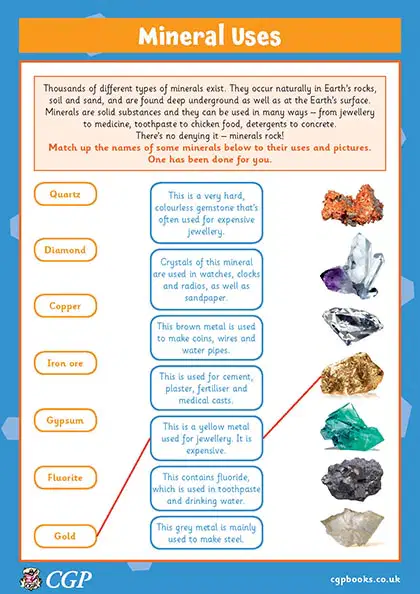
Which mineral is found in both glass and electronics (computers, watches, clocks, TVs)?

a)

apatite

b)

calcite

c)

gypsum

d)

quartz

64.

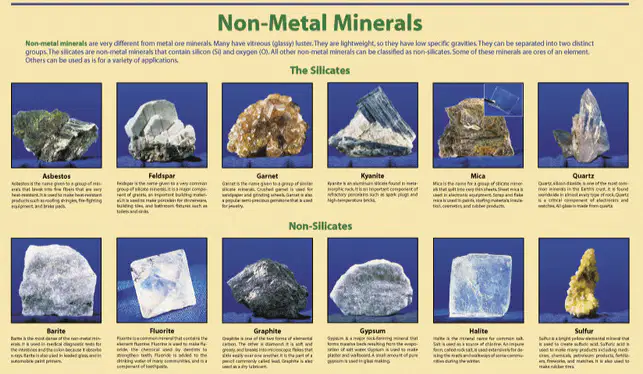
Look at the chart carefully!

What do halite and sulfur have in common?

(How are they alike?)

a)

They are metals with no minerals.

b)

They are cost less than silicates.

c)

They are non-metal, non-silicate minerals.

d)

They can be used in cooking.

65.

What are the two main categories of luster?

a)

metallic and nonmetallic

b)

sink and float

c)

density and hardness

d)

terrestrial and nonterrestrial

66.

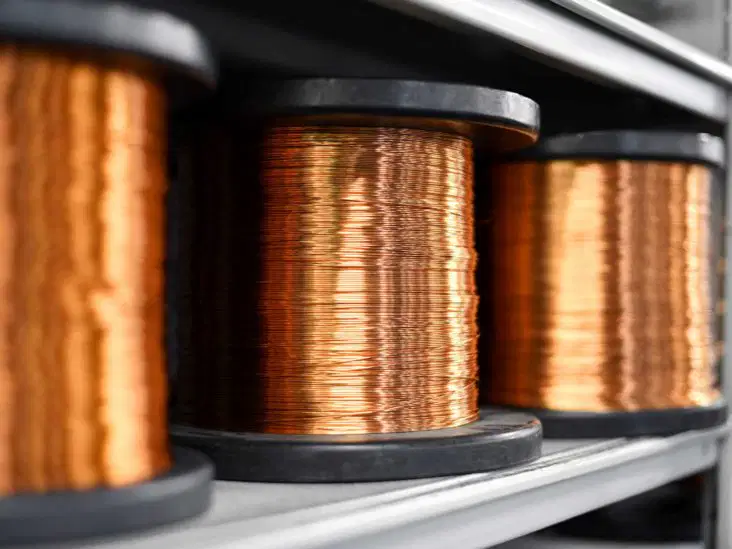
Why is copper used in wiring for buildings and electronics?

Check all answers that are correct.

a)

Copper conducts electricity.

b)

Copper is used in jewelry.

c)

Copper can be stretched thin and shaped.

d)

Copper is not valuable. That's why pennies are made of it.

67.

Which common mineral is used BECAUSE it is soft--as both pencil "lead" and machine lubricant?

a)

gypsum

b)

graphite

c)

sphalerite

d)

talc

68.

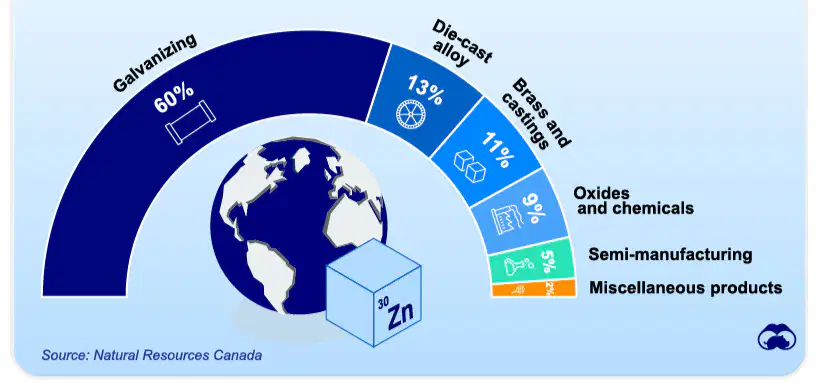
Which mineral is used in sunscreen to block UV rays, to prevent other metals from rusting, and in some cold remedies?

a)

zinc

b)

silicon

c)

quartz

d)

beryl

69.

Which 3 minerals are common ingredients in cosmetics and make-up?

a)

hematite

b)

muscovite mica

c)

talc

d)

mercury

70.

What are the advantages of using these minerals that are common ingredients in cosmetics and make-up?

a)

It is used to create red colors.

b)

It is used to make sparkles and glitter flakes.

c)

it creates a soft, powdery texture.

d)

It is used to give a silver color, but only in small amounts because very toxic.