
 Worksheets
11 PHYSICS PAPER OSCILLIATION
Total questions: 30
Worksheet time: 3600secs
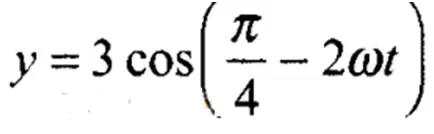
1. The displacement of a particle is represented by the equation
The motion of the particle is
(a) simple harmonic with period 2KUO
(b) simple hannonic with period nia)
(c) periodic but not simple harmonic
(d) non-periodic
The displacement of a particle is represented by the equation y= sin3 ωtThe motion is
(a) non-periodic
(b) periodic but not simple harmonic
(c) simple harmonic with period 2π/ω
(d) simple harmonic with period π/ω
The relation between acceleration and displacement of four particles are given below:
Which one of the particle is exempting simple harmonic motion?
(a) ax = +2x
(b) ax = +2x2
(c) ax = -2x2
(d) ax = -2x
Motion of an oscillating liquid column in a U-tube is
(a) periodic but not simple harmonic
(b) non-periodic
(c) simple harmonic and time period is independent of the density of the liquid
(d) simple harmonic and time period is directly proportional to the density of the liquid
A particle is acted simultaneously by mutually perpendicular simple harmonic motion x = a cos ωt and y = a sin ωt. The trajectory of motion of the particle will be
(a) an ellipse
(b) a parabola
(c) a circle
(d) a straight line
The displacement of a particle varies with time according to the relation
y = a sint + b cost
(a) The motion is oscillatory but not SHM
(b) The motion is SHM with amplitude a + b
(c) The motion is SHM with amplitude a2 + b2
(d) The motion is SHM with amplitude √a2 + b2
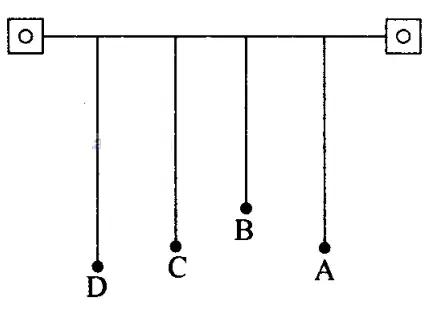
Four pendulums A, B, C and D are suspended from the same elastic support as shown in figure. A and C are of the same length, while B is smaller than A and D is larger than A. If A is given a transverse displacement,
(a) D will vibrate with maximum amplitude
(b) C will vibrate with maximum amplitude
(c) B will vibrate with maximum amplitude
(d) All the four will oscillate with equal amplitude
A particle executing SHM has a maximum speed of 30 cm/s and a maximum acceleration of 60 cm/s2. The period of oscillation is
(a) sec
(b) /2 sec
(c) 2 sec
(d) /t
The rotation of earth about its axis is
(a) periodic motion
(b) simple harmonic motion
(c) periodic but not simple harmonic motion
(d) non-periodic motion
. A body is performing SHM, then its
(a) average total energy per cycle is equal to its maximum kinetic energy
(b) average kinetic energy per cycle is equal to half of its maximum kinetic energy
(c) mean velocity over a complete cycle is equal to 2/π times of its maximumvelocity
(d) root mean square velocity is 1/√2 times of its maximum velocity
A particle executing SHM has a maximum speed of 40 cm/s and a maximum acceleration of 80 cm/s2. The period of oscillation is
(a) 1 sec
(b) /4 sec
(c) 4 sec
(d) /t
2. The displacement of a particle is represented by the equation
The motion of the particle is
(a) simple harmonic with period 3KUO
(b) simple hannonic with period mia)
(c) periodic but not simple harmonic
(d) non-periodic
The displacement of a particle is represented by the equation y= cos3 ωtThe motion is
(a) non-periodic
(b) periodic but not simple harmonic
(c) simple harmonic with period 3π/ω
(d) simple harmonic with period 2π/ω
A particle is executing simple harmonic motion with a period of 4 seconds. What is the frequency of the motion?
(a) 0.25 Hz
(b) 0.5 Hz
(c) 1 Hz
(d) 2 Hz
The displacement of a particle is represented by the equation y = 3sin(2t). What is the amplitude of the motion?
(a) 2
(b) 3
(c) 4
(d) 6
A particle is executing simple harmonic motion with an amplitude of 5 cm. What is the maximum displacement of the particle from its mean position?
(a) 5 cm
(b) 10 cm
(c) 15 cm
(d) 20 cm
The displacement of a particle is represented by the equation y= sin3 ωtThe motion is
(a) non-periodic
(b) periodic but not simple harmonic
(c) simple harmonic with period 2π/ω
(d) simple harmonic with period π/ω
The relation between acceleration and displacement of four particles are given below:
Which one of the particle is exempting simple harmonic motion?
(a) ax = +3x
(b) ax = +3x2
(c) ax = -3x2
(d) ax = -3x
A particle executing SHM has a maximum speed of 50 cm/s and a maximum acceleration of 100 cm/s2. The period of oscillation is
(a) 1 sec
(b) /4 sec
(c) 4 sec
(d) /2 sec
A particle executes simple harmonic motion with an amplitude of 6 cm. What is the maximum displacement of the particle from its mean position?
(a) 6 cm
(b) 12 cm
(c) 18 cm
(d) 24 cm
The displacement of a particle is represented by the equation y = 4sin(3t). What is the amplitude of the motion?
(a) 3
(b) 4
(c) 5
(d) 6
A particle is executing simple harmonic motion with a period of 3 seconds. What is the frequency of the motion?
(a) 0.33 Hz
(b) 0.5 Hz
(c) 1 Hz
(d) 3 Hz
What is the trajectory of motion of a particle acted simultaneously by mutually perpendicular simple harmonic motion x = a cos ωt and y = a sin ωt?
(a) an ellipse
(b) a parabola
(c) a circle
(d) a straight line
The displacement of a particle is represented by the equation y = 2sin(4t). What is the amplitude of the motion?
(a) 2
(b) 4
(c) 6
(d) 8
A particle executing simple harmonic motion with a period of 5 seconds. What is the frequency of the motion?
(a) 0.2 Hz
(b) 0.5 Hz
(c) 1 Hz
(d) 2 Hz
A particle is executing simple harmonic motion with an amplitude of 8 cm. What is the maximum displacement of the particle from its mean position?
(a) 8 cm
(b) 16 cm
(c) 24 cm
(d) 32 cm
The displacement of a particle is represented by the equation y = 5sin(6t). What is the amplitude of the motion?
(a) 5
(b) 6
(c) 7
(d) 8
A particle executing simple harmonic motion with a period of 6 seconds. What is the frequency of the motion?
(a) 0.17 Hz
(b) 0.33 Hz
(c) 0.5 Hz
(d) 1 Hz
A particle executing SHM has a maximum speed of 60 cm/s and a maximum acceleration of 120 cm/s2. What is the period of oscillation?
(a) 1 sec
(b) 2 sec
(c) 3 sec
(d) 4 sec
A particle is executing simple harmonic motion with an amplitude of 10 cm. What is the maximum displacement of the particle from its mean position?
(a) 10 cm
(b) 20 cm
(c) 30 cm
(d) 40 cm

