
Font size
 Worksheets
Geologic Time Review 25
Total questions: 42
Worksheet time: 1hrs 29mins
Which of these choices is the best definition of absolute dating?
determining the age of a rock layer by studying the fossils present
finding the age of an object compared to other objects
measuring the age of an object in years using any method
determining the amount of a radioactive isotope in an object
What is the method of measuring age that gives the most precise results?
radioactive dating, when scientists measure the levels of an isotopic element inside of an object
rate of sedimentation, which dates layers of Earth based on their thickness
law of superposition, which dates layers of Earth based on their order
B. relative dating, when scientists fill an object with carbon and measure how much will fit
Which of these choices is an example of the way a geologist would use
relative dating (The Law of Superposition)?
determining the minerals that make
up rocks
placing rock layers in order of
oldest to youngest
classifying rocks as igneous,
sedimentary, or metamorphic
using radioactive isotopes to
determine the exact age of rock samples
. Which of these statements describes what happens during radioactive decay?
A Stable isotope interacts with an unstable isotope
A stable isotope breaks down and becomes unstable
An unstable isotope breaks down into a more stable isotope.
An unstable isotope interacts with another unstable isotope.
How would a geologist determine the age of mountains formed by the upwelling of igneous rock?
use radioactive dating to date water in a lake in the mountains
use radioactive dating to date Earth's outer core below the mountains
use radioactive dating to date only the bedrock underneath the mountains
use radioactive dating to date the igneous rock and the topmost layer of soil
Limestone can be found at the top of the Himalayas, the highest mountain range in the world. Limestone is a rock that usually forms at the bottom of shallow, warm waters. What does this information show about Earth?
It shows that Earth has not changed much over the years as limestone has adapted to forming on mountain peaks.
It shows that Earth has evolved over time as areas of land that have once been covered in water, but no longer are.
It shows that Earth circulates its minerals so often that limestone always ends up on the peaks of mountains.
It shows that Earth has mostly convergent plate boundaries that push limestone from the ocean floor to the top of mountains.
At one time, several kinds of camels lived in Florida. The evidence comes from fossils found in Florida. Which of these objects would be a fossil that shows that camels once lived in Florida?
Sinkhole formed by a retreating glacier
sedimentary rock that formed a long time ago
crystal formation suspended from the ceiling of a cave
remains of an organism preserved by geologic processes

The timeline above shows changes that occurred in the Sahara Desert throughout history.
What does this timeline suggest about Earth?
It suggests that Earth has changed over time since human fossils became present in the Sahara after 9,000 years, indicating that the environment had been suitable enough to support human life at one time.
It suggests that Earth has not changed much over time since human fossils were present as early as 9,000 years ago, indicating that Earth's environment has almost always been suitable for the presence of life.
It suggests that Earth's deserts always receive monsoon rains every 1,000 years.
It suggests that Earth is only able to preserve fossils in environments that are desert like.

Analyze the image Above. According to the Law of Superposition, which sequence of letters describes the rock layers in the diagram from oldest to youngest?
D,C,B,A
A,B,C,D
A,B,D,C
C,D,B,A

The diagram above is cross-section of Earth’s sedimentary rock. Based on the Law of Superposition, which statement best compares the relative age of two rock layers?
Layer 7 is older than layer 5
Layer 2 is older than layer 7
Layer 5 is younger than layer 3
Layers 3 and 4 are the same age

Directions: The images show slices of sedimentary rock in Earth's surface in two different locations. Use the images to answer any questions that follow.
Which layer is most likely the oldest in location 1?
layer Q
layer R
layer S
layer T
Which of the following best describes an intrusive rock?
rocks formed from erosion
rocks formed from weathering
rocks that pushes up from underneath
rocks on the surface of the grand canyon
In which situation would a scientist prefer to use the Law of Superposition over radioactive dating?
A. to determine which mountain peak on Earth’s surface is the nearest
to determine which layer of sedimentary rocks at the bottom of a lake is oldest
to determine whether two dinosaurs whose fossils are found on different continents lived in the same time period
to determine the exact age of a human skeleton found in an ancient tomb
A geologist was exploring a deep cave in the desert, and discovered a fossilized school of fish. Which option below most likely explains why the geologist would find fish fossils in a desert cave?
Local wildlife went into the cave and had brought the fish to eat and then left, the fish scraps left behind in the cave became fossilized.
A few hundred years ago the lake that was there was used to irrigate the local farm lands and the lake was drained leaving the fish in the lake to be fossilized in the rock.
During the recent rainy season fish were able to swim in the flood waters to the cave, once trapped, they died and were fossilized in the rock.
Millions of years ago the desert was a lake that had fish, over time the Earth changed, the lake became a desert, and the fish in the lake were fossilized.


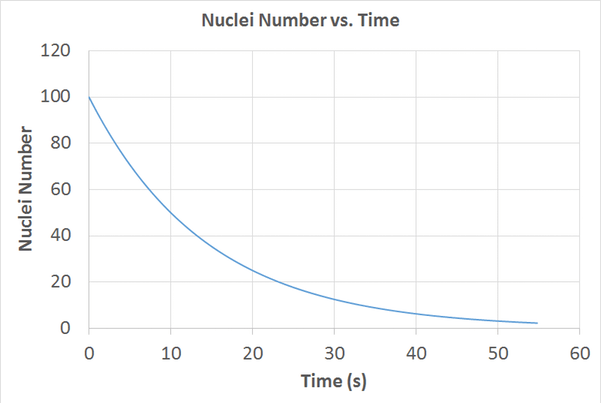
What is the Half life of this isotope?
5 seconds
10 seconds
15 seconds
20 seconds
How many grams are left after 1 half life?
What percentage of rubidium-87 atoms will be left after four half lives?
25.0%
12.5%
6.25%
3.125%
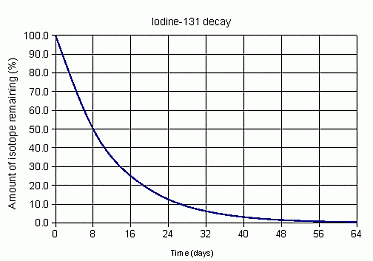
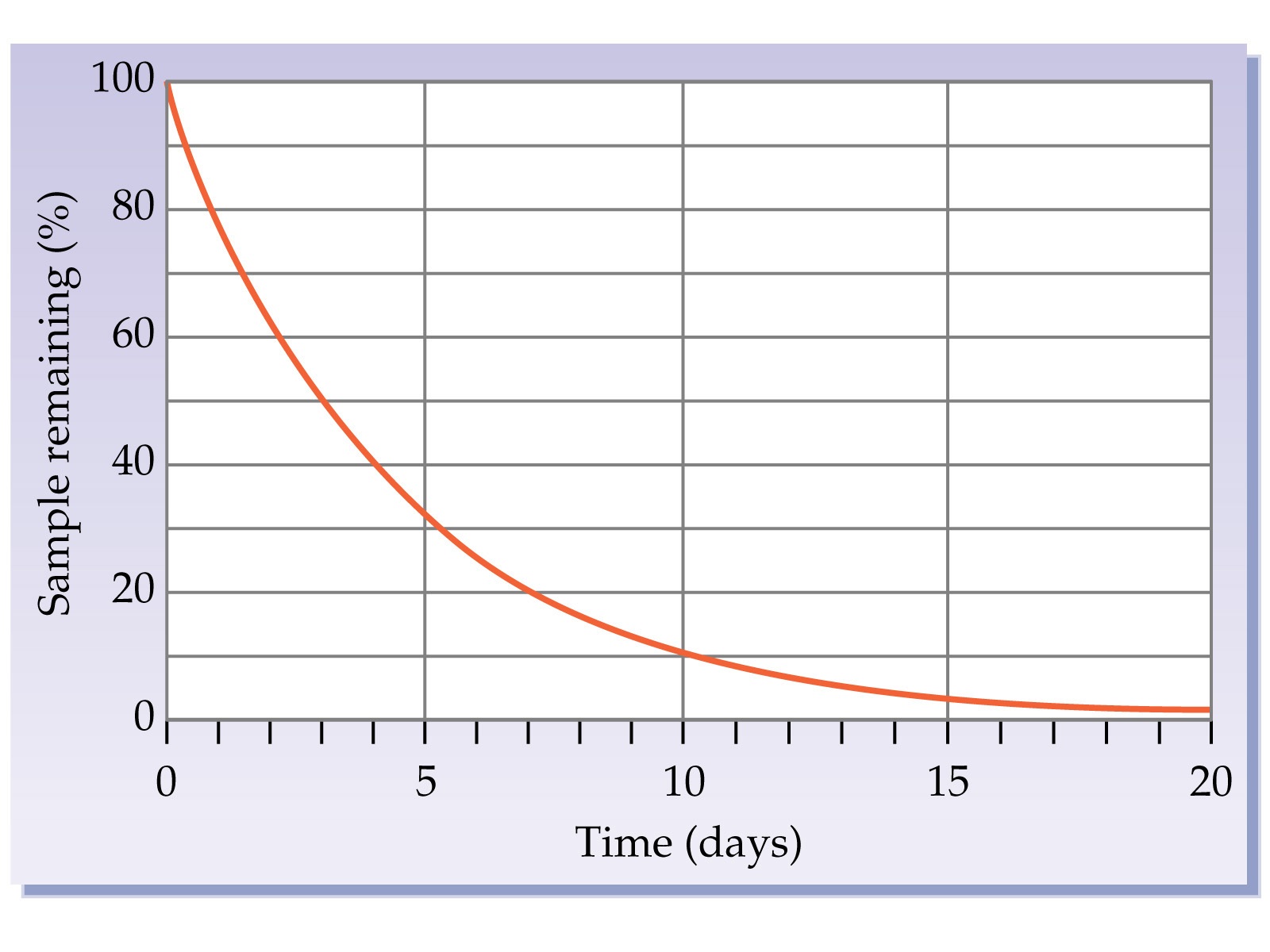
What is the Half Life of this isotope?
3 days
5 days
8 days
10 days
The % of the parent isotope remaining after 1 Half Life.
50%
25%
12.5%
6.25%
Name given to the atoms that are left after an atom decays.
Parent
Daughter
Leftovers
The term given to unstable radioactive atoms.
Parent
Daughter
Half Life
Igneous
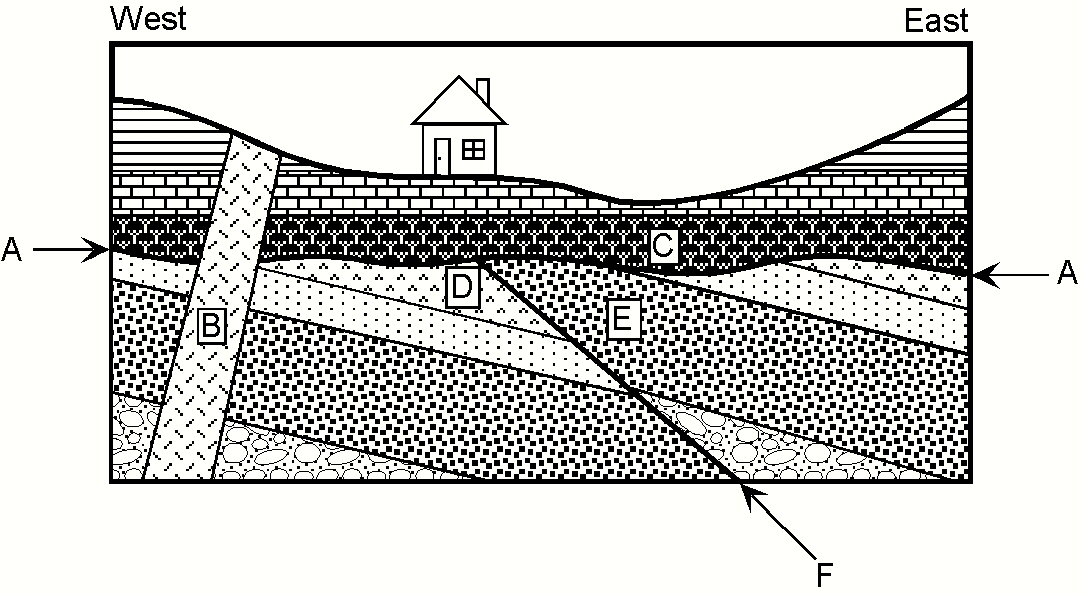

Which of the following is the oldest?
Layer L
Intrusion D
Intrusion H
Layer E
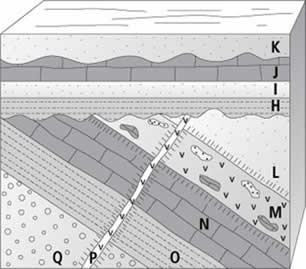
The rock formation labeled "P" is a(n)...
fault
intrusion
inclusion
unconformity
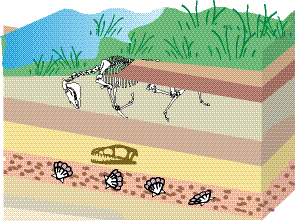
The oldest fossils are found....

Is the intrusion (letter F) older or younger than the rock layers around it?
older
younger

Look at the diagram showing rock layers. In which layer did fossil E first appear?
Layer #4
Layer #5
Layer #6
Layer #8

When two fish die, Fish A sinks to the bottom of a lake and Fish B washes up on the rocky lake shore. Why is a fossil more likely to form from the body of Fish A than from the body of Fish B?
Soft parts of the fish will decay more quickly in the water.
Sediments in the water will quickly cover the fish.
Scavengers in the water will eat the remains of the fish.
Currents in the water will move the fish.
An organism is more likely to become a fossil if (a)
At one time in the past, tropical plants lived and thrived in Antarctica.
TRUE
FALSE
What are fossils that are abundant, easily recognizable, short lived, and widespread called?
Preserved fossils
Index fossils
Imprints
Radioactive dating
This kind of fossil leaves behind evidence of an animal's behavior or activity.
Mold fossil
Cast fossil
Trace fossil
True Form fossil

